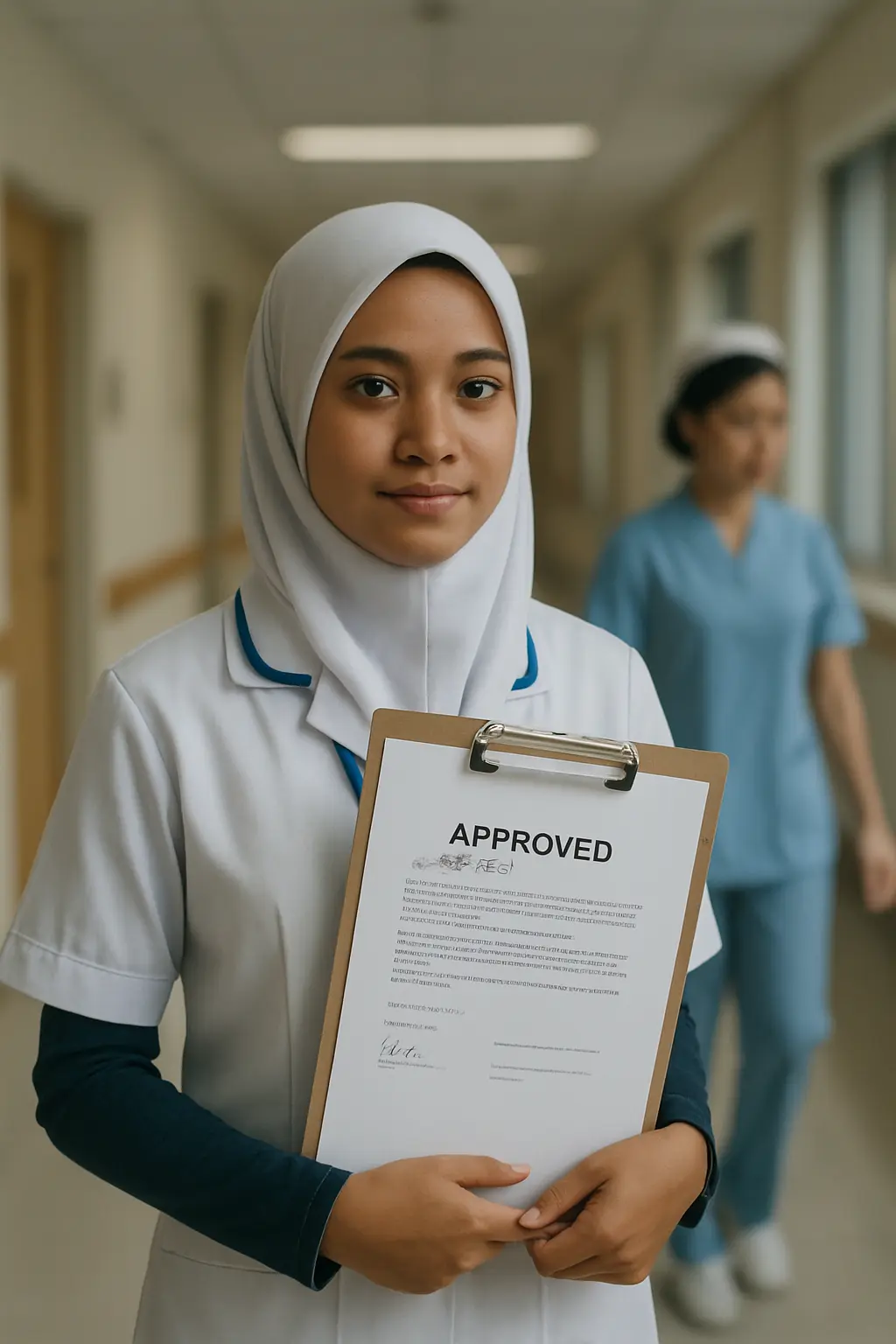
A Malaysian nursing thesis involving hospital or clinic patients needs registration on the National Medical Research Register (NMRR) and approval from the Medical Research and Ethics Committee (MREC), Ministry of Health. A campus-only study of students or staff instead goes through your own university’s human research ethics committee. Both require a signed informed consent form before any data is collected.
Why Can’t I Just Start Collecting Data?
Nursing research almost always touches patients, patient records, or health-facility staff — all classified as human subjects research under Malaysian research governance, regardless of how low-risk the questionnaire feels. Submitting a survey link before approval is a misconduct finding waiting to happen: your supervisor cannot sign off on a completed data-collection chapter that was never authorised, and a hospital’s nursing manager will not let you inside a ward without an approval letter to show at the door.
Which Ethics Committee Do I Apply To?
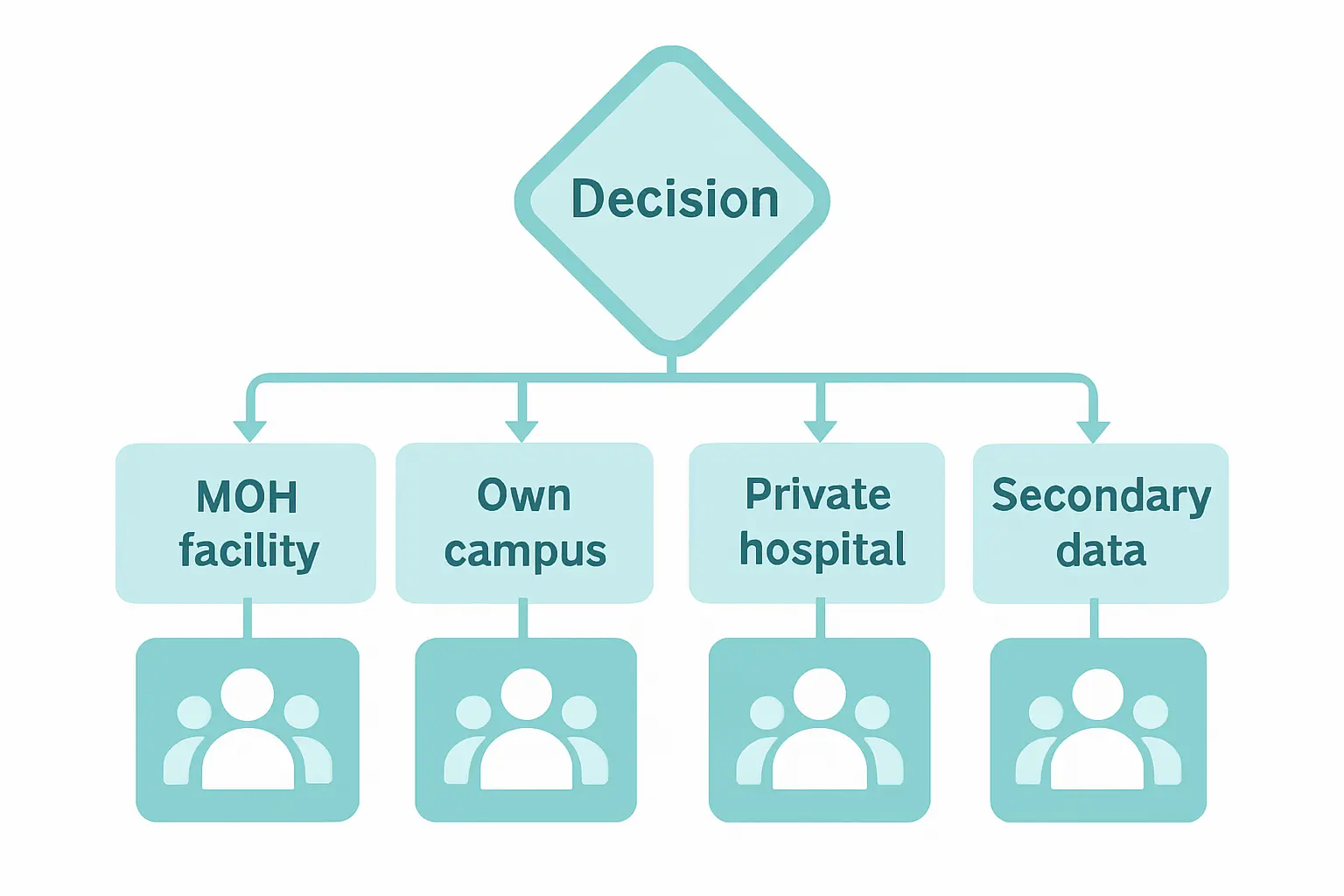
The committee depends on where your data comes from, not on your own faculty:
- Any Ministry of Health facility (government hospital, health clinic, community nursing service) — apply through NMRR to the Medical Research and Ethics Committee (MREC), Ministry of Health.
- Your own campus only (nursing students, academic staff, simulation-lab participants, no MOH facility involved) — apply to your university’s own human research ethics committee. Universiti Sains Malaysia’s is JEPeM-USM; most other public and private universities run an equivalent faculty- or university-level board under a different name — check your own faculty’s research office for the exact committee name and portal before assuming NMRR applies to you.
- A private hospital or nursing home — that facility’s own institutional ethics committee, in addition to your university’s, if it has one; otherwise your university committee alone.
- Secondary data only (anonymised hospital statistics already collected by someone else, published datasets) — still needs a light-touch ethics review or exemption letter from your university committee; it is not automatically exempt just because you did not collect it yourself.
What Is NMRR, and How Is It Different From Ethics Approval?
NMRR (the National Medical Research Register, managed by an NMRR secretariat at the National Institutes of Health under the Ministry of Health) is the online register and submission gateway for medical and health research in Malaysia — not the ethics approval itself. Registering your study on NMRR and getting MREC ethics approval are two different steps with two different outcomes on the same form: an NMRR ID confirms your study is on the national register; a separate approval letter from MREC confirms an ethics committee has reviewed and approved it. Through the same NMRR portal you may also need to route your application to the Jawatankuasa Penilaian Penyelidikan (JPP) for research-merit screening, apply for a MOH Research Grant (MRG) if you want MOH funding, and separately request Publication and Presentation Approval from the Director General of Health before you publish or present any finding drawn from MOH facility data — a step nursing students frequently miss because it happens after data collection, not before.
Step-by-Step: Applying for Ethics Approval
- Confirm which committee applies using the decision list above — do this before writing your Chapter 3 methodology, since the committee’s own format requirements shape how you must describe your design.
- Register an account on the relevant portal (NMRR for MOH-facility studies; your university’s own ethics portal otherwise).
- Prepare the full submission set: research protocol, information sheet and informed consent form (in both Bahasa Melayu and English if your participants may need either), data collection instrument, and supervisor endorsement.
- Submit and wait for the review timeline. As a concrete published example, JEPeM-USM states that researchers can expect a first decision within 4–6 weeks for low-risk non-interventional studies and 4–8 weeks for interventional studies exceeding low risk, counted from complete submission — a useful planning benchmark even if your own committee’s stated timeline differs; check your own committee’s published figure rather than assuming this one.
- Pay any processing fee if your committee charges one — JEPeM-USM, for example, has charged processing fees since January 2021, payable in full at submission, for industry-sponsored trials, other sponsors and non-USM researchers, so check whether your own status attracts a fee.
- Respond to queries or requested revisions — many first submissions come back with minor corrections (often to the consent form’s wording) rather than outright rejection; treat this as a normal step, not a failure.
- Receive your approval letter and keep the reference number — your supervisor, your faculty, and any facility you collect data from will all ask to see it.
- Renew or report if your data collection runs past the approval’s validity period — most committees issue approval for a fixed period and require an annual or close-out report.
What Must the Informed Consent Form Include?
A nursing study’s consent form is checked closely because the population is often patients in a position of reduced power relative to the researcher. At minimum it must state: the study’s purpose in plain language; that participation is voluntary and refusal carries no penalty to care received; the procedures involved and their duration; any risks, discomforts, or benefits; how confidentiality and data storage will be handled; the participant’s right to withdraw at any point without giving a reason; and a named contact (you, your supervisor, and the ethics committee) for questions or complaints. Provide the form in Bahasa Melayu as the primary version for a general Malaysian patient sample, with an English version available on request, unless your population is specifically English-speaking.
Special Cases: Vulnerable Populations and Minors
Studies involving children, patients with cognitive impairment, psychiatric inpatients, or prisoners need an additional layer of protection that a standard consent form does not cover on its own: parental or guardian consent alongside the child’s own assent in age-appropriate language, a capacity assessment noted in the protocol for patients whose consent capacity may be affected by their condition, and — for any custodial population — separate institutional permission before the ethics committee will even review the application. Committees scrutinise these applications more slowly and more strictly; build the extra weeks into your timeline rather than discovering the delay after submission.
Common Mistakes That Delay Ethics Approval
- Submitting the protocol before deciding whether the study is MOH-facility or campus-only, then having to restart on the correct portal.
- A consent form written above a layperson’s reading level, or provided only in English for a Malay-speaking population.
- No named contact for complaints, or a contact who is not actually reachable at the number given.
- Underestimating review time and scheduling data collection to start before the committee’s stated turnaround has elapsed.
- Treating secondary or “anonymised” data as automatically exempt without checking your own committee’s definition of exemption.
How to Write the Ethics Paragraph in Your Methodology Chapter
Examiners expect a short, specific paragraph in Chapter 3 that names the committee, the approval reference number, and the exact consent procedure — not a generic sentence claiming “ethical procedures were followed.” A worked example for a hospital-based study:
“Ethical approval for this study was obtained from the Medical Research and Ethics Committee (MREC), Ministry of Health Malaysia, under NMRR registration number [reference], prior to any data collection. Written informed consent was obtained from all participants after they were given an information sheet in Bahasa Melayu and English describing the study’s purpose, procedures, and their right to withdraw at any time without affecting their care. Confidentiality was maintained by assigning each participant a code number instead of a name on all data collection forms, with the identification key stored separately from the data.”
A campus-only study follows the same structure but names your own university’s committee and reference number instead of MREC/NMRR, and typically drops the “without affecting their care” clause, which applies specifically to patients rather than student or staff participants.
How This Differs by Sub-Field of Nursing
A community health nursing study recruiting from a klinik kesihatan may also need permission from the state or district health office and the clinic itself alongside MREC approval — an extra access layer most campus-only nursing topics never encounter. A psychiatric or mental-health nursing study needs the vulnerable-population safeguards above even when every participant is a competent adult, because committees apply extra scrutiny to any psychiatric setting by default. A paediatric or maternal-and-child nursing study needs the parental-consent-plus-child-assent structure described above, and — where the study touches newborns or maternal outcomes — your committee or the facility may ask for a clinician from the relevant unit to be involved as a co-investigator, so ask early.
Frequently Asked Questions
Do I need ethics approval if I am only surveying nursing students, not patients?
Yes — nursing students and staff are still human subjects; you apply to your university’s own ethics committee rather than to MREC, since no MOH facility is involved.
How long does the whole process take from submission to starting data collection?
Budget at least six to eight weeks end to end for a straightforward, minimal-risk study, and longer for anything involving a vulnerable population, a hospital site, or a first submission that needs revision.
Can I start recruiting participants while my application is still under review?
No — recruitment and data collection may only begin after you hold the signed approval letter, not after submission.
Does a validated questionnaire I am only translating still need full ethics review?
Yes; using a previously validated instrument does not remove the need for ethics approval, though you should also seek the original scale author’s permission to use and translate it, which most committees will ask you to document in the application.
What happens if I collect data from a private hospital?
You typically need both your university’s ethics approval and that private hospital’s own internal research or ethics committee approval before it will allow data collection on its premises.
Is NMRR registration enough on its own to start my study?
No — an NMRR ID only confirms your study is registered; you still need the separate MREC ethics approval letter before proceeding.
Do online or app-based surveys still require ethics approval?
Yes; the delivery method does not change the requirement — an online consent screen with the same required elements as a paper form is acceptable, but the underlying ethics approval is still needed first.
Who signs the informed consent form for a minor participant?
The parent or legal guardian signs the consent form, and the child provides separate written or verbal assent in language appropriate to their age, with both documented in the file you submit to the committee.
Can my supervisor apply for ethics approval on my behalf?
Rules differ between committees: some expect the supervisor to be named as principal investigator with the student as co-researcher, others let the student apply with the supervisor’s endorsement. Either way, your supervisor’s active involvement in the submission is expected, not optional — check your own committee’s guidance.
Does a purely qualitative interview study still need the same approval?
Yes — qualitative interviews with patients, nurses, or caregivers go through the same committee pathway; the protocol will describe an interview guide and audio-recording consent instead of a questionnaire, but the ethics requirement itself is unchanged.
Once your ethics approval letter is in hand, Tesify can help you turn your approved protocol into a fully drafted Chapter 3 methodology section in your own words — you remain responsible for every claim it produces. Draft your methodology chapter with Tesify.
For the rest of Chapter 3 once your instrument is approved, see how to design a questionnaire for your FYP. For validated instruments that already have published Malay-language versions, see validated Malay-language scales for a psychology FYP. For what examiners expect once your data is collected, see how to write the discussion chapter of a nursing FYP or thesis. For the proposal that should already describe your ethics plan before you submit it, see how to write a thesis proposal for a Malaysian FYP or postgraduate programme. For how positionality and ethics with a sensitive population are handled at the other end of the thesis, see what examiners ask at the viva for a criminology thesis in Malaysia.