
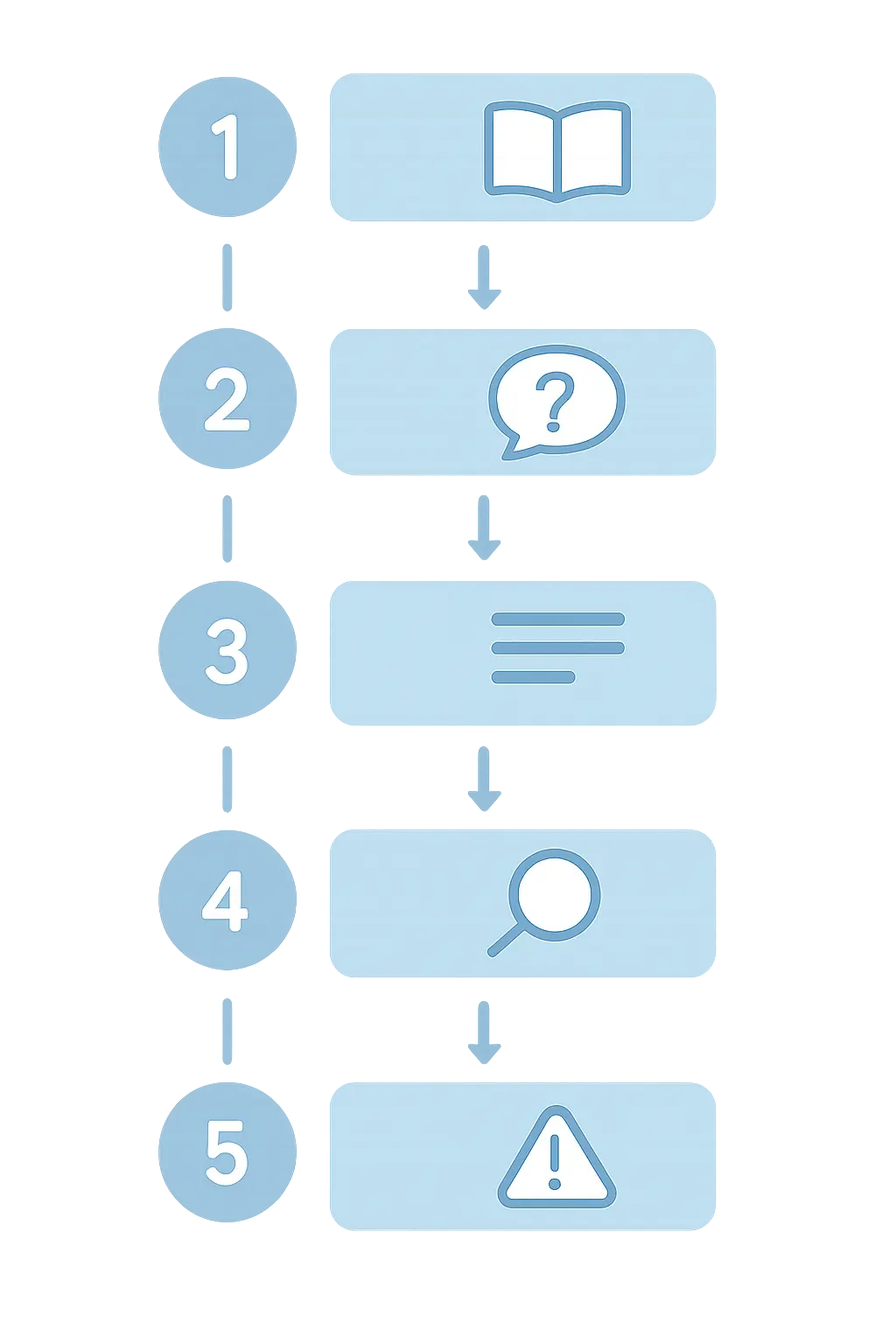
A nursing interview or focus-group guide needs six parts: an opening script that states consent and confidentiality again in plain language, a short rapport-building warm-up question, core questions mapped one-to-one to your research objectives, planned probes under each core question, a protocol for handling distress if a sensitive topic comes up, and a closing debrief question. A generic “ask about their experience” guide is not enough for a nursing ethics committee.
Why a Generic Interview Guide Doesn’t Pass for Nursing
Nursing qualitative research almost always touches patients, clinical staff under work pressure, or caregivers in a vulnerable moment, so ethics committees read the interview guide itself as part of the risk assessment — not just the consent form. A guide that only lists broad topics (“explore experience of burnout”) gives the committee nothing to check the questions against your stated objectives, and gives you nothing to defend at the viva when an examiner asks how question six maps to research question two. The guide is also the document your supervisor uses to judge whether your qualitative design is actually answerable within a semester: eight loosely worded prompts read very differently from a bank that shows objective, question and at least one planned probe for each.
What Goes Into a Nursing Interview Guide, Section by Section
- Opening script — restates, in the participant’s own language, what the study is about, that participation is voluntary, that they may stop at any time without it affecting their care or employment, and that the interview will be recorded with their permission.
- Warm-up question — low-stakes and factual (“How long have you worked in this ward?”), never the first substantive question, so the participant is speaking before anything sensitive is asked.
- Core questions, one per objective — every research objective in Chapter 1 should have at least one matching open-ended core question here; if an objective has no question, the design has a gap an examiner will find.
- Probes under each core question — two or three planned follow-ups (“Can you give me an example?”, “What happened after that?”, “How did that make you feel about the policy?”) so you are not improvising follow-ups live, which is where novice interviewers lose depth.
- A distress protocol — a scripted pause-and-check response if a participant becomes upset (offer to stop, resume later, or end the interview; a referral contact for staff support where relevant), agreed with your supervisor and stated in your ethics submission, not improvised on the day.
- Closing question and debrief — “Is there anything about this topic you expected me to ask that I haven’t?” followed by a short thank-you and a reminder of how to withdraw their data if they change their mind within the stated window.
Worked Example: A Guide for a Study on Ward Nurses’ Experience of Escalating a Deteriorating Patient
The table below is a worked, illustrative example for a qualitative study exploring how ward nurses experience the process of escalating concern about a deteriorating patient to a doctor — adapt the objectives, questions and probes to your own topic rather than copying this one.
| Objective | Core question | Planned probe |
|---|---|---|
| Describe how nurses recognise early deterioration signs | “Tell me about a recent time you noticed a patient was starting to deteriorate. What did you notice first?” | “What made you trust that observation over the numbers on the monitoring chart, or vice versa?” |
| Explore barriers to escalating concern to a doctor | “What goes through your mind in the moment before you decide to call a doctor about a patient you’re worried about?” | “Has hierarchy ever made that call harder to make? Can you describe a time?” |
| Understand how ward culture shapes escalation behaviour | “How would you describe how escalation is generally handled on this ward, compared to other wards you’ve worked on?” | “What happens, informally, to a nurse who escalates ‘too often’ in your colleagues’ eyes?” |
| Identify what would make escalation easier | “If you could change one thing about how escalation works here, what would it be?” | “What would need to be true for that change to actually work day to day?” |
Notice that every core question is open-ended and asks for a story or a description, never a yes/no answer, and every probe is planned rather than left to be invented mid-interview — this is what a supervisor and an ethics committee are both checking for.
Focus Groups vs One-on-One Interviews for Nursing Research
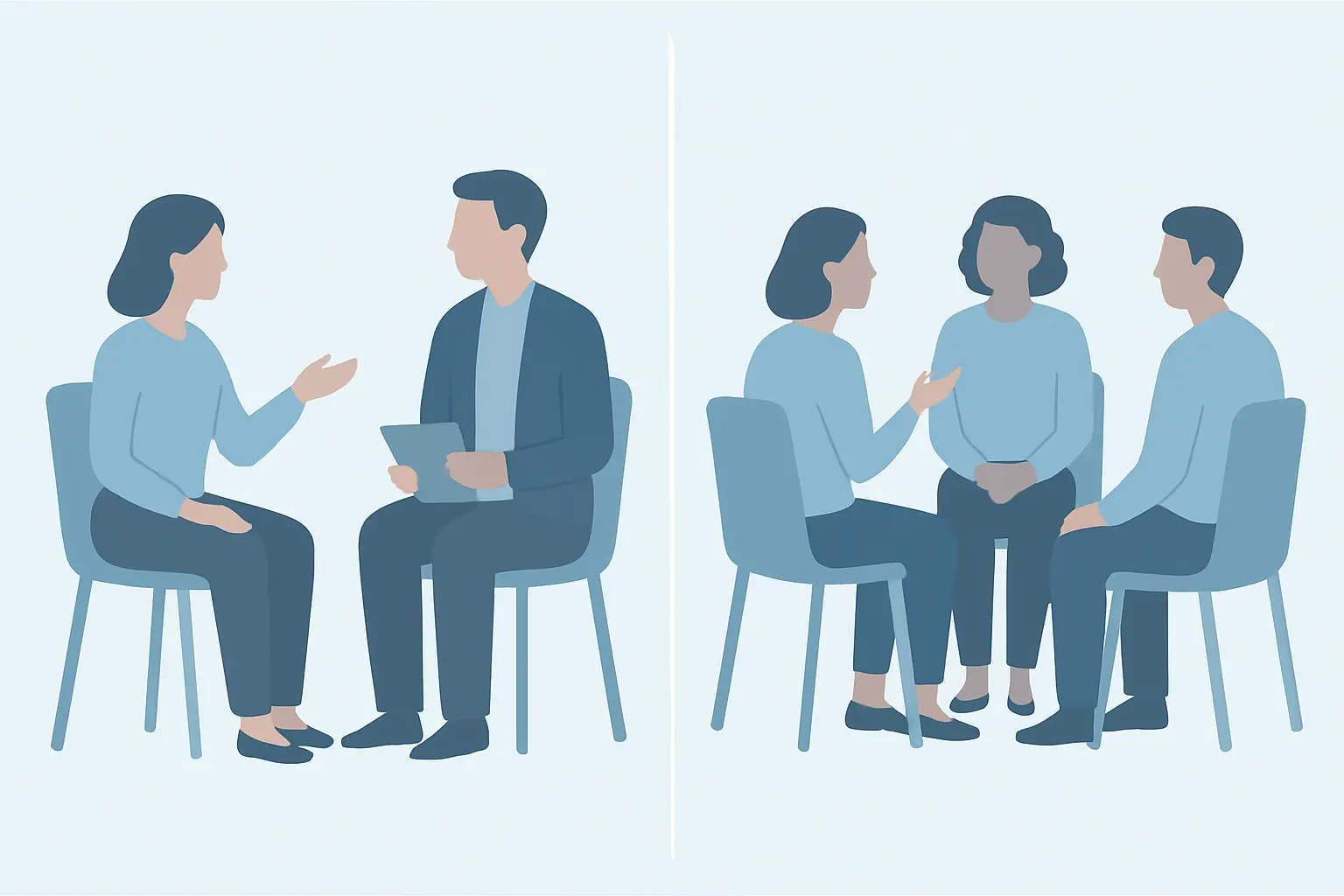
Choose one-on-one interviews when the topic is personally sensitive (a nurse’s own experience of a near-miss, moral distress, or a difficult patient death) or when hierarchy in the room would silence junior participants in front of senior colleagues. Choose a focus group when the topic benefits from participants building on each other’s accounts — shared ward practices, how a new protocol was actually adopted on the floor, or perceptions of a policy that most staff have an opinion on — and when you specifically want to observe agreement and disagreement between participants as data, not just each individual’s account. A common and defensible compromise on nursing wards: run individual interviews first to identify themes, then a smaller focus group to test whether those themes are recognised more broadly — state this sequencing explicitly in your methodology if you use it, rather than presenting it as two unrelated data sources.
Ethics, Consent and Recording — What’s Specific to Nursing
A nursing interview or focus-group study involving hospital or clinic staff, patients or their records goes through the same National Medical Research Register (NMRR) registration and Medical Research and Ethics Committee (MREC), Ministry of Health, pathway as a quantitative nursing study — a qualitative design does not reduce the ethics requirement, and the protocol you submit must describe the interview guide itself, the audio-recording and storage method, and how you will anonymise quotations before they appear in your write-up. A campus-only study of nursing students or academic staff instead goes through your own university’s ethics committee. Build in extra time in your timeline for a focus group specifically: committees often ask how you will handle a participant disclosing something during a group session that others were not meant to hear, and expect a stated confidentiality reminder read aloud at the start of every group, in addition to the individual consent forms signed beforehand.
Piloting Your Guide Before the Real Interviews
Pilot the guide with one or two people who are similar to your intended participants but not part of your actual sample — a nurse from a different ward, or a classmate role-playing the participant role. Time how long the guide actually takes to work through (a guide that reads as fifteen minutes on paper often runs closer to forty in a real conversation once probes and follow-ups are included), note any question a pilot participant misunderstands or answers with a flat yes/no despite being written as open-ended, and revise the wording before your real data collection begins. Report in your methodology chapter that a pilot was conducted, with whom, and what changed as a result — a one-sentence acknowledgement is enough, but its absence is a common reason a qualitative methodology chapter is sent back for revision.
From Recording to Themes: Transcription and Coding
Transcribe every recording in full rather than summarising as you go — you cannot code accurately from memory or from notes taken during the interview, and an examiner may ask to see a transcript excerpt against a specific theme in your findings chapter. Many nursing qualitative theses in Malaysia use thematic analysis following Braun and Clarke’s six-phase framework: familiarisation with the data, generating initial codes, searching for themes, reviewing themes, defining and naming themes, and producing the final report — naming this framework explicitly in your methodology, rather than describing coding vaguely as “themes were identified,” is what separates a defensible qualitative chapter from one an examiner keeps probing.
Common Mistakes in a Nursing Interview Guide
- Questions that can be answered with a single word, disguised as open-ended (“Did you find that difficult?” instead of “What made that difficult for you?”).
- No mapping between objectives and questions, so a reader cannot see which question is meant to answer which part of Chapter 1.
- Leading questions that assume the answer (“Don’t you think staffing shortages caused the problem?”) rather than letting the participant name the cause themselves.
- No planned distress protocol, discovered as a gap only when a participant becomes upset during an actual interview.
- Treating the pilot as optional and skipping straight to real data collection with an unrevised, untested guide.
Frequently Asked Questions
How many questions should a nursing interview guide have?
Enough to cover every objective with at least one core question plus its probes — for most undergraduate nursing studies that is five to eight core questions, planned to fit a forty-five to sixty-minute conversation rather than counted for its own sake.
Can I change my questions partway through data collection if something isn’t working?
Minor wording adjustments after a pilot or early interviews are normal and expected in qualitative research; a substantial change to your objectives or core questions after data collection has started should go back to your supervisor and, in most cases, be reported to your ethics committee as an amendment.
Do I need a different guide for each participant group (for example, staff nurses versus ward matrons)?
If your study includes participants at meaningfully different levels of seniority or role, a lightly adapted version of the same core guide — same objectives, questions reworded for the role — is usually more defensible than one identical guide forced onto very different participants.
Is it acceptable to send participants the interview guide in advance?
Many qualitative researchers do share broad topic areas in advance to help participants prepare, while keeping specific probes for the conversation itself; check whether your ethics committee or supervisor has a preference either way, since practice varies.
What if a nurse participant wants to discuss something clinical that isn’t part of my research questions?
Let them finish the thought — it is sometimes valuable context — then gently guide the conversation back to your core questions using your closing or transition phrases; note the aside in your reflexive journal rather than forcing it into your coded data if it is genuinely off-topic.
How long should I keep the audio recordings after transcription?
Follow your university’s and your ethics committee’s stated retention period, commonly a period specified in your approval letter rather than a fixed universal number — state this explicitly in your consent form so participants know in advance.
Can I use WhatsApp voice notes or video calls to conduct interviews instead of meeting in person?
Yes, if your ethics approval covers remote data collection and you have a reliable way to record and store the audio securely; state the modality explicitly in your methodology, since it can affect rapport and the depth of answers you get.
Should the interview guide be in Bahasa Melayu, English, or both?
Match the participant’s preferred language, with a translated version of the guide prepared and available for both if your sample may include speakers of either — translate carefully rather than relying on a literal word-for-word rendering, since idiom matters for open-ended questions.
What’s the difference between a probe and a follow-up question I make up on the spot?
A probe is planned in advance and written into the guide under its core question; an improvised follow-up is one you generate live in response to something unexpected the participant says — both are legitimate, but only the planned probes should be treated as part of your approved protocol.
Once your interview guide is drafted, Tesify can help you turn it into a full Chapter 3 qualitative methodology section in your own words — you remain responsible for checking every claim it produces against your actual ethics approval. Draft your methodology chapter with Tesify.
For the ethics approval pathway this guide feeds into, see what ethics approval you need for a nursing thesis in Malaysia. For the chapter this interview data eventually becomes part of, see how to write the discussion chapter of a nursing FYP or thesis. For validated instruments if your study also uses a quantitative scale alongside interviews, see validated Malay-language scales for a psychology FYP. For sample-size reasoning that also covers qualitative interview counts, see how many respondents you need for your FYP or thesis. For the proposal stage where your interview guide should already be described, see how to write a thesis proposal for a Malaysian FYP or postgraduate programme.