
Your industrial training (latihan industri) placement can become the basis of a Business Administration FYP, but the internship report itself is not a thesis — it lacks a research question, a theoretical framework, and a methodology section. Six steps turn a completed placement into a properly structured FYP built around the real problem you observed on the job.
Why Your Internship Report Isn’t Automatically a Thesis
A standard latihan industri report is a reflective log: what you did, what you learned, how the placement mapped onto your coursework. An FYP is a different document entirely — it needs a stated problem, a review of what academic literature already says about that problem, a defined method for examining it, and a set of findings that answer a specific question. The placement gives you something most FYP students do not have: real access to a real organisation’s real data and real staff. What it does not give you automatically is the research architecture around that access — you have to build that yourself, using the placement as your case rather than as your topic.
Step 1: Choose the Angle Your Internship Actually Supports
Look back at your internship log for a recurring friction point, not a general department description. “I worked in the HR department” is not an angle; “new hires in the department I interned at took an average of three weeks longer than the company’s own onboarding target to become fully productive, and nobody had documented why” is. Good angles usually come from a process you watched repeat with the same problem each time: a recruitment bottleneck, an inventory discrepancy that recurred monthly, a customer complaint pattern the company tracked but never analysed, a marketing campaign whose results nobody formally reviewed. If nothing comes to mind immediately, re-read your own weekly logbook entries — the complaint you made twice to yourself in different weeks is usually the angle.
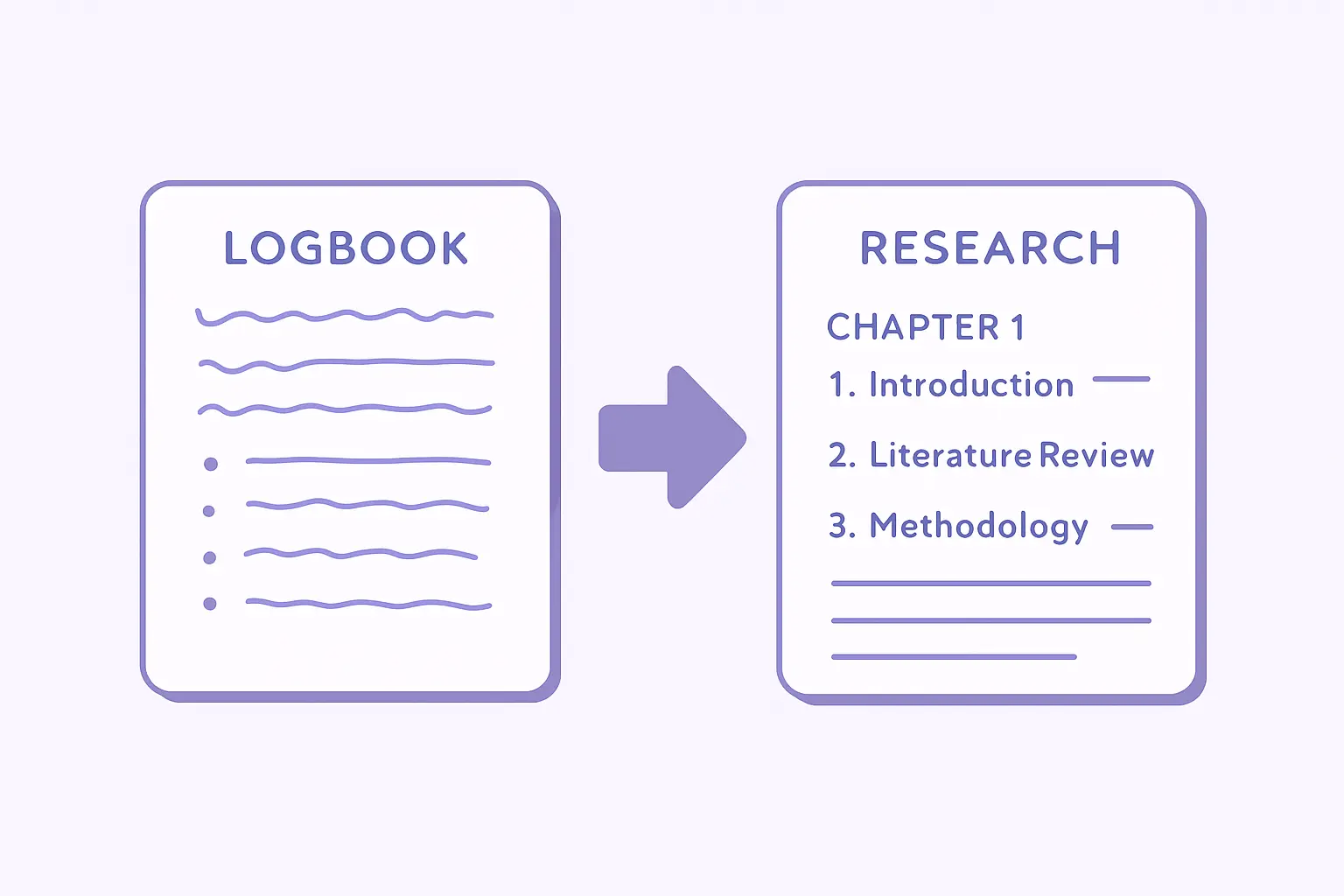
The table below shows how a routine logbook entry becomes a research angle across different placement functions:
| What your logbook says | The FYP angle it hides |
|---|---|
| “Helped process new hire onboarding paperwork, sometimes delayed by missing documents” | Onboarding process efficiency and document-completeness bottlenecks in the HR function |
| “Assisted with monthly stock count, noticed frequent discrepancies in one product category” | Inventory accuracy and inventory-control-system gaps for that category |
| “Answered customer complaint calls, many about late delivery in one zone” | Service-quality and last-mile delivery performance in that route zone |
| “Supported a social media campaign, engagement metrics tracked but never formally analysed” | Digital marketing campaign effectiveness measurement and reporting gaps |
Step 2: Turn Your Placement Into a Case-Study Chapter 1
Chapter 1 for an internship-based FYP names the host organisation (or an anonymised version of it, see below), states the specific operational problem you observed, and frames it as a case study — a single-organisation investigation, not a claim about “Malaysian companies” in general. A worked example: Background — a mid-sized logistics company where you interned in customer service; Problem statement — the company’s own complaint log showed a recurring pattern of late-delivery complaints in one specific route zone that management had not formally investigated; Objectives — (1) to identify the operational causes behind the route-zone delay pattern using company delivery records, (2) to evaluate these causes against established supply-chain service-quality theory, (3) to propose company-specific recommendations grounded in both the data and the theory. Scope: the single branch and route zone you observed, over the specific period your placement covered — stated as a limitation on generalisability, not hidden.
Step 3: Build Chapter 2 From Company Documents Plus Academic Theory
Chapter 2 does two things at once: it reviews the academic literature on your problem area (service quality models such as SERVQUAL for a customer-service angle, or the relevant HRM, operations, or marketing theory for other angles), and it uses whatever company documents you had legitimate access to during your placement — SOPs, internal reports, dashboards you were shown — as context, cited as internal or organisational sources rather than as peer-reviewed literature. Keep the two source types clearly separated in your writing: academic theory establishes what should predict or explain the problem; company documents establish what is actually happening on the ground. The gap between the two is your literature-review conclusion.
Step 4: Chapter 3 Methodology for an Internship-Based Study
Many internship-based FYPs are case studies using a mix of document analysis and informal or semi-structured interviews rather than a large-sample survey — closer in shape to a single-organisation methodology than to a respondent-count-driven design. Name the design explicitly: a single-case, mixed-method case study; describe your data sources (which company records you analysed, how many staff you spoke with and in what role); and be explicit that this is exploratory and organisation-specific rather than a representative sample of the industry. If you conducted interviews with staff during or after your placement, they still need supervisor sign-off and, in most faculties, the same informed-consent procedure as any other interview-based FYP — the fact that you already knew the interviewees from your placement does not remove this requirement.
Step 5: Chapter 4 — Connecting Company Findings to Theory
Chapter 4 presents what the company records and interviews actually showed, then explicitly maps each finding back to the theoretical framework from Chapter 2 — for the logistics example, this means presenting the route-zone delay pattern from the company’s own data, then testing each theorised cause (staffing gaps, route-planning inefficiency, last-mile handoff delays) against what the records and interviews actually support, and stating plainly which theorised causes the evidence does and does not confirm.
Step 6: Chapter 5 — Recommendations for Two Audiences at Once
This is where an internship-based FYP earns its extra credibility: Chapter 5 gives recommendations both the host company and an academic examiner can use. Structure it in two halves — practical recommendations addressed to the company (specific, low-cost, implementable within the organisation’s actual constraints, which you understand from having worked there), and an academic contribution paragraph stating what this single case adds to the broader theory (a boundary condition, a Malaysian SME-context nuance, a variable the established model underweights). A recommendation that only makes sense as a business consulting deliverable, with no connection back to Chapter 2’s theory, will read as a report, not a thesis.

What to Do About Confidential Company Information
Ask your placement supervisor, early, whether the company is comfortable being named in an academic document that will sit in your university’s repository. If the answer is no, or if you are unsure, anonymise: refer to “the company” or use a pseudonym (“a mid-sized logistics firm in Selangor, hereafter referred to as Company A”), strip any figures that could identify the company from context (exact revenue figures, unique product names), and state in your methodology that anonymisation was applied and why. Never include internal documents verbatim as an appendix without explicit permission — summarise findings from them in your own words instead. If you signed a non-disclosure agreement during your placement, re-read it before submission: NDA wording varies, and many focus on identifiable commercial or financial data rather than general observations about processes, so a well-anonymised case study may still be possible — but confirm with your supervisor and, if needed, the company before you rely on that.
Common Mistakes That Turn This Into a Report, Not a Thesis
- No academic literature at all — just company documents and personal observation, with nothing to compare the findings against.
- A problem statement copied almost verbatim from the internship logbook’s “challenges faced” section, with no research framing.
- Recommendations addressed only to the company, with no paragraph connecting the case back to the academic literature.
- Presenting a single-branch, single-period case as if it generalises to “the industry” or “Malaysian companies” without stating the scope limitation.
- Naming the company and quoting internal figures without checking whether the company consented to being identified.
Frequently Asked Questions
Can I use my internship report as an appendix in my FYP?
Some faculties allow a short excerpt or summary of the internship report as an appendix, but the FYP body itself must be a separate, properly structured research document — check your own faculty’s specific rule before assuming this is permitted.
What if my placement didn’t reveal any clear problem?
Look at a comparison angle instead — how the company’s actual practice compares to a documented industry best-practice or standard, which is a legitimate research angle even without an obvious internal complaint.
Does my supervisor need to approve the topic before I start writing?
Yes — confirm the angle and access feasibility with your academic supervisor before drafting Chapter 1, since some faculties also require the placement company’s written consent for the topic itself, not only for any data you use.
Can I interview my own former supervisor at the company?
Usually yes, and their operational knowledge is often the most valuable data source you have access to — but it still needs to go through your university’s normal ethics or interview-consent process, not be treated as an informal conversation.
Is a case study FYP treated as less rigorous than a survey-based one?
No, provided the methodology explicitly names it as a case study design with its own established logic (data triangulation across documents and interviews, explicit scope boundaries) rather than presenting it as an under-sampled survey.
How do I handle a placement that covered multiple departments?
Pick one department or one process as your case rather than trying to cover everything you saw — a narrower, well-evidenced single-process case is stronger than a broad, thinly evidenced multi-department one.
What if the company closes down or changes its practices before I submit?
Your findings still stand as a documented case from the period you studied — state the timeframe clearly in your scope and, if relevant, note the change as a limitation or a direction for future comparison.
Should Chapter 2 cite the company’s own annual report or website?
Yes, as an organisational source for background context (company size, market position), clearly distinguished in your citations from the peer-reviewed academic sources that anchor your theoretical framework.
Can I switch topics if my supervisor rejects the angle I picked from my logbook?
Yes — bring two or three candidate angles from your logbook to the first supervision meeting rather than committing to one in advance, since a supervisor’s early feedback on data access and theoretical fit is far cheaper to act on before you have drafted Chapter 1 than after.
Does a short placement (four to eight weeks) still give enough material for an FYP?
Yes, if the angle is narrow enough — a four-week placement rarely supports a broad organisational study, but it is often enough to document one specific process closely, which is exactly the scope this approach recommends.
Tesify can help you turn your placement notes and company observations into a structured Chapter 1 problem statement and a full first draft across all five chapters — you remain responsible for checking every company detail and citation it produces. Draft your FYP chapters with Tesify.
For the proposal stage before Chapter 1, see how to write a thesis proposal for a Malaysian FYP or postgraduate programme. For the general methodology-chapter structure this example adapts, see how to write the methodology chapter of a Malaysian FYP or thesis. For a comparable methodology without a large respondent sample, see how to write Chapter 3 for a civil engineering FYP without respondents. For how to report findings the way Chapter 4 above does, see how to write the results chapter of your FYP or thesis. For how this document differs from an undergraduate FYP in scope, see what is the difference between an FYP, a thesis and a dissertation in Malaysia.