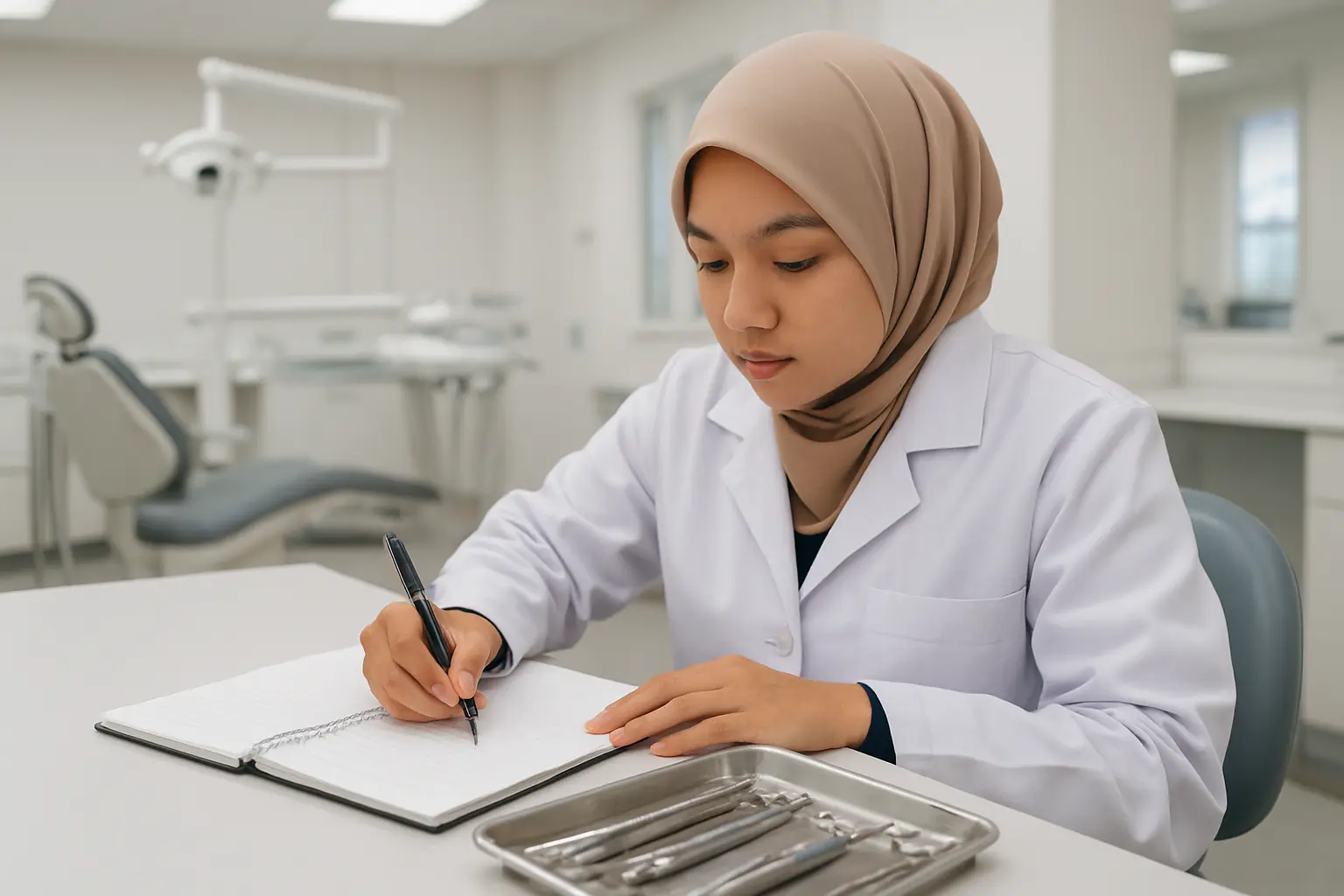
In short: The methodology chapter of a dentistry thesis in Malaysia follows one of four common designs — cross-sectional epidemiological survey, in-vitro laboratory study, clinical or quasi-experimental comparison, or retrospective patient-record review — and each has its own structure for reporting sample, materials or setting, procedure, and analysis. Choose your structure based on which design you ran, not a generic template, and state your ethics approval and consent process early.
Dentistry FYPs at Malaysian dental schools split cleanly into a handful of recurring designs, and Chapter 3 marks are lost most often when a student writes a generic “research methodology” chapter that does not match what their study actually did — a lab-based material-testing study described with survey-sampling language, or a clinical comparison missing the calibration procedure examiners expect. This guide gives you the structure for each design Malaysian dentistry students actually run, with example sentences you can adapt to your own data.
Step 1: State your design and justify it in one paragraph
Open Chapter 3 by naming your design precisely and in one sentence explaining why it fits your research question — not defining the design in the abstract, which examiners already know. Example: “This study used a cross-sectional design to determine the prevalence of early childhood caries among children aged four to six in [district], because prevalence at a single time point, rather than change over time, was the study’s objective.” If your study combines designs — a lab-based material test followed by a small clinical pilot, for instance — state both and explain how they connect.
Step 2: Describe your setting and sample the way your design requires
For a cross-sectional epidemiological study, state the population (schoolchildren, adult outpatients, a specific clinic’s attendees), the sampling method, and the sample size calculation — our guide to how many respondents you need for an FYP covers the calculation itself. For an in-vitro laboratory study, replace “sample” with “specimens”: state the material tested, the number of specimens per group, and how group allocation was randomised, since examiners expect specimen numbers reported with the same rigour as human participant numbers. For a clinical comparison, state inclusion and exclusion criteria precisely — tooth type, restoration size, patient age range — because a vague criterion here is the most common source of a viva challenge. For a retrospective record review, state the date range of records searched, the clinic or hospital source, and how incomplete records were handled.
Step 3: Describe your materials and instruments precisely
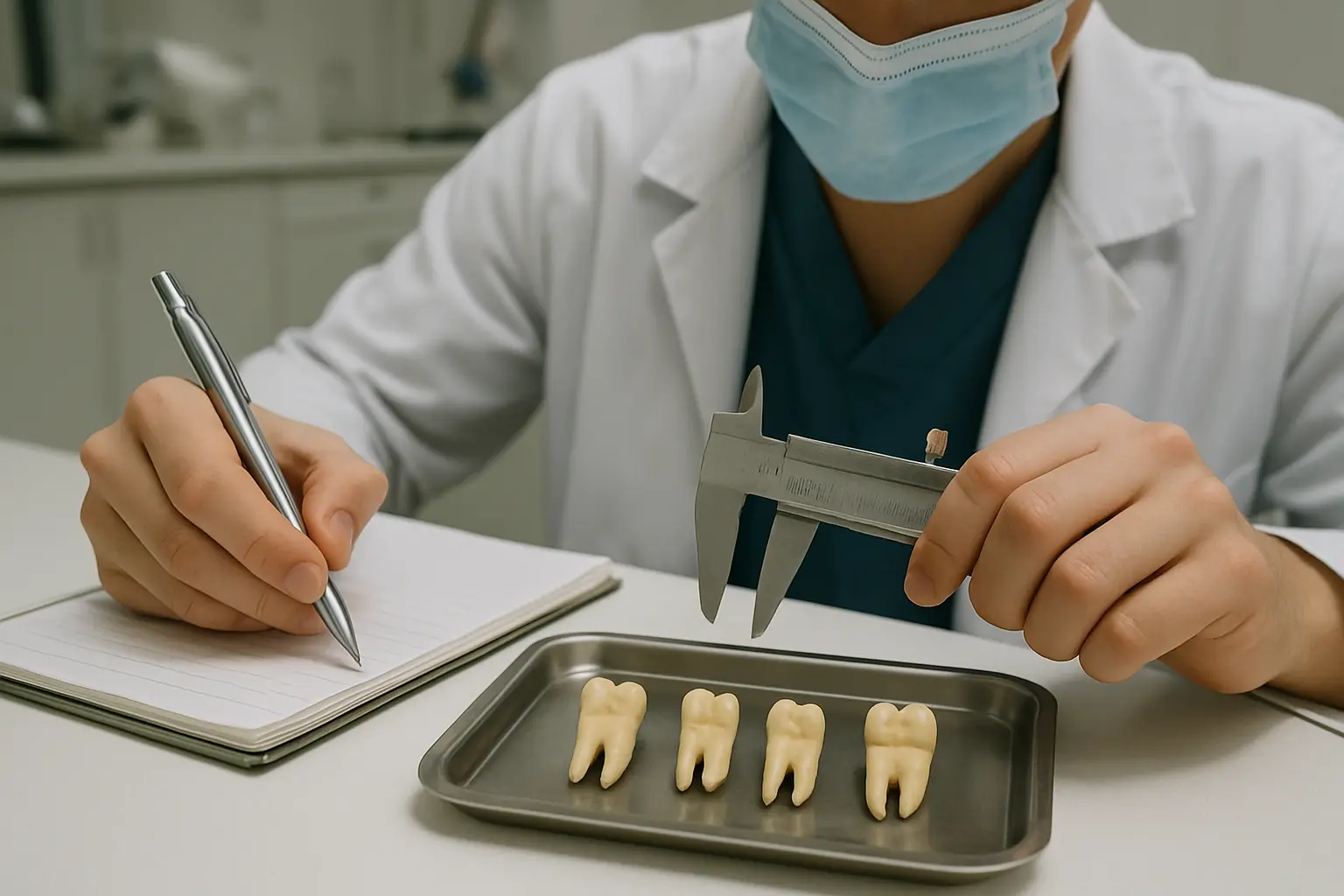
Name every material, instrument and index by its full name, manufacturer and, where relevant, batch or lot number on first mention — a generic reference to “a resin composite” or “a bonding agent” without the specific product is a common examiner flag, because dental materials vary enough between products that the result may not replicate with a different one. For clinical or epidemiological studies using an index — DMFT/dmft for caries, the Community Periodontal Index, the Oral Health Impact Profile for quality-of-life outcomes — state the index’s full name, its scoring range, and cite the source that validated it. If you translated or adapted an index into Bahasa Malaysia, state whether that adaptation was formally validated, following the same logic our guide to validated Malay-language scales sets out for psychology instruments.
Step 4: Report calibration and reliability before the procedure
Dentistry examiners look specifically for a calibration statement that most other fields do not require: if more than one examiner scored teeth, restorations or radiographs, state how inter-examiner reliability was established (a kappa statistic against a gold-standard examiner is the common approach) and what threshold was accepted. If a single examiner scored everything, state that explicitly and note it as a limitation rather than leaving it for the reader to infer. Example: “Inter-examiner reliability was established through calibration against a gold-standard examiner on 20 test cases, achieving a kappa value of [value], considered [substantial/almost perfect] agreement.”
Step 5: Write the procedure as a sequence a reader could replicate
Write the procedure in the order it happened, in enough detail that another dental student could repeat it: for a clinical study, the examination position, lighting, and any pre-examination preparation (drying teeth before a visual-tactile caries exam, for instance); for a lab study, the mixing ratios, curing light specifications and time, storage conditions and testing machine settings; for a survey, how and where questionnaires were administered. State exactly what happened, in the past tense, without justifying the choices again — justification belongs in Step 1 and in the discussion, not repeated here.
Step 6: State your statistical or analytical plan, matched to your data type
State the specific test for each research question, not a general list of software used. Categorical outcomes such as caries presence or restoration failure typically use chi-square or logistic regression; continuous outcomes such as bond strength in megapascals typically use t-tests or ANOVA, depending on group number; ordinal indices sometimes need non-parametric equivalents. Our guide to which statistical test to use for FYP data covers how to match the test to your data type in more depth. State the significance threshold you used (commonly p < 0.05) and the software and version, and for a laboratory study, state the units for every measurement precisely, since a bond-strength figure without stated units is a common examiner correction.
Step 7: State your ethics approval and consent process
State which ethics committee approved the study — a university’s own research ethics committee for most FYPs, or the Medical Research and Ethics Committee (MREC) for studies at Ministry of Health facilities — and the approval reference. For studies involving children, state how parental consent and child assent were both obtained, since dentistry theses frequently involve school-based samples. For retrospective record reviews, state how patient identifiers were removed or anonymised during data extraction.
What mistakes cost marks in a dentistry methodology chapter?
Five recur across Malaysian dentistry FYPs and dissertations. Reusing a generic methodology template from a supervisor’s previous student without matching it to your own design, which shows the moment a detail does not fit — a lab-study template that still mentions informed consent from “participants” when the study used extracted teeth. Naming a material generically instead of by full product name and manufacturer, which makes the study impossible to replicate exactly. Omitting the calibration statement entirely, which is one of the first things a dentistry examiner checks for and one of the most common gaps in undergraduate work. Describing the statistical test used without stating which research question it answered, leaving the reader to guess the connection between Chapter 3 and Chapter 4. And writing the procedure in the present tense as an instruction manual rather than the past tense as a record of what was actually done — a small stylistic point that examiners nonetheless read as sloppiness if it appears throughout.
Our broader guide to writing the methodology chapter of an FYP covers the generic structure these dentistry-specific steps build on, and once your data is collected, our guide to writing the results chapter shows how the analysis plan you state here should map directly onto the tables and figures you present next.
What does a complete Chapter 3 structure look like?
For most Malaysian dentistry FYPs, the chapter runs in this order: research design and justification, study setting and population or specimens, sampling method and sample-size calculation, materials and instruments, calibration and reliability, procedure, data analysis plan, and ethical considerations. A masters dissertation typically adds a pilot-study subsection describing any pre-testing of the procedure or instrument. Keep each subsection to what a reader needs to replicate or evaluate your study — Chapter 3 is the chapter examiners return to most often while reading your results, so precision here saves questions later.
Draft your dentistry methodology chapter while the design is still fresh
The methodology chapter is easiest to write accurately in the week you finalise your protocol, while every material, index and calibration detail is still fresh — and hardest to reconstruct later from memory. Tesify helps you draft the chapter in the structure Malaysian dental faculties expect: describe your design, materials and procedure, and it returns a structured Chapter 3 draft with the calibration and ethics sections examiners look for, ready for you to check against your actual protocol.
Draft your dentistry methodology chapter with Tesify
Frequently asked questions
Where does the methodology chapter go in a dentistry thesis?
Chapter 3, after the literature review and before the results chapter, at most Malaysian dental faculties. Check your own faculty handbook for the exact chapter numbering, since some masters programmes number chapters differently.
Do in-vitro dental studies need ethics approval?
Studies using only extracted teeth with no living participants often need a lighter form of ethics clearance or a declaration of the teeth’s source (typically extracted for unrelated clinical reasons and donated anonymously); confirm the exact requirement with your faculty’s research ethics committee, since this varies by institution.
How many specimens do I need for a laboratory-based dentistry study?
This depends on the effect size you expect and the test you plan to run; many undergraduate material-testing studies use 10 to 15 specimens per group as a practical minimum, but state your own calculation or cite the precedent study you based your number on rather than asserting a fixed rule.
What if two examiners disagreed frequently during calibration?
Report the actual kappa value honestly, even if it falls below the threshold you hoped for, and state what you did about it — further calibration sessions, consensus scoring for disagreements, or treating it as a limitation. A low kappa reported and addressed reads better than one left unmentioned.
Can I use a retrospective chart review for an undergraduate FYP?
Yes, and it is a common design where prospective data collection is not feasible within one semester; state clearly which records you had access to and why, and treat data completeness as a limitation to discuss explicitly.
Should I include the manufacturer of every material in the methodology, even minor ones?
Yes for anything that could affect your outcome — the restorative material, bonding agent, curing light and testing machine at minimum. A minor consumable with no plausible effect on the outcome can be named without extensive detail.
How do I report a pilot study in a masters dentistry dissertation?
As a short subsection stating what was pre-tested (typically the questionnaire, the calibration protocol or the specimen-preparation procedure), on how many cases, and what changed as a result before the main study began.
What statistical software do Malaysian dentistry theses typically use?
SPSS is the most common choice at Malaysian dental faculties, with R appearing more often in masters and PhD work; state the version number of whichever you used, since this is a standard reporting requirement.
Do I need to justify why I chose a cross-sectional design over a longitudinal one?
Yes, briefly — state the practical reason (typically the one-semester or one-year timeframe available) alongside the scientific one, since examiners read this as evidence you understood the trade-off rather than defaulting to the easier option without considering it.
How detailed should the procedure section be for a survey-based dentistry study?
Detailed enough that another researcher could administer the same survey the same way: where it was administered, in what language, whether it was self-administered or interviewer-administered, and how long it took respondents on average.