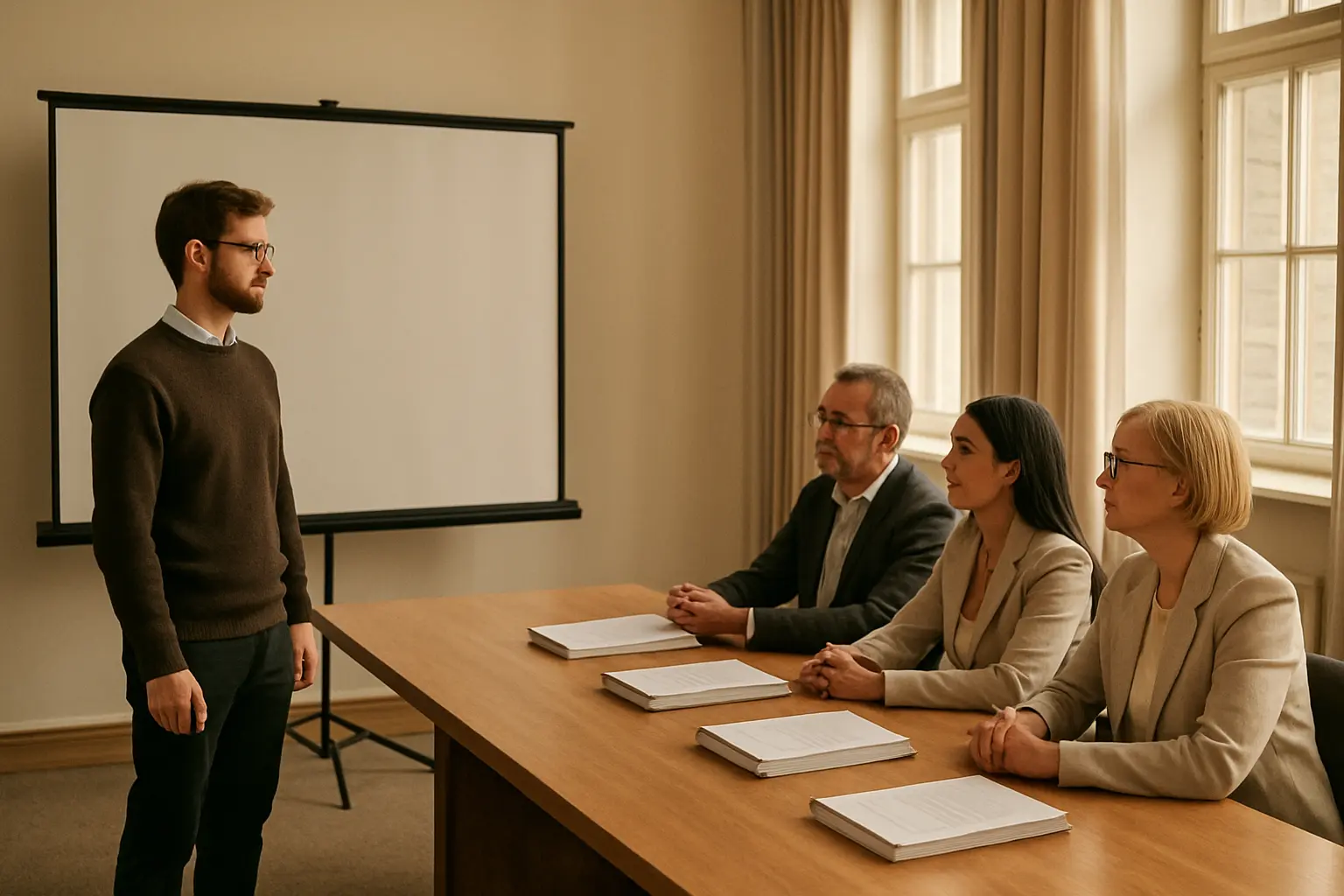
The viva is the only part of your degree where you cannot revise the document — you can only defend it. That sounds frightening until you realise what it actually means: the questions are largely predictable, because they come from the decisions you already wrote down. A panel cannot ask about a study you did not do. Every question they have is somewhere in your own methodology, your own sample and your own limitations.
This guide covers preparation for a postgraduate viva voce — the oral examination after your thesis has been submitted and read by appointed examiners. It uses one Malaysian university’s published procedure as a worked example so you can see the real shape of the process, then tells you exactly what to go and find for your own institution.
First, Know Which “Viva” You Are Preparing For
Three different events get called a viva in Malaysian universities, and preparing for the wrong one wastes weeks:
- An undergraduate FYP presentation. Usually a short departmental session with a supervisor and one or two internal assessors, often with other students in the room, sometimes assessed with a poster or demonstration. The rest of this guide still helps, but the formal machinery below does not apply.
- A proposal defence. This happens before the study, and the panel is testing feasibility, not findings. That is a different event with different questions, covered in how to write a thesis proposal.
- A postgraduate viva voce. After submission, after examiners have read the thesis. This is what the steps below prepare you for.
If you are unsure which category your programme falls into, the distinction between the levels is set out in FYP vs thesis vs dissertation in Malaysia.
Step 1: Get Your Own University’s Examination Regulations
This is the step students skip, and it is the one that changes how you prepare. The procedure is written down, it is public at most institutions, and it tells you the timeline, the panel composition and the possible outcomes.
As a worked example, Universiti Sains Malaysia’s Institute of Postgraduate Studies publishes its research-mode examination procedure in full. Reading it gives you concrete numbers rather than rumour:
- The Notice of Thesis Submission is meant to reach your School at least three months before you submit — that is the trigger for nominating examiners.
- The draft thesis goes through Turnitin screening at the School before submission, and format checking at IPS. USM states plainly that IPS “will not accept any thesis that has not been written in accordance with the prescribed format.”
- Examiners are given one month for a Master’s thesis and two months for a doctoral thesis to examine it. That gap between submission and viva is your actual preparation window.
Scope warning: those figures are USM’s. They are not a national standard, and UM, UKM, UPM and UTM each set their own. Use them to know what kind of facts to look for, then get the equivalent document from your own graduate school before you plan anything around a date.
Step 2: Know the Outcome Scale Before You Walk In
Students walk into a viva imagining two outcomes, pass or fail. Real regulations use a graded scale, and knowing it changes how you hear the panel’s comments. USM publishes five possible results:
| Scale | Outcome | What it means in practice |
|---|---|---|
| 1 | Award | The degree is awarded. Rare without any corrections. |
| 2 | Pass with minor corrections | Awarded subject to the changes listed in the Viva-voce Panel Report. |
| 3 | Pass with major changes | Awarded subject to changes, and the corrected thesis must be verified by the Viva-voce Panel after you make them. |
| 4 | Re-examination (re-viva) | Resubmit after corrections and attend another viva. The re-viva result can only be pass or fail. |
| 5 | Not awarded | Not eligible for the degree and not permitted to resubmit. |
The useful insight: scales 2 and 3 are both passes. A panel listing twenty corrections is not rejecting your work — it is telling you what to fix on a thesis it has already decided to pass. Students who hear a long correction list as failure argue back and turn a scale 2 into a harder conversation than it needed to be.
Step 3: Rebuild Your Own Argument on One Page
Before touching slides, write your entire thesis on a single page, in this order: the problem, the gap, the objectives, the design, the sample, the key findings, and the contribution. No more than one or two sentences each.
This is not a summary exercise. It is a diagnostic. Any element you cannot state cleanly in one sentence is exactly where the panel will push, because it is the part of your own argument you have not resolved. If your contribution takes a paragraph to explain, you do not yet have a contribution sentence — and “what is the contribution of your study?” is asked in nearly every viva.
Keep this page with you in the room. It is a legitimate aid and it anchors you when a question knocks you off balance.
Step 4: Prepare the Questions Every Panel Actually Asks
Viva questions cluster tightly. Prepare an answer of thirty to sixty seconds for each of these, out loud:
- Summarise your study in two minutes. Almost always the opener. Rehearse it until it is boring.
- Why is this study needed? The gap, in one sentence, with the evidence behind it.
- Why this design and not another? Name the alternative you rejected and why — see how to write the methodology chapter.
- Why this sample size? The single most common quantitative challenge. The acceptable bases are set out in how many respondents do I need for my FYP or thesis.
- Why this statistical test? Match each test to the research question it answers; the decision logic is in which statistical test should I use.
- Is your instrument valid and reliable? Give the source of the instrument and your own reliability figures.
- What does this finding actually mean? Interpretation, not repetition of the numbers — the boundary is drawn in how to write the results chapter.
- Why does your result differ from the literature? Offer a mechanism, not an apology.
- What are the limitations? State them before the panel does. It reads as competence.
- What is your contribution? Separate theoretical from practical.
- What would you do differently? Have one honest answer ready. “Nothing” is the wrong answer.
- What next? One or two concrete follow-up studies.
Panels also probe the framework you claimed to use — “what do examiners flag most often” is answered directly in theoretical framework vs conceptual framework. If you ran qualitative analysis, expect a question on your coding approach; whether the specific software matters is discussed in NVivo vs ATLAS.ti vs MAXQDA.
Step 5: Build the Presentation to the Time Limit You Were Given
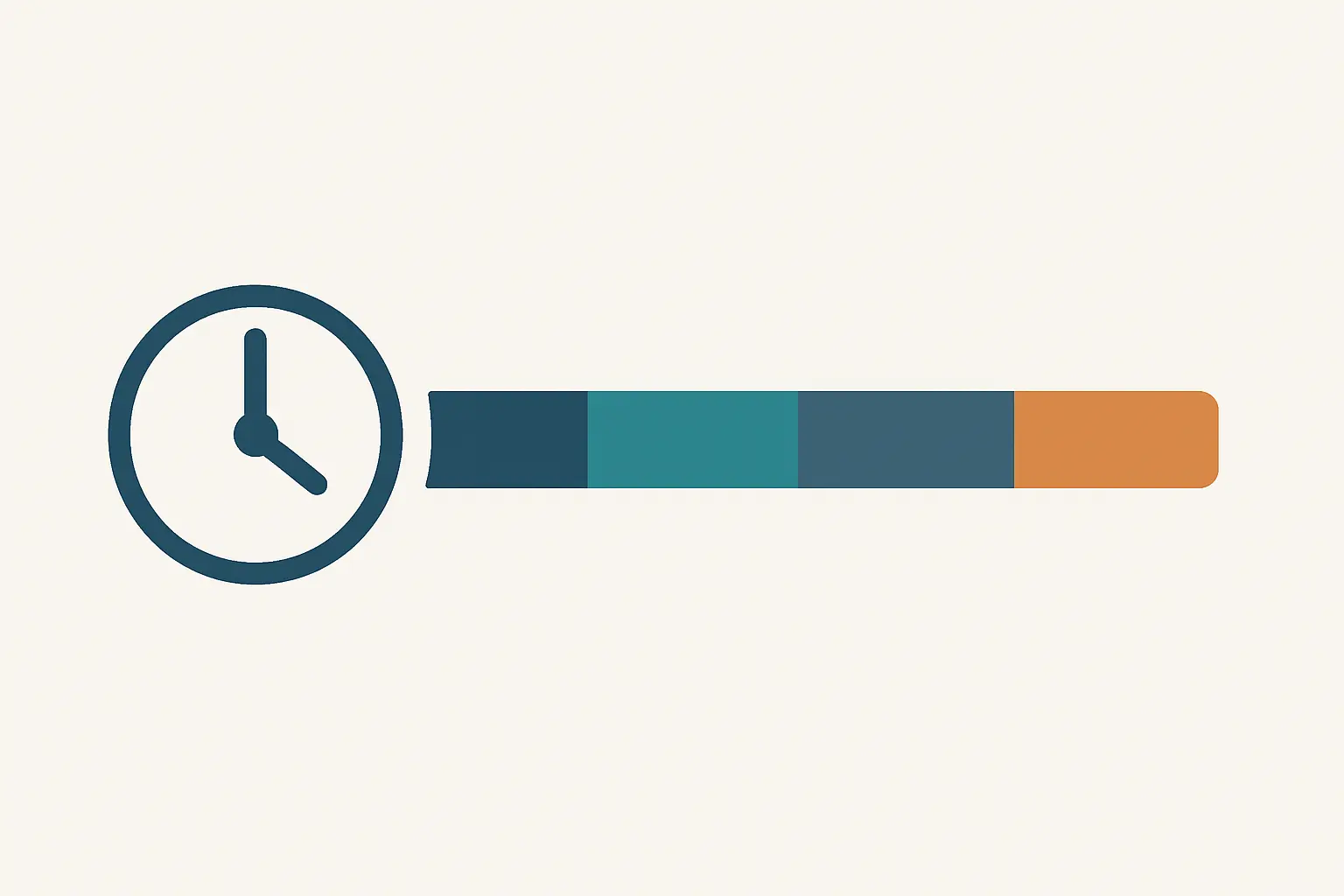
Ask the panel secretary for the exact slot, then build to it. A common shape for a twenty-minute presentation:
- Problem and gap — 3 minutes
- Objectives and research questions — 2 minutes
- Method: design, sample, instrument, analysis — 5 minutes
- Key findings, one slide per objective — 6 minutes
- Contribution, limitations, recommendations — 4 minutes
Two rules that matter more than design. One slide per objective in the findings section, so the panel can see that every objective was answered — an unanswered objective is the fastest route to a hard viva. And put your limitations on a slide yourself. Raising them first converts your weakest point from an attack into a demonstration of judgement.
Keep spare slides after the final one: your full results tables, the reliability figures, the sampling calculation. When a panel asks for detail, turning to a prepared slide is far stronger than describing it from memory.
Step 6: Rehearse Against Someone Who Has Not Read It
Reading your slides silently is not rehearsal. Do two runs:
- A timed full run in front of a coursemate from a different programme. They will stop you at every unexplained term — which is exactly what an external examiner from a different specialism will do.
- A hostile run where someone asks only the twelve questions from Step 4, in random order, and interrupts. The aim is not perfect answers; it is getting used to being interrupted without losing the thread.
Record one run and watch it. Almost everyone discovers they are speaking too fast and answering a question they wish had been asked rather than the one that was.
Step 7: Prepare Honest Answers for the Weak Points
Every thesis has three or four soft spots and you already know what yours are — the small sample, the convenience sampling, the low response rate, the single site, the instrument you adapted without full revalidation.
For each one, prepare a three-part answer: acknowledge it, explain the constraint that produced it, then state what remains valid despite it. For example: “The response rate was 38 per cent, which limits how far the findings generalise. Access was granted through a single HR department during a restructuring period. The observed relationship within this sample remains valid and is consistent with two prior studies in comparable settings.”
Never defend an indefensible choice. Panels are not testing whether your study was flawless; they are testing whether you can see it clearly.
Step 8: The Day Itself — and Write Down Every Correction
Practicalities: bring a printed copy of the thesis with your own tabs, your one-page summary, a notebook and a pen. Arrive early enough to test the projector.
The part students consistently get wrong is the end. When the panel gives corrections, write down every single one verbatim, including who asked for it. At USM the procedure is explicit that the student must obtain the list of corrections from the secretary of the thesis examination panel after the viva — so ask for that document before you leave the room, and check your notes against it.

If a correction is unclear, ask for clarification while the panel is still assembled. Working out three weeks later what “strengthen the theoretical linkage in Chapter 5” meant is far harder than asking in the moment.
Turn the Correction List into a Finished Thesis
Corrections are where a passed viva quietly stalls. The list arrives as twenty scattered comments across five chapters, and without a system the easy ones get done and the structural ones drift.
Tesify keeps a thesis together chapter by chapter, so you can work through a correction list against the actual text and see what is still outstanding rather than tracking it in a separate document. You remain the author and remain responsible for every sentence, and nothing here replaces your panel’s instructions or your faculty’s handbook.
Work through your corrections in Tesify and get the final version submitted on time.
Frequently Asked Questions
How long does a viva voce last?
Commonly one to three hours for a postgraduate viva, including your presentation and the panel’s deliberation. Your university sets the format, so ask the panel secretary for the expected length and your presentation slot.
How long after submission is the viva held?
It depends on how long examiners are given to read. USM allows one month for a Master’s thesis and two months for a doctoral thesis, so a viva several weeks after submission is normal rather than a delay.
Can I fail the viva outright?
It is possible but uncommon at the first attempt. Graded outcome scales mean the usual results are passes with minor or major corrections; outright non-award sits at the far end of the scale.
What happens if I am asked to re-viva?
You make the corrections listed in the panel report, resubmit, and attend a second viva. Under USM’s scale the re-viva result can only be pass or fail, so treat the correction list as the exact specification.
Should I memorise my presentation?
Memorise the opening two-minute summary and the closing contribution statement. Memorising the whole thing makes interruptions destabilising, and panels interrupt.
Can I say “I don’t know” in a viva?
Yes, and it is better than inventing an answer. Say what you do know, name the boundary, and offer how you would find out. Panels penalise bluffing far more heavily than gaps.
Who sits on the panel?
Typically a chairperson, at least one internal examiner and one external examiner, with a secretary recording the corrections. Your supervisor’s role varies by institution — check whether yours may speak.
Do I need to bring a printed thesis?
Bring one even if the panel works from their own copies. Tabbing your own copy lets you find a table in seconds instead of scrolling.
Will the panel have checked my similarity report?
Screening usually happens before submission rather than at the viva — at USM the draft thesis is submitted for Turnitin screening at the School. How the resulting figure is read is covered in what similarity percentage is acceptable in Turnitin.
Some of my thesis reuses my own proposal. Is that a problem in the viva?
Normally no — a thesis is expected to grow out of its proposal. If a similarity match on your own earlier work concerns you, the distinction that matters is explained in can you plagiarise yourself.
What should I wear?
Formal business dress. Some faculties specify it; where they do not, treat it as a formal examination and dress accordingly.
How much time should I spend preparing?
Two to three focused weeks is enough for most candidates: one week re-reading the thesis and building the one-page summary, one week on the presentation and the question set, and a few days of rehearsal. Re-reading your own thesis end to end is non-negotiable — you wrote Chapter 2 a long time ago.