
A theoretical framework is the established theory you borrow to explain why your variables should be related. A conceptual framework is your own study’s map of those specific variables and the exact relationships you will test. One is inherited from published work and cited; the other is built by you and defended. Most Malaysian FYPs need both, and most rejected chapters confuse them.
What is a theoretical framework?
It is the named theory, or small set of theories, that explains the mechanism behind your study. You do not invent it. You select it from the literature, state who developed it, summarise what it claims, and justify why it fits your context.
Examples a Malaysian supervisor will recognise: the Technology Acceptance Model for a study on system adoption, the Theory of Planned Behaviour for intention studies, Herzberg’s two-factor theory for job satisfaction, or the Service Quality model for customer perception studies. The test of a real theoretical framework is that you can name a source for it. If you cannot cite it, it is not a theory — it is an assumption.
What is a conceptual framework?
It is the diagram and accompanying explanation showing the variables in your study and the directions of the relationships you will test. It is usually drawn as boxes joined by arrows, with each arrow corresponding to one hypothesis.
Where the theoretical framework says “attitudes influence behavioural intention in general”, your conceptual framework says “perceived usefulness and perceived ease of use influence the intention of undergraduate students at three Klang Valley campuses to keep using the university e-learning system”. It is narrower, specific to your population, and made of the exact constructs your questionnaire measures.
In qualitative studies the conceptual framework is often not a variable diagram at all. It is a set of sensitising concepts that guide what you look for in interviews, and it may legitimately change as data collection proceeds.
How do they differ, point by point?
| Aspect | Theoretical framework | Conceptual framework |
|---|---|---|
| Origin | Existing published theory | Built by you from theory plus prior findings |
| Scope | General, applies beyond your study | Specific to your variables, population and setting |
| Form | Prose, sometimes the theory’s original diagram | A diagram of your constructs plus an explanatory paragraph |
| Cited? | Always, to its originators | Sources cited for each relationship, but the map is yours |
| Answers | Why should these things be related? | What exactly will I test, and in which direction? |
| Changes during the study? | No, unless you change the study | Rarely in quantitative work; often in qualitative work |
| Maps onto | Your justification of the study | Your hypotheses, one arrow each |
Which one does my FYP actually need?
Check your faculty handbook first, because the requirement genuinely differs. As a working rule for Malaysian programmes: a quantitative study that tests hypotheses needs both — a theoretical framework to justify the model and a conceptual framework to define it. A qualitative study usually needs a conceptual framework and may present the theoretical position more briefly. A purely descriptive study, such as a systems development FYP, may need neither, and forcing a diagram into it looks like padding.
If you are unsure, count your hypotheses. Every hypothesis should be an arrow on a diagram. If you have hypotheses and no diagram, you are missing a conceptual framework.
Where does each one go in my report?
Most Malaysian handbooks place both at the end of Chapter 2, in this order: review of each construct, review of the relationships, theoretical framework, conceptual framework, hypotheses. Some faculties ask for the conceptual framework in Chapter 1 alongside the objectives, and a few place it at the start of Chapter 3. Follow your handbook, and keep the same diagram in only one place — repeating it in two chapters invites an examiner to compare them and find a difference.
Whichever chapter it lands in, the variables in the diagram must match the objectives and research questions exactly, and the instrument must measure every construct in it. Building the review that leads to it is covered in how to write a literature review for your FYP, and turning the constructs into items is covered in how to design a questionnaire for your FYP.
How do I build a conceptual framework in five steps?
- List your constructs from the objectives. Take the nouns out of your research objectives. Those are your boxes; nothing else belongs on the diagram.
- Label each construct’s role. Independent, dependent, mediator, moderator or control. A construct with no role is a construct you do not need.
- Draw one arrow per hypothesis. Single-headed arrows for directional effects. Number them H1, H2, H3 so the diagram and your hypothesis list can be read against each other.
- Attach a source to each arrow. For each relationship, note at least one prior study or the theory that predicts it. If an arrow has no source, either find one or remove the arrow.
- Write the explanatory paragraph. A diagram alone is not a framework. One paragraph must state which theory the model draws on, what each arrow claims, and why.
Once the diagram is fixed, the whole downstream chain follows from it: the sampling plan, the instrument, and the analysis. The chapter that documents that chain is described in how to write the methodology chapter, and the test that answers each arrow is chosen using the decision table in which statistical test should I use for my FYP data.
How do I draw mediators, moderators and controls correctly?
This is where diagrams most often go wrong, and it is easy to get right.
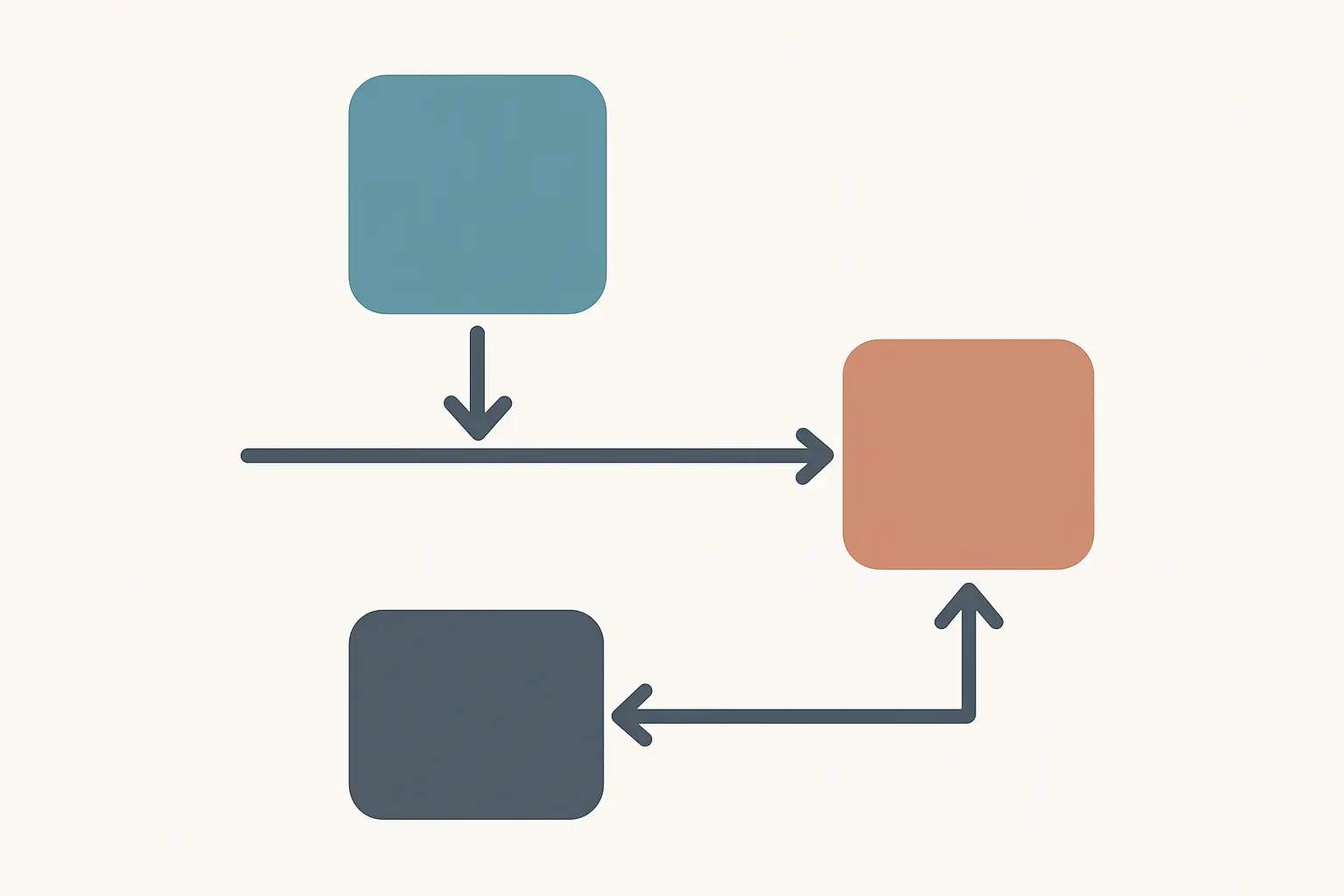
- Mediator. Sits between the independent and dependent variable, on the path. The independent variable points at it, and it points at the dependent variable. You are claiming the effect travels through it.
- Moderator. Its arrow points at the path between two other variables, not at a box. You are claiming the strength or direction of that relationship changes at different levels of the moderator.
- Control variable. Points at the dependent variable only, usually drawn with a dashed or thinner line, and is not part of any hypothesis.
A moderator drawn as an arrow into the dependent variable is the single most common diagram error, and it is a direct contradiction of the hypothesis it is supposed to represent.
How do I write the paragraph that explains the diagram?
Four sentences are enough. Name the theory and its source. State what the model proposes overall. Walk through each arrow in numbered order. Close with the boundary of the model.
Example you can adapt: “The conceptual framework for this study is grounded in the Technology Acceptance Model, which proposes that usage intention is shaped by perceived usefulness and perceived ease of use. The framework proposes that both constructs positively influence continued usage intention among undergraduate users of the campus e-learning system (H1 and H2), and that perceived ease of use also acts on intention indirectly through perceived usefulness (H3). Year of study is included as a control variable. The model is limited to individual-level perceptions and does not account for institutional factors such as mandatory usage policies.”
What do examiners flag most often?
- A diagram containing variables that are not in the objectives, or objectives with no arrow.
- A theory named once in the framework and never mentioned again in the discussion chapter.
- A borrowed diagram reproduced from another study without citation or adaptation.
- Arrows with no supporting source.
- A moderator drawn as a direct effect.
- Constructs the questionnaire does not actually measure.
- A framework in Chapter 2 that no longer matches the hypotheses tested in Chapter 4.
That last point is the expensive one. When results come in and a variable is dropped, the framework must be updated with it, and so must the abstract — the method for rewriting that summary once the numbers move is in how to write an abstract for a thesis or FYP. If you adapt a published diagram, cite it in the figure caption using the rules in what is APA 7th edition format.
Keeping the framework and the chapters in step
The framework is the one element that touches every chapter: it comes out of Chapter 2, dictates Chapter 3, is tested in Chapter 4 and is revisited in Chapter 5. When it changes — and it usually does once — every one of those places has to change with it. That is why so many students find contradictions the week before submission.
Tesify keeps your thesis chapter by chapter in one place, so a change to your variables is visible everywhere it matters instead of hiding in a file you last opened two months ago. You remain the author and are responsible for every claim, and your faculty handbook still outranks any tool.
Start building your thesis in Tesify and keep your framework and your chapters saying the same thing.
Frequently asked questions
Can a study have a conceptual framework without a theoretical framework?
Yes, and it happens often in applied and exploratory work where no single theory fits. You then justify each relationship from prior empirical findings instead of from a named theory, and you say so explicitly rather than leaving the gap unexplained.
Can I use more than one theory?
Yes, provided each one earns its place by explaining a different part of your model. Two theories used to explain the same relationship usually signals that you have not chosen.
Do qualitative studies need a conceptual framework?
Usually yes, but not as a variable diagram. It takes the form of the concepts guiding your interview protocol and analysis, and it may be revised as the study proceeds — which you should report rather than hide.
Should the conceptual framework be a diagram or text?
Both. The diagram makes the model readable in seconds; the paragraph states what it claims. Most handbooks expect the figure to carry a number and a caption.
Can I copy a conceptual framework from another study?
You can adapt one, and adapting a validated model is often viewed favourably. You must cite the source in the caption and state what you changed. Reproducing it unchanged and uncited is a citation problem, not a shortcut.
How many variables should a conceptual framework have?
Enough to answer your objectives and no more. For an undergraduate FYP, two to four independent variables and one dependent variable is a workable size; each extra variable adds items to the questionnaire and respondents to the sample.
Where do hypotheses go in relation to the framework?
Immediately after it, in the same order as the arrows. H1 should be the first arrow a reader’s eye meets on the diagram.
What is the difference between a conceptual framework and a research framework?
Many handbooks use the terms interchangeably for the same diagram. A few use “research framework” to mean the overall design flow of the study — objectives, method, analysis. Use whichever term your handbook uses, and define it once at first mention.
Can the framework change after data collection?
In quantitative work it should not, because you tested what you specified. If a variable had to be dropped for a practical reason, report the change and the reason rather than quietly redrawing the diagram.
Does the framework belong in the abstract?
Only the theory’s name, and only if there is room. The abstract’s job is problem, method, results and implications; the framework diagram itself never appears there.
What if my supervisor asks for a framework and I have no hypotheses?
Then you likely need a conceptual framework in the qualitative sense — the concepts you will look for — rather than a variable diagram. Ask which of the two they mean before drawing anything; the two are marked differently.