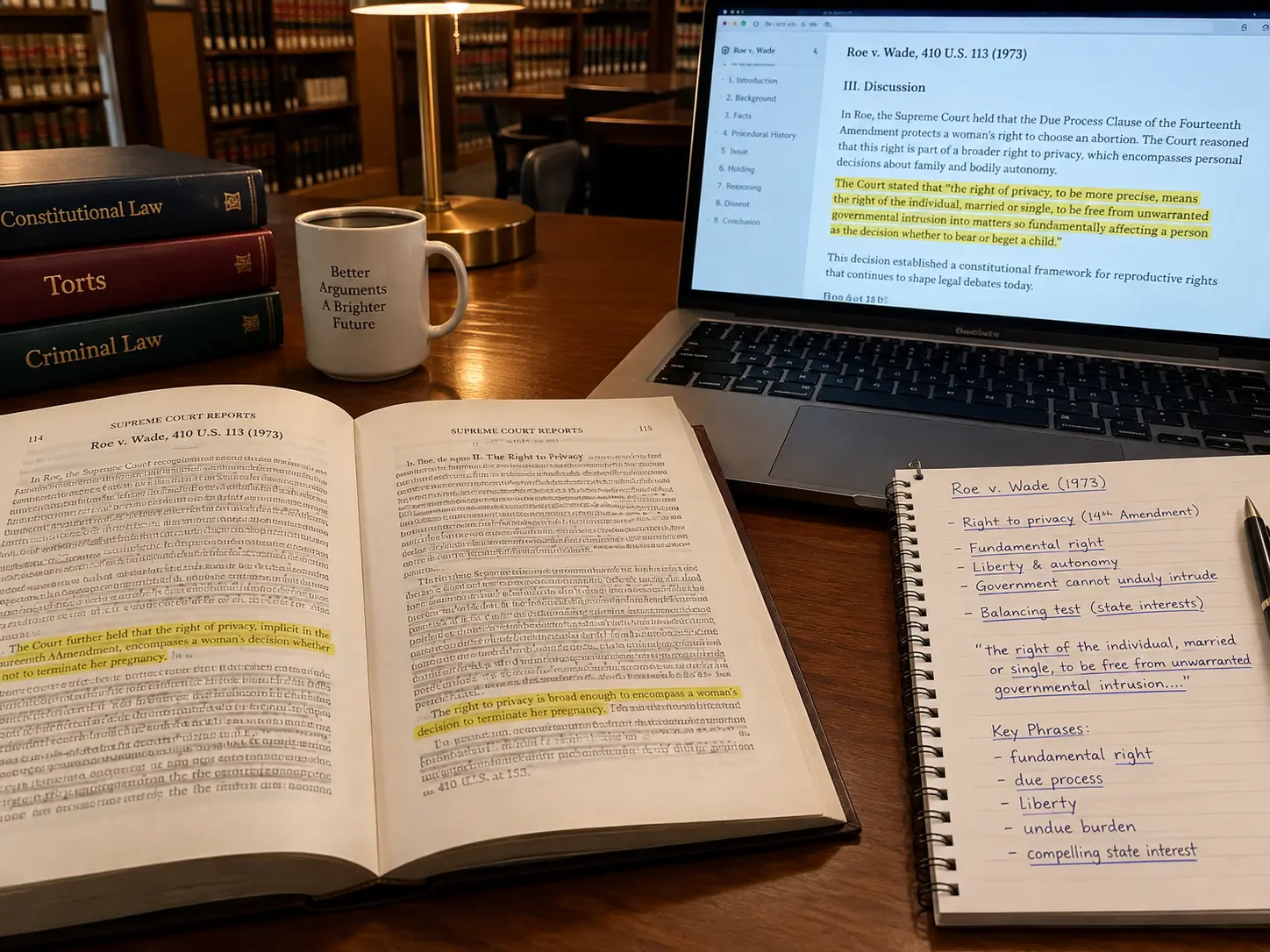
A Malaysian law dissertation can have a sound argument and still come back from a supervisor marked “language needs work” — not because the English is wrong, but because it does not read like legal writing. Legal register is a specific set of conventions: how you handle tense, voice, case names, and hedged claims. Here is how to write in it, step by step.
Step 1: Write the facts and precedent in past tense, the law itself in present tense
Legal writing keeps two tenses working side by side, and mixing them up is one of the fastest ways to sound imprecise. When you describe what happened in a case, use past tense: “The plaintiff argued that the contract was void for uncertainty.” When you state what the law currently is, switch to present tense: “The Contracts Act 1950 sets out when an agreement is a contract.” A sentence that says “the Act provided” when you mean the provision still applies today reads as though it has been repealed — examiners notice this immediately.
Step 2: Choose active or passive voice deliberately, not by habit
Legal academic writing tolerates more passive voice than most disciplines, especially in doctrinal analysis where the actor matters less than the rule (“the test was applied narrowly in three subsequent cases”). But default passive voice throughout an entire chapter reads as evasive, particularly when you are making a critical argument. When you are taking a position — arguing that a rule is wrong, outdated, or wrongly applied — active voice with a clear subject is stronger: “This dissertation argues that the current test conflates two separate concepts,” not “It is argued by this dissertation that the current test is conflated.”
Step 3: Hedge your claims the way examiners expect, not the way everyday English hedges
Legal writing has its own vocabulary for degrees of certainty, and using the wrong one changes what you are claiming. “It is submitted that” signals your own reasoned position, distinct from summarising what a court held. “Arguably” flags a genuinely contestable point, not a throwaway qualifier. “It is trite law that” should only introduce something genuinely settled and uncontroversial — using it to introduce your own contested argument is a mismatch examiners flag quickly, because you are borrowing the authority of settled law for a claim that is not settled at all. The same discipline applies to the reporting verb you choose when you summarise a case: see how reporting verbs commit you to a stance for the same logic applied outside doctrinal law.
Step 4: Format case names and statutes the way the convention requires, every time
Case names are italicised, with the parties separated by “v” (no full stop in most modern legal writing, though check your own faculty’s house style): Donoghue v Stevenson. Statutes are cited by their full short title and year on first mention — Contracts Act 1950, Evidence Act 1950 — and can be abbreviated after that. For the bibliography itself, see the reference-list conventions for Malaysian Acts and cases. For footnoted legal writing, one convention Malaysian law faculties and journals point students to is OSCOLA (the Oxford University Standard for Citation of Legal Authorities), edited by the Oxford Law Faculty and now in its fifth edition — a footnote-based system with its own rules for pinpoint references, neutral citations and law reports. Confirm which convention your own faculty requires before you commit a whole draft to one system. Pull the primary sources you are citing from a proper legal database in the first place — see the legal research databases ranked for a Malaysian law dissertation — rather than a secondary summary, since register slips are often a sign the writer is working from a case summary rather than the judgment itself.

Step 5: Use Latin terms only where they carry real precision, and gloss them on first use
Legal register still relies on a working set of Latin and law-French terms — ratio decidendi, obiter dictum, ultra vires, mens rea, actus reus, prima facie, stare decisis — because each one names a precise concept English does not have a single-word equivalent for. Use them for that precision, not to sound more formal than the sentence needs. On first use in your dissertation, gloss the term briefly in your own words; an examiner should never have to look a term up to follow your argument.
Step 6: Structure your legal argument with IRAC, and keep the structure visible
Most doctrinal chapters read more clearly when they follow Issue, Rule, Application, Conclusion (IRAC) at the paragraph or section level: state the legal question, state the rule that governs it, apply the rule to your facts or your critique, then conclude. Signal each stage with the sentence-opening phrase that matches it — “The issue is whether…”, “The applicable rule, as established in…”, “Applying this to…”, “It is submitted, therefore, that…” — so an examiner can follow your reasoning without re-reading the paragraph twice.
Step 7: Avoid contractions, rhetorical questions, and first-person “I” outside your own methodology chapter
Legal academic register avoids contractions (“does not” rather than “doesn’t”), avoids rhetorical questions used as a stylistic device, and generally keeps first-person “I” out of the doctrinal chapters — reserve it for the methodology chapter or the reflective sections where you are explicitly describing your own research choices. “This dissertation contends” or “it is submitted” carries the same meaning as “I believe” while matching the register examiners expect from a formal legal argument.
Step 8: Read a page of a real judgment aloud before you write your own analysis
The fastest way to recalibrate your ear for legal register mid-chapter is to read a page of an actual Malaysian judgment aloud — the rhythm, the hedging, the way a judge moves from stating the rule to applying it to the facts in front of them. You do not need to imitate judicial style exactly (a dissertation is analysis, not a judgment), but doing this before a long writing session resets your register faster than any style guide. A final proofreading pass — see the proofreading options available to Malaysian thesis writers — is still worth budgeting for even once your register is consistent, since register and grammar are separate problems.
One more register habit worth building early: when you paraphrase a judge’s reasoning rather than quoting it directly, attribute the reasoning explicitly to the named judge or the bench, not to the case as an abstract entity — “the learned judge reasoned that…” reads as more precise legal writing than “the case reasoned that…”, since a case itself does not reason; the people deciding it do. This distinction is small, but examiners notice it, because it signals whether you are engaging with the actual judgment or working from a headnote summary.
Step 9: See the difference in a worked before-and-after example
Here is a paragraph a first-draft chapter typically produces, followed by the same content rewritten in legal register.
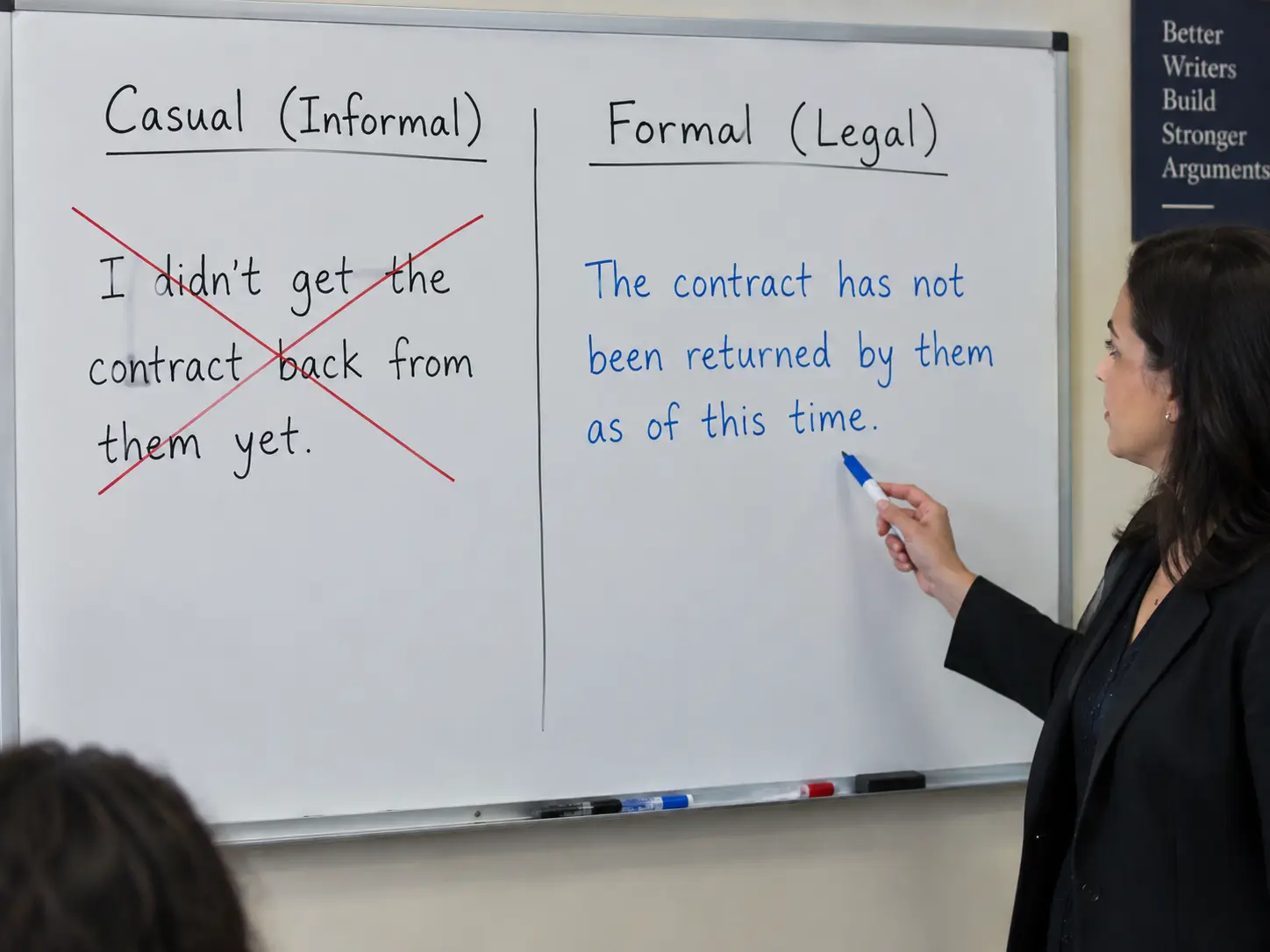
Before (mixed register): “I think the court got this wrong because they didn’t really look at what the earlier case said properly. Doesn’t the test basically ignore intention altogether? This seems like a big problem for how the law works now.”
After (legal register): “It is submitted that the court’s application of the test in this instance failed to give proper weight to the earlier authority. The test, as currently formulated, arguably omits any consideration of intention, which raises a doctrinal difficulty for its application going forward.”
Notice what changed: “I think” became “it is submitted that”; the rhetorical question became a hedged, declarative claim using “arguably”; “didn’t” and “doesn’t” lost their contractions; and “this seems like a big problem” became a specific, named claim — “a doctrinal difficulty for its application going forward” — rather than a vague expression of concern. The underlying argument is identical. Only the register changed, and that is usually the entire gap between a chapter that reads as still-a-draft and one that reads as ready for a supervisor.
Step 10: Keep your paragraph-level signposting consistent across the whole chapter
Once you have chosen your IRAC signal phrases, keep them consistent for the length of the chapter rather than varying them for the sake of variety. A reader tracking a long doctrinal argument relies on recognising “the issue is whether…”, “the applicable rule…”, “applying this to the facts…” and “it is submitted, therefore, that…” as structural markers, not as prose to be kept fresh. Varying your connective phrases mid-chapter (switching between “it is submitted”, “in my view”, “arguably”, and “one might contend” within a few pages) reads as inconsistency rather than variety, and makes it harder for an examiner to see where your own analysis begins and where you are still summarising authority.
Where Tesify fits into this workflow
Tesify helps you plan and draft a doctrinal chapter section by section, so you spend your revision time on tense, voice and hedging rather than on a blank page — every word you keep is your decision, so the argument and the writing stay 100% written by you. More than 9,000 students have used it, across 15,000+ chapters.
Frequently asked questions
What tense should I use when describing a court’s decision?
Past tense for what happened in the case and what the court held (“the court held that the duty of care did not extend to…”), and present tense for stating what the law currently is.
Should my law dissertation use passive or active voice?
Both, deliberately: passive voice suits neutral doctrinal description where the actor matters less than the rule, while active voice with a clear subject is stronger for the paragraphs where you are making your own critical argument.
What does “it is submitted that” actually signal in legal writing?
It marks the sentence as your own reasoned position, distinct from a summary of what a court or statute says — use it when you are making your own argument, not when reporting settled law.
How should I write case names?
Italicised, with the parties separated by “v”, for example Donoghue v Stevenson — confirm your own faculty’s convention on the full stop after “v”.
Which citation style do Malaysian law dissertations use?
It varies by faculty. OSCOLA (the Oxford University Standard for Citation of Legal Authorities, now in its fifth edition) is one footnote convention Malaysian law faculties point students to, alongside faculty-specific rules for the bibliography — confirm which one your own faculty requires before you commit a full draft to a single system.
Is it acceptable to use Latin legal terms in my dissertation?
Yes, where they carry precision English lacks — terms like ratio decidendi, obiter dictum or ultra vires — but gloss each one briefly on first use so an examiner does not have to look it up.
Can I use “I” in my law dissertation?
Keep first-person “I” out of your doctrinal analysis chapters; reserve it for the methodology chapter or reflective sections. Elsewhere, “this dissertation contends” or “it is submitted” carries the same meaning in the expected register.
What is IRAC and should I use it in my dissertation?
Issue, Rule, Application, Conclusion — a structure for legal argument at the paragraph or section level. Following it, with a signal phrase for each stage, makes doctrinal chapters easier for an examiner to follow.
Are contractions acceptable in a law dissertation?
No. Legal academic register avoids contractions (“does not” rather than “doesn’t”) throughout the formal chapters.
How can I tell if my writing has slipped out of legal register?
Read a page of an actual Malaysian judgment aloud, then read your own paragraph aloud immediately after — the mismatch in rhythm, hedging and formality is usually obvious once you hear the two back to back.
What is the difference between “it is submitted that” and “it is trite law that”?
“It is submitted that” introduces your own reasoned argument; “it is trite law that” should only introduce something genuinely settled and uncontroversial — using the second phrase to introduce a contested claim borrows authority the claim does not actually have.
Should I vary my signal phrases (issue, rule, application, conclusion) for style?
No. Keep the same signal phrases consistent across a chapter so a reader can track your structure; varying them for stylistic freshness makes the argument harder to follow, not more engaging.