
A marketing FYP proposal needs nine parts: title, background, problem statement, objectives and research questions, a conceptual framework naming a real model, significance, scope, a methodology outline with a named design, and a reference list in APA 7th edition. Below is a fully worked example built on those nine parts.
What Makes a Marketing Thesis Proposal Different From a Generic One?
A generic proposal guide teaches you the shape of the document: eight steps, a mirror test between objectives and questions, six reasons committees send proposals back. What it cannot give you is the content a marketing examiner is actually scanning for on page one — a named theoretical model, a construct that can be measured, and a Malaysian market context that makes the gap real rather than borrowed from an overseas textbook example. If your proposal names no model and measures no construct, it reads as a business idea, not a marketing thesis.
Marketing proposals fail more often on construct vagueness than on formatting. “Social media marketing effectiveness” is not a construct; “purchase intention,” “brand trust,” and “electronic word-of-mouth (eWOM) credibility” are. Every marketing proposal your supervisor approves will have swapped a vague theme for two or three named, measurable constructs before Chapter 1 is finished.
The Nine Sections a Marketing FYP Proposal Needs
- Working title — states the independent and dependent constructs and the population, e.g. “The Effect of Influencer Credibility on Purchase Intention Among Malaysian Gen Z Consumers.”
- Background of study — the industry or market context (a real Malaysian retail, e-commerce, or brand category), narrowed to the specific behaviour you are studying.
- Problem statement — the documented gap: either a practical problem (declining engagement, brand switching, low conversion) or a theoretical gap (a model tested overseas but not in a Malaysian or ASEAN retail context).
- Research objectives and questions — three to four objectives, each with one matching question, written as a mirror pair.
- Conceptual framework — one named theory or model with your constructs mapped onto its boxes (see the framework options below).
- Significance of study — who uses the finding: a brand manager, a public agency, or the next researcher in the same sub-field.
- Scope and limitations — the market segment, region, and time window your findings can honestly speak to.
- Proposed methodology — quantitative survey, qualitative interview, or mixed method, with the population and an instrument named.
- Preliminary references — 15 to 20 sources in APA 7th edition, at least half from the last five years.
A Fully Worked Example: Influencer Credibility and Purchase Intention Among Malaysian Gen Z Consumers
The example below is written to the depth a supervisor expects at proposal defence, not as a template to copy verbatim — swap the constructs and context for your own sub-field using the pattern.
Working Title
“The Effect of Social Media Influencer Credibility on Purchase Intention Among Malaysian Gen Z Consumers: The Mediating Role of Brand Trust.”
Background and Problem Statement
Malaysian brands increasingly allocate marketing budgets to social media influencers rather than traditional celebrity endorsement, yet campaign briefs rarely specify which dimension of an influencer’s credibility — expertise, trustworthiness, or attractiveness — actually drives the purchase decision. Most published credibility research uses Western or East Asian samples; a replication in a Malaysian Gen Z sample is the gap this study addresses. The problem in one sentence: brands cannot optimise influencer selection when the credibility-to-purchase-intention pathway has not been tested on their own market’s youngest consumer segment.
Objectives and Research Questions (mirror pairs)
- Objective 1: To examine the relationship between influencer credibility and purchase intention among Malaysian Gen Z consumers.
Question 1: Is there a significant relationship between influencer credibility and purchase intention among Malaysian Gen Z consumers? - Objective 2: To determine which dimension of influencer credibility (expertise, trustworthiness, attractiveness) most strongly predicts purchase intention.
Question 2: Which dimension of influencer credibility most strongly predicts purchase intention? - Objective 3: To examine whether brand trust mediates the relationship between influencer credibility and purchase intention.
Question 3: Does brand trust mediate the relationship between influencer credibility and purchase intention?
Conceptual Framework
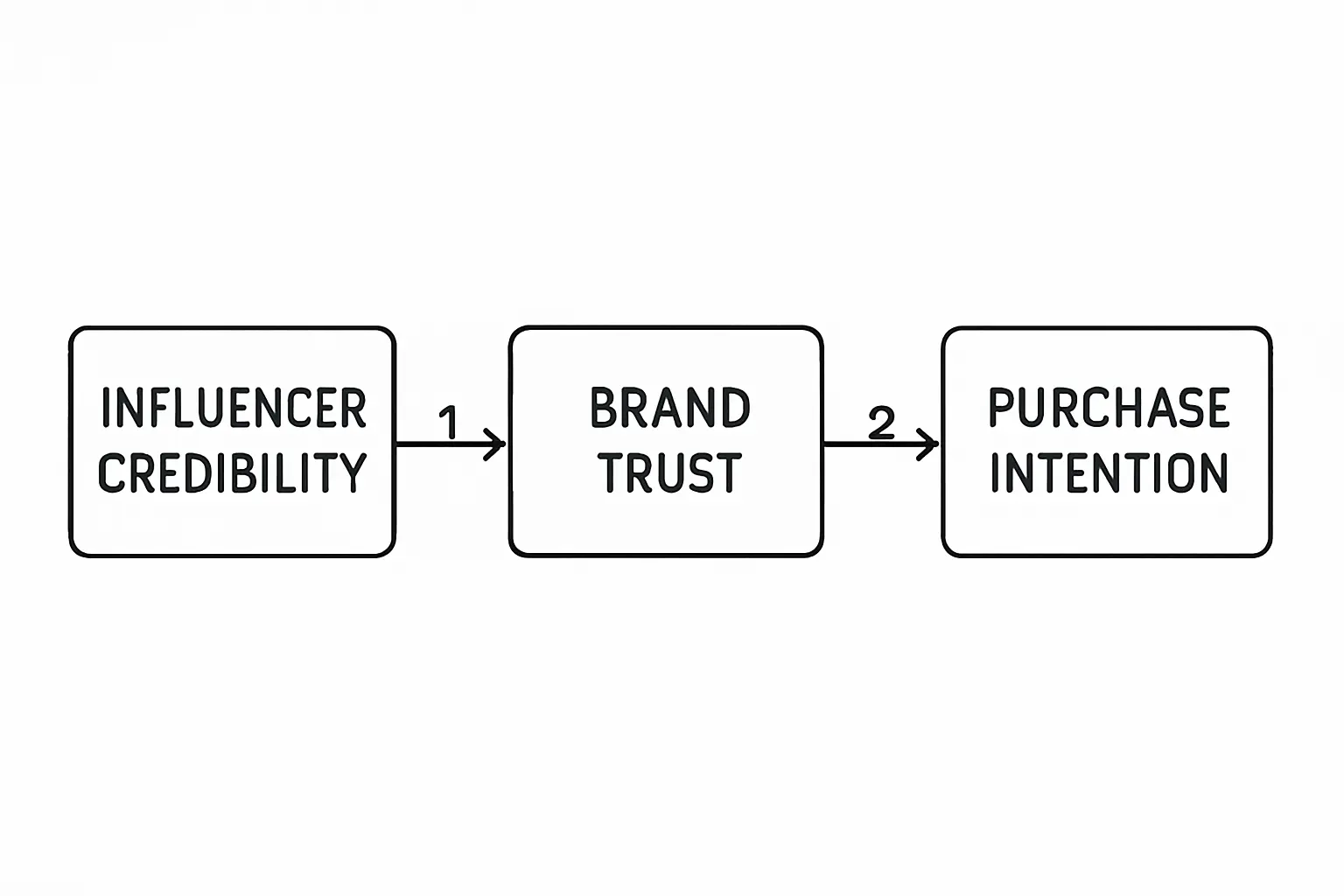
Built on the Source Credibility Model (Hovland, Janis & Kelley, 1953; operationalised for influencer marketing by Ohanian’s 1990 scale of expertise, trustworthiness and attractiveness), with the Elaboration Likelihood Model explaining how a peripheral cue (the influencer) can shift attitudes, and brand trust added as the mediating construct between that cue and the outcome (purchase intention). Three boxes: Influencer Credibility (independent, three sub-dimensions) → Brand Trust (mediator) → Purchase Intention (dependent), with three numbered arrows matching the three objectives above. This differs from a theoretical-framework FAQ answer in one respect: a proposal only needs the framework drawn and justified, not yet tested — the full argument for why this model fits your field belongs in Chapter 2.
Significance, Scope and Methodology
Significance: brand managers get an evidence-based answer to which credibility dimension to brief influencers on; the discipline gets a Malaysian Gen Z data point in a literature dominated by Western and East Asian samples. Scope: Malaysian consumers aged 18–24 who follow at least one lifestyle or beauty influencer on Instagram or TikTok, surveyed within one state or region — stated honestly as a limitation on generalisability, not hidden. Methodology: a quantitative cross-sectional survey using Ohanian’s (1990) 15-item source credibility scale, an adapted brand trust scale, and a purchase intention scale, distributed to a purposive sample of 200–250 respondents via an online panel, analysed with PLS-SEM for the mediation test.
How the Proposal Changes Across Marketing Sub-Fields
“Marketing” is too broad a label for a proposal — examiners expect the sub-field to shape every section below the title.
- Digital / social media marketing — constructs like eWOM, engagement rate, and platform-specific behaviour; data usually primary (survey or platform analytics with permission).
- Retail and consumer behaviour — store environment, impulse buying, loyalty programme constructs; often mixed with observational or intercept survey methods.
- Services marketing — the SERVQUAL gaps model (reliability, responsiveness, assurance, empathy, tangibles) replaces the credibility model above as the natural framework anchor.
- B2B / industrial marketing — relationship marketing and buyer-seller trust constructs; the population is procurement or purchasing managers, not consumers, which changes the whole sampling section.
- Social marketing / CSR — behaviour-change constructs (attitude, subjective norm, perceived behavioural control from the Theory of Planned Behaviour) rather than purchase intention; the “purchase” outcome becomes a health, environmental, or civic behaviour instead.
Where to Find Literature and Data for a Malaysian Marketing Proposal
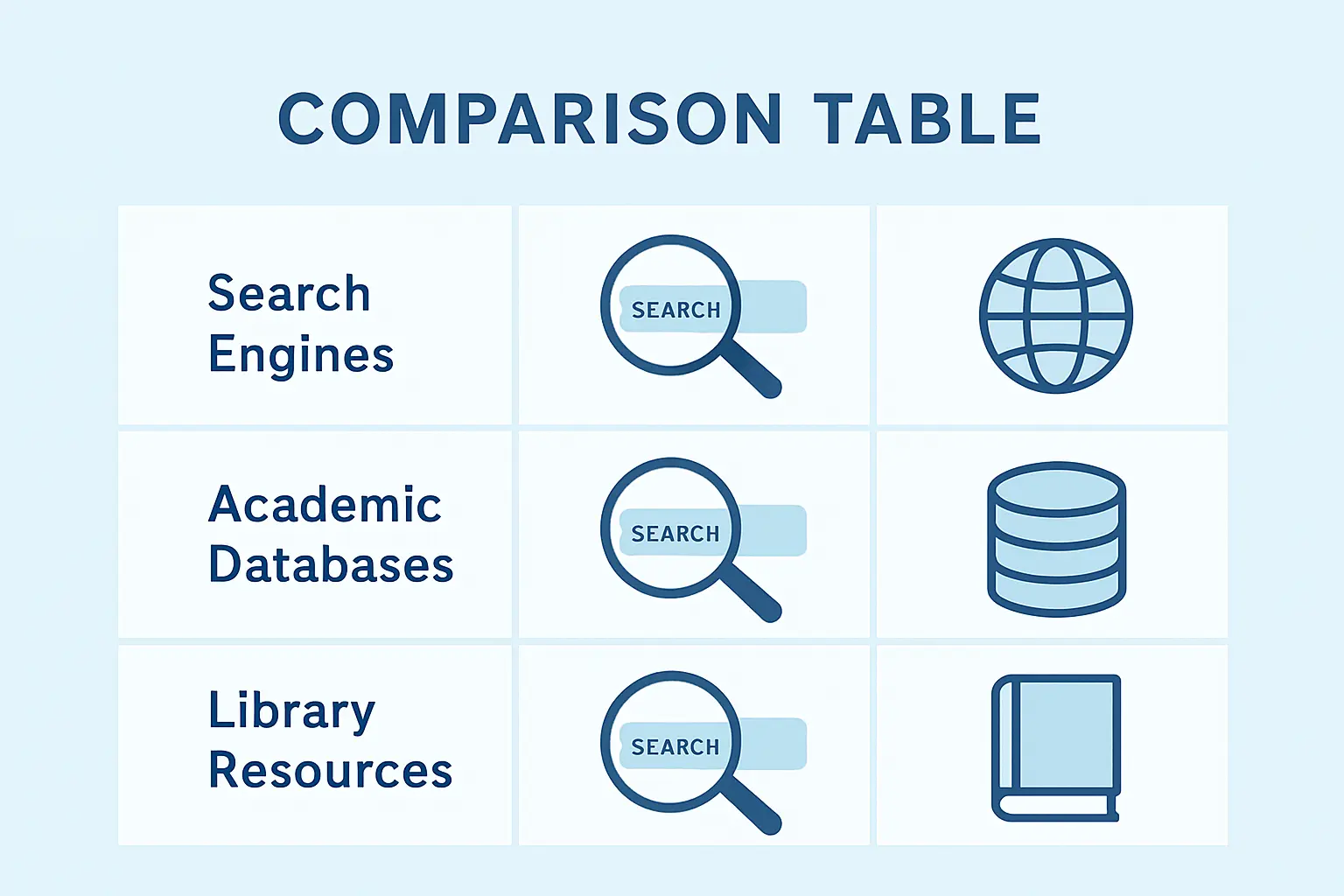
Many Malaysian university libraries subscribe to databases such as Emerald Insight, ScienceDirect or EBSCO Business Source Complete (check your own library’s list) — search these for the named theory (“source credibility model” or “SERVQUAL”) plus “Malaysia” or “ASEAN” to find the closest prior study your proposal is extending or contradicting. Google Scholar is useful for a first scan but check that anything it surfaces is peer-reviewed before citing it in the literature-gap paragraph. For market-level context rather than academic sources, the Department of Statistics Malaysia’s ICT Use and Access by Individuals and Households survey reports (published on dosm.gov.my), and MDEC’s digital economy publications, can give citable context figures without needing a paid data vendor — read the methodology note on each release before quoting a figure, since sample frames differ between surveys.
A short table like the one below, placed at the end of the background section, shows an examiner you searched systematically rather than citing whatever came up first:
| Search terms | Database | What you are checking for |
|---|---|---|
| “influencer credibility” AND purchase intention | Emerald Insight / ScienceDirect | The closest non-Malaysian study using your framework |
| “eWOM” OR “influencer marketing” AND Malaysia | Google Scholar | Any Malaysian replication already published — your gap disappears if one exists |
| social commerce OR digital advertising | DOSM / MDEC | Citable market-level context figures, with their source year noted |
Five Reasons Marketing Proposals Get Sent Back
- The title names a topic (“social media marketing in Malaysia”) instead of a relationship between two named constructs.
- The conceptual framework box diagram is missing or names a theory without showing which construct sits in which box.
- The objectives and questions do not mirror each other one-to-one.
- The population is defined too broadly (“Malaysian consumers”) for the sample size and access the student actually has.
- No instrument is named — “a questionnaire will be developed” without saying which validated scale it is adapted from.
Frequently Asked Questions
Do I need primary data for a marketing FYP proposal?
Most Malaysian undergraduate marketing FYPs use primary survey data because published Malaysian market datasets at the brand or campaign level rarely exist publicly; secondary data (company reports, industry statistics) is more common as supporting context than as the main dataset.
Can I combine two theories in one conceptual framework?
Yes, as long as each theory contributes a distinct, clearly labelled construct rather than two competing explanations of the same box — the worked example above combines the Source Credibility Model and a mediating brand-trust construct rather than treating them as rivals.
How many constructs is too many for an undergraduate proposal?
Three to four is the practical ceiling for a one- or two-semester undergraduate timeline with PLS-SEM or regression; more than that usually means the topic needs narrowing, not a bigger questionnaire.
Does the proposal need a hypothesis or just a question?
Quantitative marketing proposals normally state both: the research question in words and a directional hypothesis (e.g. “H1: Influencer credibility has a significant positive effect on purchase intention”) that Chapter 3 will test statistically.
What is the most common mistake in the significance section?
Writing significance only for “future researchers” — examiners want a named practical beneficiary (a brand, an agency, a regulator) as well as an academic one.
Should the proposal cite Malaysian consumer protection law?
Only if your topic touches advertising claims or data collection directly; most consumer-behaviour proposals do not need it, but a study on influencer marketing disclosure practices should reference the advertising provisions (Part 3) of the Malaysian Communications and Multimedia Content Code 2022 in the background section.
Can qualitative interviews replace the survey in this example?
Yes — a qualitative version would keep the same three constructs but restructure objectives around “exploring how” rather than “testing whether,” use semi-structured interviews with 10–15 brand managers or consumers, and analyse with thematic analysis instead of PLS-SEM.
How long should the proposal be before the defence?
Length is set by each faculty, so check your programme’s guidelines; a proposal typically covers Chapters 1–3 in draft form (background through proposed methodology), not the full thesis.
Is it acceptable to study a single brand rather than a whole industry?
Yes, and a single-brand case is often stronger for an undergraduate timeline because access, respondent recruitment, and scope are all easier to defend — state clearly in the limitations section that findings describe that brand’s customer base and should not be generalised to the category as a whole.
What software should the methodology section name?
Name the actual tool you will use for analysis — SPSS for basic descriptive and inferential statistics, or SmartPLS/AMOS if the design is a mediation or moderation model tested with structural equation modelling, as in the worked example above — rather than leaving the software unnamed until Chapter 3.
Tesify can turn this nine-section structure into a first full draft in your own voice, built from your chosen constructs and context rather than a generic template — you still supervise every claim it makes. Start your proposal draft with Tesify.
For the generic eight-step version of this document, see how to write a thesis proposal for a Malaysian FYP or postgraduate programme. For the problem-statement formula behind step three above, see how to write a problem statement for research. For the difference between a conceptual framework and a theoretical framework used in step five, see theoretical framework vs conceptual framework. For building the survey instrument named in the methodology section, see how to design a questionnaire for your FYP. For working out how many of the 200–250 respondents above you actually need, see how many respondents do I need for my FYP or thesis.