Universiti Malaya’s Faculty of Education publishes its own formatting, submission and publication rules for the research reports, dissertations and theses of its postgraduate students. The current document is the Guidelines for the Preparation of Research Report, Dissertation and Thesis, Edited Version 2022, and the faculty states plainly that “the rules and format in this document need to be strictly adhered to.” Below is what it actually requires, step by step, so you format your document once instead of reformatting it after a rejected submission.
Step 1: Confirm which of the three document types applies to you
The guideline defines three separate document types, and the rules that follow (word limit, binding colour, publication requirement) differ by which one you are writing:
- Research Report — submitted for the award of a Master’s Degree by Coursework.
- Dissertation — submitted for a Master’s Degree by Research or Master’s Degree by Mixed Mode.
- Thesis — submitted for a Doctoral Degree by Research or Doctoral Degree by Mixed Mode.
Check your offer letter or programme structure against this list before you open a template — if the general distinction is still unclear, see what actually separates an FYP, a thesis and a dissertation in Malaysia — a Mixed Mode master’s candidate, for example, is writing a dissertation under this guideline, not a “thesis,” and that label decides which binding colour and word-limit row apply to you later.
Step 2: Hit the word-limit band for your specific programme, not a generic “80,000 words” figure
The faculty sets eight separate word-limit ranges, one per document type and credit-hour load, and the limit includes footnotes, references, tables, figures and preliminaries — not just your running chapter text.
| Document type | Word limit range |
|---|---|
| Research report (12 credit hours) | 14,000–17,000 |
| Research report (15 credit hours) | 17,000–20,000 |
| Master’s dissertation, Mixed Mode (24 credit hours) | 20,000–25,000 |
| Master’s dissertation, Mixed Mode (30 credit hours) | 25,000–30,000 |
| Master’s dissertation, Mixed Mode (40 credit hours) | 30,000–40,000 |
| Master’s dissertation, Research Mode | 40,000–60,000 |
| PhD thesis, Mixed Mode | 60,000–80,000 |
| PhD thesis, Research Mode | 80,000–100,000 |
The guideline explains that the maximum word limits for the last four rows follow the maximum set by AASC, and that the 80,000-word minimum for a Research Mode PhD is a Malaysian Qualifications Agency (MQA) requirement, not a faculty preference — so a PhD thesis in Research Mode that comes in under 80,000 words is not just “shorter,” it is below a national qualifications-agency threshold. If your complete draft is genuinely going to exceed your row’s upper limit, apply to the Dean of Faculty at least one month before submission and state your reason in writing; do not submit over the limit and hope it passes.
Step 3: Type and space the document the way the guideline specifies
Use Times New Roman, font size 12, justified alignment, in Microsoft Word or similar software (a thesis written in Arabic uses Traditional Arabic, font size 16, instead). Any word in a language different from your document’s main language — an English methodology term dropped into a Bahasa Melayu chapter, for instance — must be italicised. For mathematical text the guideline advises Equation Editor or LaTeX, and script fonts are not permitted anywhere in the document.
Double-space the entire text, including your abstract. Switch to single-spacing only for long tables, direct quotations, footnotes and reference-list entries. Print single-sided, on one side of the paper only, using a laser printer for a clean, legible copy.
Step 4: Set your margins and don’t indent paragraphs
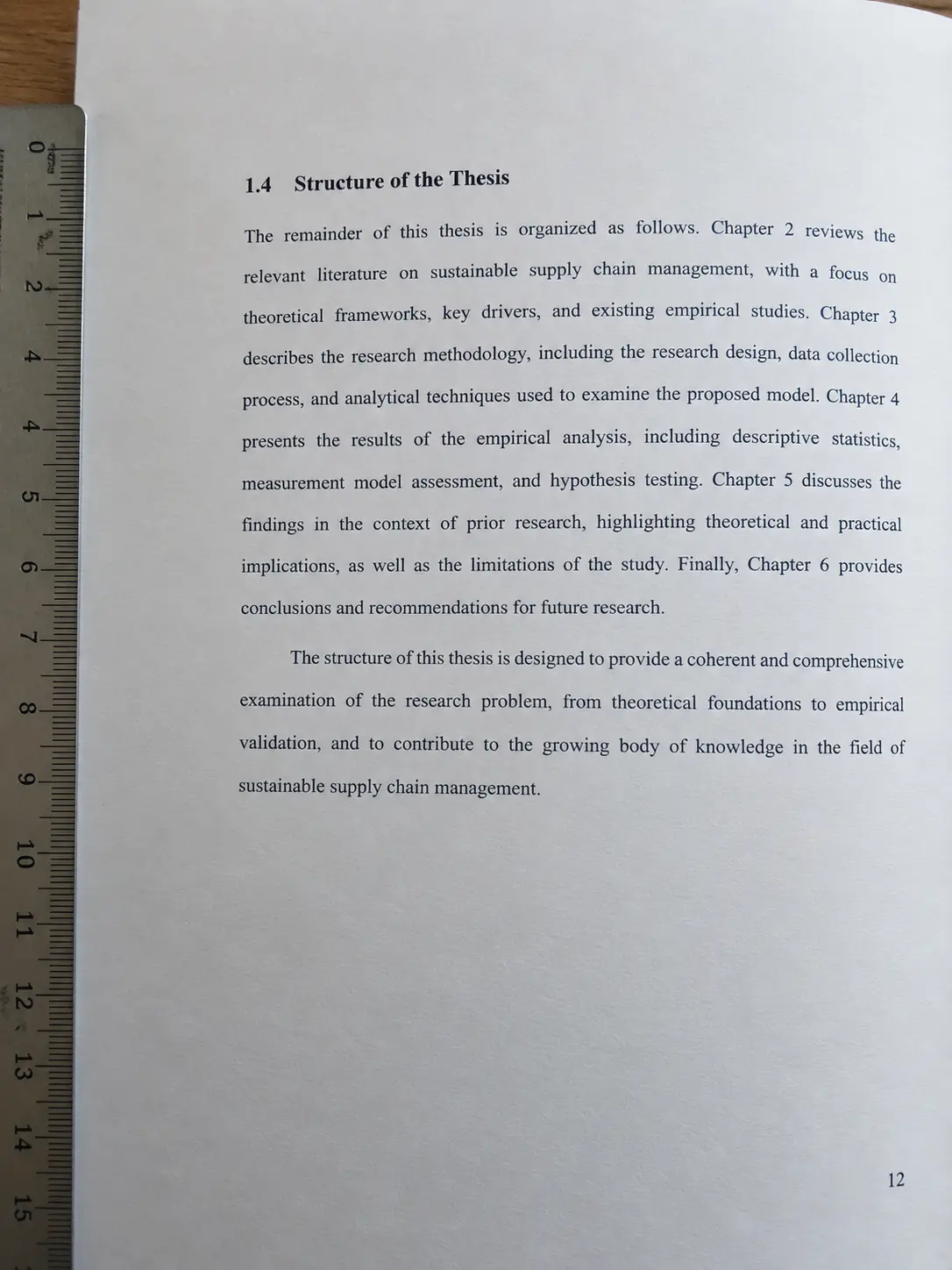
The stipulated margins are top 2.0 cm, right 2.0 cm, bottom 2.0 cm, and left (binding side) 4.0 cm. A few rules attach to this: typing should not run more than one line below the bottom margin except to finish a footnote or the last line of a chapter; every table and figure, including its caption, must stay inside these margins; a new paragraph starting at the bottom of a page needs at least two full lines of text or it moves to the next page; leave two double-spacings between paragraphs; and use justified alignment without indenting the first word of a new paragraph — a formatting habit many students carry over from other guides and have to strip out.
Step 5: Get your pagination sequence right
All page numbers sit 1.0 cm from the bottom edge, right-hand side, without punctuation, in Times New Roman 10. Two separate numbering sequences apply:
- The Preliminaries — title page, Original Literary Work Declaration, abstract (see how to structure a thesis abstract), acknowledgement, table of contents, list of tables, list of figures, list of abbreviations — are numbered in lower-case Roman numerals (i, ii, iii…). The title page counts as page i, but the number is not printed on it; “ii” is the first Roman numeral that actually appears, on the page right after the title page.
- The whole Main Text (every chapter plus your references) and the Supplementaries (appendices and your list of publications) are numbered consecutively in Arabic numerals, starting at 1 on the first page of Chapter 1.
Step 6: Match your binding and cover to your document type
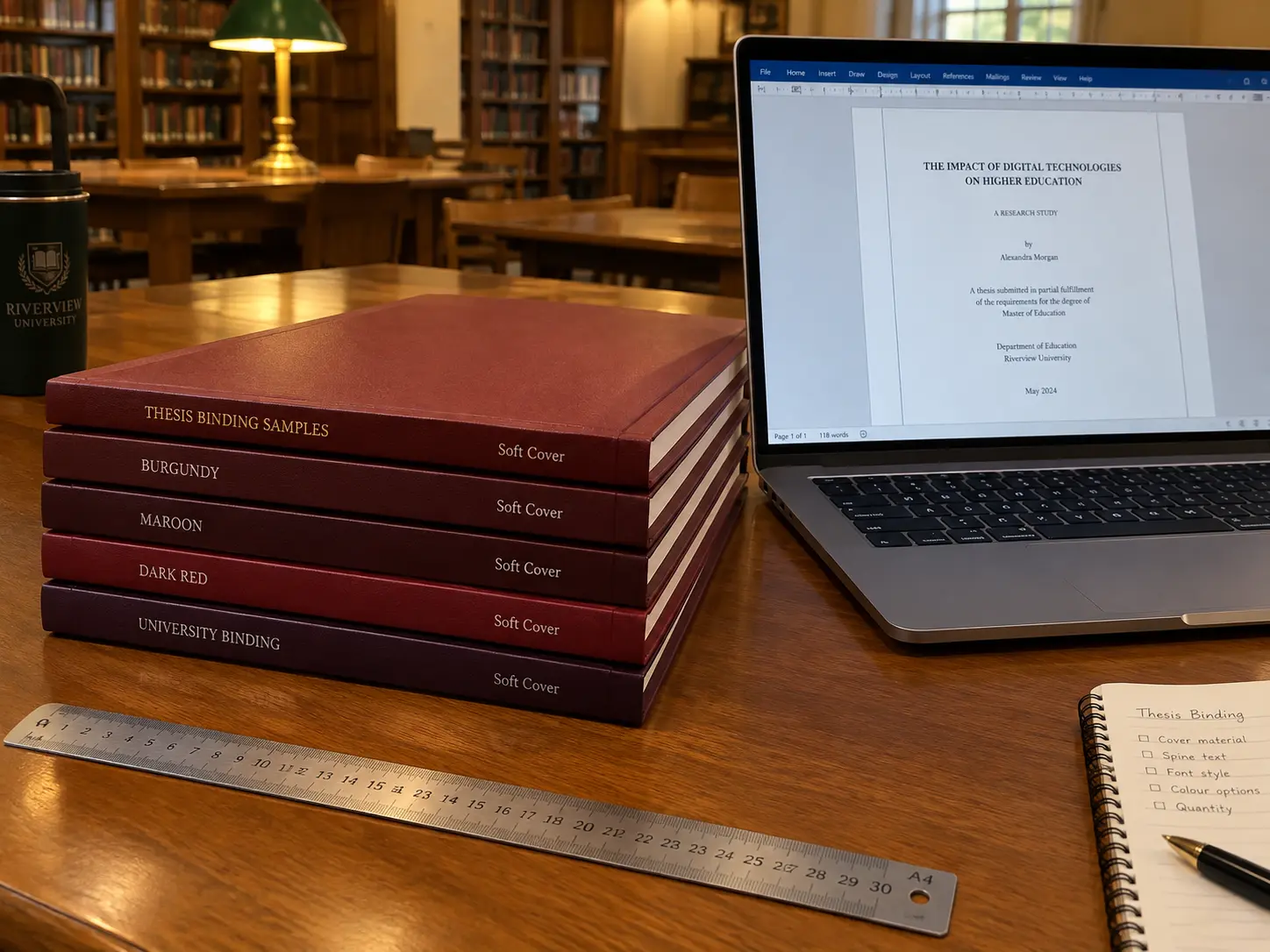
A completed research report, dissertation or thesis is bound in one volume; a second volume needs the faculty’s special permission. For examination, submit a soft-cover rexine copy in the colour that matches your document type: ocean blue or light bright blue for a research report, dark red or maroon for a dissertation or thesis. After you pass and complete corrections, the final copy for graduation is hard-cover rexine in the same colour. The cover itself must be A4 size, and the title, your name, the university’s name and the year of submission are printed in gold block on the front cover, in Arial Narrow, font size 16, bold, uppercase. The spine repeats the title, your name, year of submission and the name of your degree.
Step 7: Run Turnitin before you submit, and know the threshold
The faculty requires the use of Turnitin and sets a specific ceiling: the similarity index for a research report, dissertation or thesis should be equal to or less than 15% (≤15%). Compare that with the general picture in what similarity percentage is acceptable in Turnitin, and do not assume a threshold you saw quoted for a different faculty or university applies to you — this figure is the one written into the Faculty of Education guideline. Candidates are also directed to a separate resource, “How to Avoid Plagiarism: A Handbook for Postgraduate Students,” for the fuller rules on what counts as plagiarism in the first place, including the narrower question of whether reusing your own earlier proposal counts as self-plagiarism.

Step 8: Plan for the publication requirement early, not in your final semester
If you are a Master’s (Research Mode) or PhD candidate, the faculty requires you to publish a research article or review article — and this is a step students can discover too late. The article must appear in one of these indexes or categories:
- Web of Science (WoS) Core Collection — Science Citation Index Expanded, Social Sciences Citation Index, or Arts & Humanities Citation Index
- Scopus
- Malaysian Citation Index (MyCite)
- A journal the faculty separately recognises, subject to any conditions stated in your own offer letter
A few rules govern authorship and timing: you must be the first author, with your supervisor(s) as co-author (a supervisor can be the corresponding author for a journal article); you need your supervisor’s consent, evidenced by a publisher verification, letter or email; the publication has to be accepted within your candidature period; its topic has to conform to your actual thesis research; and it must carry the affiliation of the department and/or faculty where you are registered. Publications in journals the Ministry of Higher Education (MOHE) has blacklisted are not accepted — the guideline names Academic Journal (academicjournals.org), Euro Journal Inc, Common Ground Publishing, Africa World Press Inc, and journals on Beall’s List of probable predatory journals, noting this list changes from time to time. Candidates who have completed their examination must meet the publication requirement before their maximum candidature period expires, and the guideline states plainly that those who do not will be terminated from the programme and considered failed — which is why this step belongs on your Year 1 planning table, not your final-semester checklist.
Step 9: Assemble the right documents and go through the MAYA portal
Before you submit — and ideally from the proposal stage onwards, see how to write a thesis proposal for a Malaysian FYP or postgraduate programme — plan for sign-off from your supervisor(s) and the faculty through MAYA before online submission; this is what lets the faculty nominate your examiners in time. You can only submit for examination within your candidature period and after the faculty has approved your title. The guideline also warns candidates directly against copying another student’s previously submitted formatting, since older submissions may not match the current requirements — and a document that fails the formatting requirements may be rejected at the point of submission, before an examiner ever reads it.
For examination, submit to the faculty’s Postgraduate Officer: at least two printed softbound or comb-bound copies (or the number your faculty specifies), one electronic PDF copy, and the Submission of Thesis/Dissertation for Examination/Re-examination form. After your corrections are approved, final submission for graduation needs at least one printed hardbound copy, one electronic PDF copy, the Final Submission form, the Repository Policy for Universiti Malaya Postgraduate Theses/Dissertation/Research Reports form, and a Correction Report form if you had corrections. The guideline points to the MAYA portal for downloading all of these forms.
Where Tesify fits into this workflow
Tesify helps you plan and draft each chapter in the order this guideline expects, with the drafting and editing staying entirely under your control, so the document you submit is still 100% written by you. More than 9,000 students have used it, across 15,000+ chapters. Formatting, the Turnitin run and the final checks against the faculty guideline stay your job; Tesify helps you get the words onto the page in time to do them properly.
Frequently asked questions
Does this guideline apply to undergraduate FYP students at Universiti Malaya?
No. This specific document governs postgraduate candidates in the Faculty of Education submitting a research report, dissertation or thesis — undergraduate final year projects follow a separate faculty or programme guide.
What is the actual difference between a research report, a dissertation and a thesis under this guideline?
A research report is for a Master’s by Coursework, a dissertation is for a Master’s by Research or Mixed Mode, and a thesis is for a Doctoral degree by Research or Mixed Mode — the label follows your degree type and mode, not the length of what you write.
What word limit applies to my dissertation or thesis?
It depends on your exact document type and credit-hour load — the guideline sets eight separate ranges from 14,000 words (a 12-credit-hour research report) up to 100,000 words (a Research Mode PhD thesis), and the count includes footnotes, references, tables, figures and preliminaries.
Can I submit a dissertation or thesis that goes over the word limit?
Only with prior approval. You must apply to the Dean of Faculty at least one month before submission and explain why you cannot meet the prescribed limit.
What font, size and spacing does the Faculty of Education require?
Times New Roman, font size 12 (tables and figures excepted), justified, double-spaced throughout including the abstract, with single-spacing reserved for long tables, quotations, footnotes and reference entries.
What are the margin requirements?
Top, right and bottom margins are 2.0 cm each, and the left (binding) margin is 4.0 cm, with tables and figures required to stay inside these margins as well.
What Turnitin similarity percentage is acceptable for a Faculty of Education thesis?
The faculty guideline sets a similarity index of 15% or lower (≤15%) for a research report, dissertation or thesis.
Do I have to publish a journal article before I can graduate?
Yes, if you are a Master’s (Research Mode) or PhD candidate. You need a research or review article in a Web of Science Core Collection index, Scopus, MyCite, or a faculty-recognised journal, as first author and accepted within your candidature, and the requirement must be met before your maximum candidature period expires.
What happens if I don’t meet the publication requirement in time?
The guideline states that candidates who do not fulfil the publication requirement within the approved period will be terminated from the programme and considered to have failed.
What colour should my binding be?
Research reports use ocean blue or light bright blue soft-cover rexine for examination and hard-cover rexine (same colours) for final submission; dissertations and theses use dark red or maroon for both stages.
What documents do I need to submit for examination versus final graduation?
For examination: at least two softbound or comb-bound copies, one electronic PDF, and the Submission for Examination/Re-examination form. For final submission after corrections: at least one hardbound copy, one electronic PDF, the Final Submission form, the Repository Policy form, and a Correction Report form if applicable.
Where do I get the official forms and submit everything?
The guideline points to the MAYA portal for all required forms, and supervisor and faculty approval for submission also goes through MAYA before your examiners can be nominated.