| Source | What it actually gives you | Access | Best for |
|---|---|---|---|
| MDA — Malaysia Medical Device Register (MMDR) | Searchable register of registered medical devices, registered Conformity Assessment Bodies (CABs) and licensed establishments under the Medical Device Act 2012 (Act 737) | Free public search at mmdr.mda.gov.my | Device classification examples, regulatory pathway background, and device-category counts for a device-design or regulatory-focused FYP |
| NMRR — National Medical Research Register | The Ministry of Health’s registry and submission gateway for medical and health research, including studies involving Ministry of Health facilities, personnel, or funding | Public research directory at nmrr.gov.my | Finding examples of registered biomedical/clinical device studies and the ethics-approval route (via MREC) they went through |
| KKMNOW (data.moh.gov.my) | Ministry of Health dashboards and datasets such as blood donations, organ donation pledges, Peka B40 screenings, hospital and ICU bed utilisation, and COVID-19 surveillance | Free, browsable dashboards and data catalogue | National health-system context for a background section, not device-specific engineering data |
Why Biomedical Engineering Has No Single “Data Source” the Way Some Fields Do
Biomedical engineering FYPs split across at least three different kinds of work — designing or prototyping a device, evaluating an existing device’s performance, and researching regulatory or health-system context — and each kind draws on a different official source. A student searching for one central “biomedical engineering data Malaysia” portal will not find one, because the three sources above serve three different purposes: MDA’s register tells you what devices are legally on the Malaysian market and how they are classified; NMRR tells you what medical research is registered and going through ethics review; KKMNOW tells you about the health system those devices operate within. Most biomedical engineering FYPs need only one or two of the three, depending on whether the project is design-based, evaluation-based, or context-based.
MDA’s Medical Device Register: What You Can Actually Verify
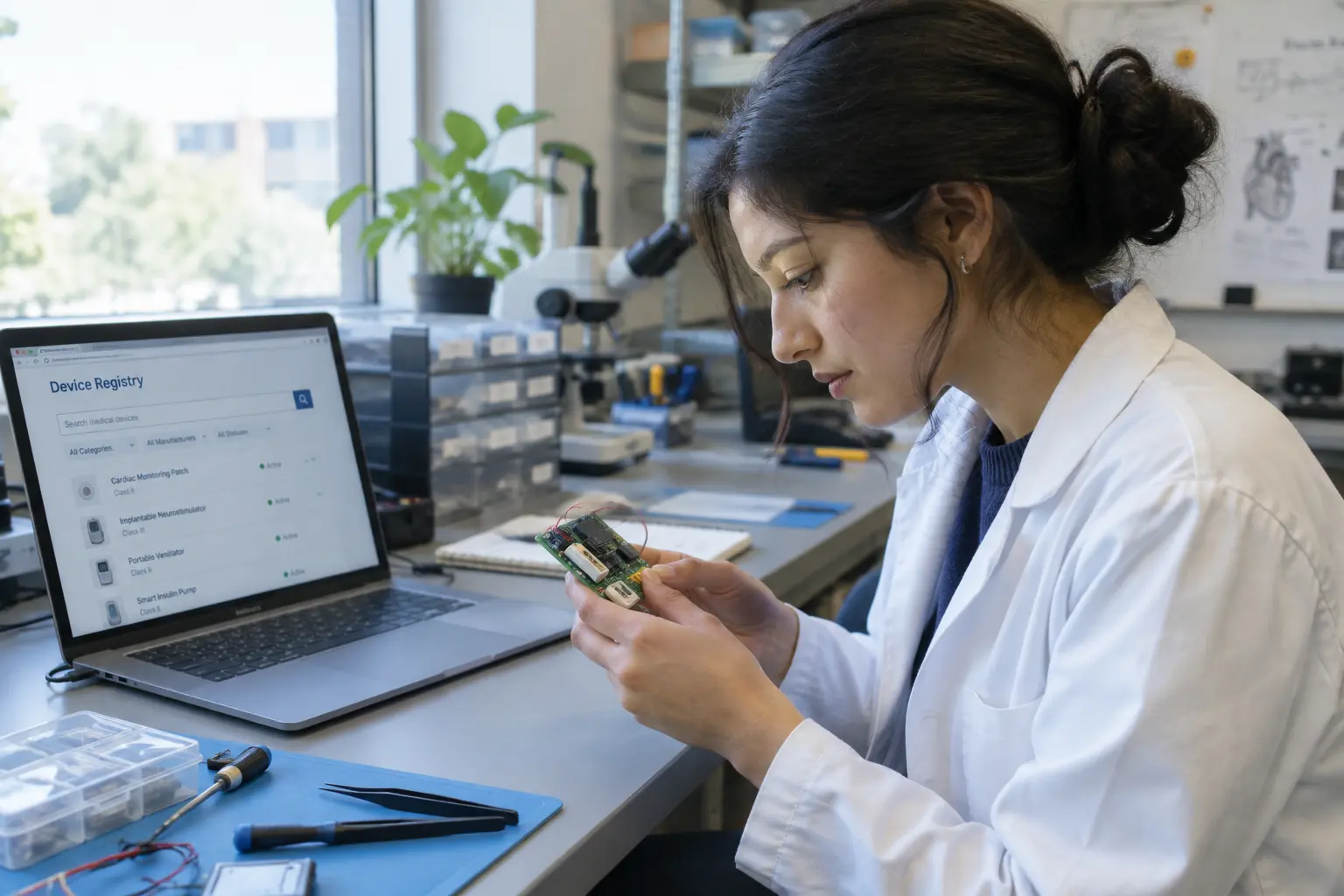
The Medical Device Authority’s public search system, the Malaysia Medical Device Register (MMDR), lets you search for registered medical devices, registered Conformity Assessment Bodies, and licensed establishments under Sections 5, 10 and 15 of the Medical Device Act 2012 (Act 737) respectively, plus notified medical devices under the Medical Device (Exemption) Order 2016. This is genuinely useful for a biomedical engineering FYP that needs real examples of how a specific device category is classified and registered in Malaysia, or that wants to verify whether a comparable device to the one being designed is already registered and under what device class. It is a regulatory register, not a technical specifications database — do not expect engineering drawings or performance data from it, only registration status, class, and the registered establishment.

NMRR: Where Registered Medical and Device Research Lives
The National Medical Research Register is the Ministry of Health’s registration and submission gateway for medical and health-related research, including research involving Ministry of Health facilities, personnel, or funding. Its public research directory lets you search for registered studies, which is useful for a biomedical engineering FYP that wants to find comparable registered research (for example, a clinical evaluation of a similar device) and see how those studies describe their ethics-approval route — typically through the Medical Research and Ethics Committee (MREC) for Ministry of Health-linked research. If your own biomedical engineering project involves testing a device on human participants or with patient data from a Ministry of Health facility, NMRR registration and MREC approval are very likely part of your own required process, not just a reference source.

KKMNOW: Context, Not Device Data
The Ministry of Health’s KKMNOW open data initiative, hosted at data.moh.gov.my, publishes national health dashboards and datasets — blood donation activity, organ donation pledges, Peka B40 health screenings, hospital and ICU bed utilisation, and COVID-19 surveillance, among others. These are health-system datasets, not data about medical devices or biomedical engineering outputs; treat the portal as background context for a health-system rationale section (for example, motivating why a specific screening device matters given national screening activity), not as a source for device-specific engineering data.
Matching the Source to Your Specific Biomedical Engineering FYP Type
- Device design or prototyping FYPs — use MDA’s register mainly to check whether similar devices already exist and how they are classified, which helps justify your device’s novelty or positioning in Chapter 1.
- Device evaluation or clinical-performance FYPs — NMRR is central, both as a source of comparable registered studies and, if your own project involves human participants or patient data, as part of your own required registration and ethics pathway.
- Health-technology-policy or health-system FYPs — KKMNOW’s open datasets provide the national health-system context, but you will likely also need sector-specific reports (for example, from the Ministry of Health’s own planning divisions) not covered by the open data catalogue alone.
Worked Example: Searching MDA’s Register for a Comparable Device
Illustrative: suppose your FYP is designing a low-cost pulse oximeter prototype. Before finalising your Chapter 1 justification, search MDA’s public register by device name or by a comparable establishment or brand name to see how existing pulse oximeters are registered in Malaysia, and note the device class returned (medical devices in Malaysia are classified by risk into different classes under the Act). Record the exact search terms you used, the date you searched, and what the search returned — including a “no result found” outcome, which is itself a usable finding if you searched correctly, since it can support a novelty claim provided you clearly show your search was thorough rather than just narrow. Do not use the classification information to claim your own prototype meets any specific regulatory class unless you have separately confirmed that against the Act’s own classification rules — a search result showing how existing devices are classified is background evidence, not a certification of your own design.
How This Differs From the Biotechnology Tools Comparison Elsewhere on This Site
A separate comparison on this site covers free bioinformatics and lab-analysis software (BLAST, MEGA, Fiji, and similar tools) for a biotechnology FYP — that piece is about laboratory and computational software tools, not official government data sources, and it covers a different discipline (biotechnology, focused on molecular and lab-bench work) rather than biomedical engineering’s device-and-health-systems focus. If your project sits at the boundary of the two fields (for example, a biosensor project), both pieces are worth reading, but do not expect the software-tools piece to cover MDA, NMRR, or KKMNOW, since it does not.
What These Sources Do Not Provide
None of the three sources publishes device-level technical performance data (accuracy, sensitivity, failure rates) for registered medical devices — MDA’s register records regulatory status and classification, not technical performance benchmarks. If your FYP needs technical performance data for a specific device category, expect to rely on the manufacturer’s own published specifications, peer-reviewed literature, or your own bench-testing data, and state clearly in your methodology which of these you used rather than implying a government source provided performance figures it does not publish. Likewise, for funding-landscape context in your background section, check your own faculty’s research office or the Ministry of Higher Education’s own grant portals directly rather than assuming a device-specific national funding registry exists.
Common Mistakes When Citing These Sources
- Treating MDA’s device register as a technical specifications database rather than a regulatory registration record.
- Assuming a device-testing FYP with human participants does not need NMRR registration or MREC approval because it “is just engineering, not medicine.”
- Citing KKMNOW’s general health statistics as if they were device-specific data.
- Searching MDA’s register by an informal product name instead of the exact registered brand or establishment name, then concluding a device “is not registered” when the search terms were simply wrong.
- Citing a device’s registration status without noting the exact date it was checked, since registrations can expire, be suspended, or be renewed.
Frequently Asked Questions
Do I need to register my FYP device project with MDA?
Registration through MDA generally applies to devices being placed on the market, not typically to an academic prototype that stays within a university lab — confirm your specific situation with your supervisor and your faculty’s research office, since rules can depend on whether the device will be tested on patients or marketed afterward.
Can I find technical specifications for medical devices through MDA’s register?
No — the register confirms regulatory registration status, classification, and the licensed establishment, not detailed technical specifications; get those from the manufacturer’s own published documentation or peer-reviewed literature.
Does my biomedical engineering FYP need NMRR registration?
If your study involves Ministry of Health facilities, personnel, funding, or human participants in a health-research context, check directly with NMRR and your ethics committee — do not assume an engineering-labelled project is automatically exempt.
Is KKMNOW useful for a purely technical device-design FYP?
Usually only for background motivation (for example, citing national screening activity to justify why a diagnostic device matters), not for the technical or engineering content of your project.
How current is the data on MDA’s public register?
Search results reflect current registration status at the time you search; state the exact date you checked in your thesis, since registrations can change (expire, be suspended, or be renewed) after you record them.
Can I use a device’s absence from the MDA register as evidence it does not exist in Malaysia?
Be cautious — confirm you searched using the correct registered name, brand and establishment, since a device might be registered under a different brand or establishment name than the one you searched.
Where do I find ethics approval requirements specific to biomedical device research?
Start with your own university’s ethics committee, and if your research touches a Ministry of Health facility, confirm the additional NMRR/MREC route directly with that committee rather than assuming your university’s approval alone is sufficient.
Are there Malaysian standards bodies relevant to a biomedical engineering FYP?
The Department of Standards Malaysia and SIRIM are the general national standards bodies relevant to engineering compliance topics; check their own current publications directly for any specific standard your device category needs to reference, rather than assuming a specific standard number without verifying it.
Can I cite MDA and NMRR data together in the same literature review?
Yes, if your project has both a regulatory-classification angle and a research-registration angle — just be explicit in your writing about which source supports which specific claim, rather than blending the two into one undifferentiated “official data” reference.
Once your data sources are confirmed, Tesify can help you turn your findings into a properly structured background or methodology section — you remain responsible for verifying every source and figure it cites. Draft your FYP chapters with Tesify.
For the general methodology chapter structure this data-sourcing work feeds into, see how to write the methodology chapter of a Malaysian FYP or thesis. For free bioinformatics and lab analysis tools relevant to a related biotechnology FYP, see best free bioinformatics tools for a biotechnology FYP. For the ethics approval process a health-related FYP will need, see what ethics approval you need for a health-related thesis in Malaysia. For designing the survey instrument a device-evaluation FYP might still need, see how to design a questionnaire for your FYP.