
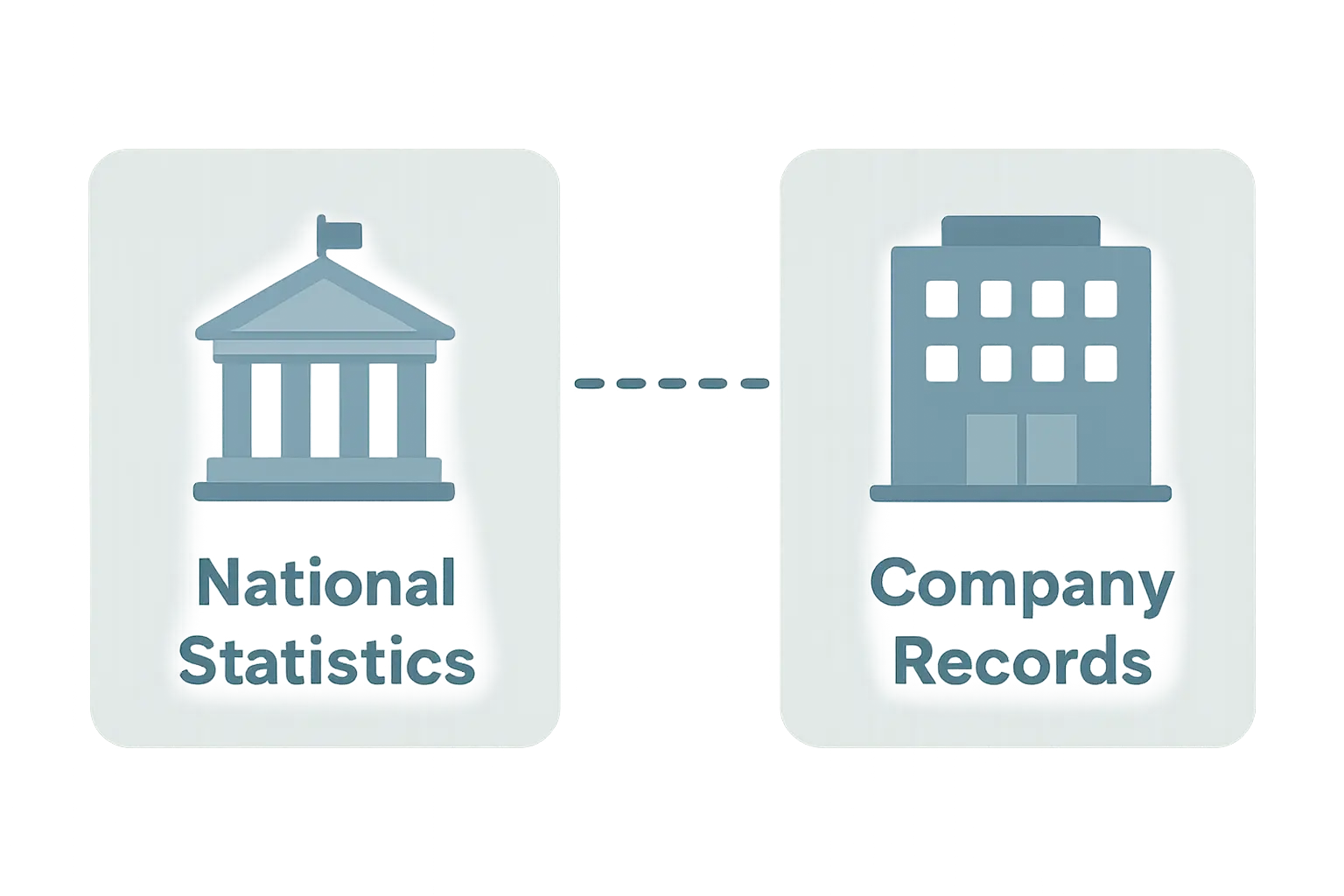
No single portal publishes ready-made HRM statistics for a Malaysian FYP — the real sources split across DOSM’s labour force and productivity datasets on OpenDOSM (free, public, official), the Malaysian Employers Federation’s published Survey Series (access terms vary by report, so confirm them directly with MEF), and individual company data you collect yourself through a survey or case study.
Why There Is No Single “HRM Statistics Malaysia” Portal
HRM as a discipline sits between two different data worlds: national labour-market statistics (which DOSM does publish, extensively) and organisation-specific HR practices like compensation structures, recruitment metrics, and employee engagement scores (which are held internally by companies and by private industry bodies, not published as open government data). A student searching for “HRM statistics Malaysia” often expects one dataset that does not exist — the honest answer is that most HRM FYPs combine a national labour-market baseline from DOSM with primary data collected directly from organisations or employees.
DOSM / OpenDOSM — Labour Force Statistics
| Dataset | Frequency | What it covers |
|---|---|---|
| Principal Labour Force Statistics | Monthly / Quarterly / Annual | Labour force participation, employment and unemployment rates, national and by state |
| Employment by Status in Employment | Monthly | Employee, employer, own-account and unpaid-family-worker breakdowns |
| Employment by MSIC Sector and Sex | Available on OpenDOSM | Employment counts by industry sector, cross-tabulated by sex |
| Skills-Related and Time-Related Underemployment | Quarterly | Underemployment by age and sex |
| Productivity by Economic Sector | Annual / Quarterly | Labour productivity (value added per worker) by sector |
These OpenDOSM datasets give an HRM FYP its national context — workforce participation trends, sectoral employment shifts, and underemployment patterns that a literature review or background section can cite with an exact publication name and date. What they do not provide is company-level compensation, turnover, or engagement data — and before assuming OpenDOSM carries a wages-and-salaries-by-occupation dataset for your purpose, search the current catalogue yourself.
Malaysian Employers Federation (MEF) — Survey Series
The Malaysian Employers Federation publishes research through a Survey Series listed under its own Publications section. Access terms differ between reports — some may be purchasable or restricted to MEF members — so check MEF’s Publications store or contact MEF (mef-hq@mef.org.my) before you rely on a report as a data source in your proposal, and do not cite a specific salary figure from MEF unless you have actually opened that report yourself.
Company-Level Data You Collect Yourself
Most Malaysian HRM FYPs that need compensation, turnover, engagement or recruitment-process data collect it directly, through one of three routes: a survey distributed to employees or HR practitioners at one or more organisations (with the organisation’s permission and your ethics approval in place), a case study built around one company’s HR records with the company’s consent and appropriate anonymisation, or a mixed approach combining a national DOSM baseline with your own primary data. State in your methodology exactly which of these applies, and — for a case-study or company-survey design — confirm access with the organisation before finalising your proposal, since a proposal built on an assumed data-sharing agreement that never materialises is a common cause of semester delays.
Other Sources Worth Checking
- Ministry of Human Resources (Kementerian Sumber Manusia) — policy documents and labour-law context (Employment Act, minimum wage policy) relevant to an HRM FYP’s regulatory background section.
- Social Security Organisation (PERKESO/SOCSO) — contribution and coverage statistics relevant to workplace-safety or employee-welfare-focused HRM topics; take current figures directly from its own site rather than citing a remembered number.
- Academic databases (via your university library) — for published Malaysian HRM studies that have already collected and reported compensation, turnover or engagement data you can cite as secondary evidence in your literature review.
- Professional bodies such as the Malaysian Institute of Human Resource Management (MIHRM) — for industry context and, in some cases, member surveys; check current publication access directly.
Matching the Source to Your HRM Sub-Topic
Recruitment and selection studies typically rely on primary data (a survey of HR practitioners or job seekers) rather than any national dataset. Compensation and benefits studies often combine a DOSM sectoral wage context (where available) with company-specific data collected via survey or case study. Employee engagement and retention studies are almost always primary-data-driven, since the open national datasets do not include an employee-engagement index. Training and development studies frequently use a case-study design around one organisation’s training records and staff feedback. Workplace diversity and industrial relations studies can draw more heavily on DOSM’s demographic breakdowns of the workforce alongside primary interview or survey data.
Building a Literature Review Around Data That Does Not Exist Locally
Where a genuinely comparable Malaysian dataset does not exist for your specific HRM outcome — a national employee-engagement index, for example — the honest move is to state that plainly in your literature review rather than substituting an international figure and implying it applies locally. A defensible paragraph looks like this: “No national employee-engagement index for the Malaysian workforce was located in the OpenDOSM catalogue at the time of writing; international benchmarks such as those published by global HR consultancies exist but were not verified against a Malaysian-representative sample and are cited here only as context, not as a local baseline.” This kind of explicit honesty about a data gap reads to an examiner as a sign of a careful researcher, not a weak literature review — the opposite of what students often assume.
Using Industry Reports Responsibly
HR consultancies and recruitment platforms occasionally publish Malaysia-specific salary guides or workforce trend reports as marketing content rather than peer-reviewed research. These can be useful for context — describing what employers themselves say about hiring difficulty or salary trends in a given year — but should be clearly labelled in your literature review as industry or grey literature, distinct from peer-reviewed academic sources, and never presented as having the same methodological rigour as a DOSM government statistic or a published academic study. If a report does not disclose its sample size, sampling method, or survey date, treat any figure from it as illustrative context rather than a citable statistic for your own findings comparison.
A Note on PERKESO and Ministry of Human Resources Data
For HRM FYPs touching workplace safety, employee welfare or social protection, PERKESO (the Social Security Organisation) publishes contribution and coverage figures relevant to background sections on employee benefits and social protection coverage — always pull the current figure directly from PERKESO’s own published statistics rather than an older secondary source, since coverage rates and scheme details change. The Ministry of Human Resources similarly publishes current minimum wage figures and Employment Act provisions directly — for any policy figure you plan to cite (minimum wage rate, statutory leave entitlements, EPF or SOCSO contribution rates), check the ministry’s or agency’s own current page when you write that section, rather than relying on a figure remembered from an earlier year that may since have changed.
Common Mistakes When Sourcing HRM Data
- Assuming a single “HRM statistics Malaysia” dataset exists and searching for it instead of combining the real, separate sources above.
- Citing a specific salary or turnover figure attributed to MEF or another body without having opened the actual report.
- Building a proposal around a company case study before confirming the company will actually grant data access.
- Treating a DOSM sectoral employment figure as if it directly measures a company-specific HR outcome like turnover or engagement.
- Skipping the ethics-approval step for primary data collection because “it’s just a workplace survey.”
Frequently Asked Questions
Can I do an HRM FYP using only secondary data, with no survey or interviews?
It is possible for a narrow topic well served by DOSM’s national statistics (for example, sectoral employment trend analysis), but most HRM sub-topics — compensation, engagement, recruitment — genuinely need primary data because no public dataset covers them at the level of detail an FYP requires.
Is MEF’s Survey Series free to access?
Access terms vary by report — check MEF’s Publications section or contact MEF directly before assuming either free or paid access, and budget time for obtaining a report if your proposal depends on it.
Where do I find the minimum wage or Employment Act details for my background section?
The Ministry of Human Resources (Kementerian Sumber Manusia) is the correct primary source for current minimum-wage policy and Employment Act provisions — cite the ministry’s own published version rather than a secondary summary.
Can I use LinkedIn or JobStreet data for my HRM FYP?
Only if you have a legitimate, ethical method of collecting it (for example, a documented content analysis of publicly posted job listings) and your ethics committee has approved the approach — scraping or using platform data without checking the platform’s own terms of service is a risk you should clear with your supervisor first.
Do I need company permission to survey employees about HR practices?
Yes — both the organisation’s permission to approach its employees and your university’s ethics approval are needed before distributing any survey to employees at a specific company.
How current does my DOSM data need to be?
Use the most recent release available on OpenDOSM at the time you write your literature review or background section, and state the exact publication date so an examiner can verify it was current when cited.
Can I compare HRM practices across multiple companies without a huge budget?
Yes — a smaller-scale comparative case study (two or three organisations, with a structured interview or short survey at each) is a common, feasible design for an undergraduate FYP, provided access is confirmed at all sites before the proposal is finalised.
Are industry salary guides from recruitment agencies acceptable sources?
They can be cited as grey literature for context, clearly labelled as industry rather than academic sources, but avoid treating a figure from an undisclosed sample or methodology as equivalent to a government statistic or a peer-reviewed study’s finding.
What if my target company will only share anonymised, aggregated HR data?
That is often the most realistic and most ethically appropriate outcome — state in your methodology exactly what level of data access was granted and design your analysis around what the aggregated data can actually support, rather than the individual-level analysis you might have originally planned.
Once your data sources are confirmed, Tesify can help you turn your research design into a fully drafted methodology chapter — you remain responsible for verifying every source and figure it cites. Draft your FYP chapters with Tesify.
For the general methodology chapter structure this feeds into, see how to write the methodology chapter of a Malaysian FYP or thesis. For designing the survey instrument an HRM FYP often needs, see how to design a questionnaire for your FYP. For a comparable case-study-based FYP built on company access, see how to turn your industrial training report into a Business Administration FYP. For choosing the right statistical test once your data is collected, see which statistical test should you use for your FYP data. For sample-size reasoning behind your survey or case-study design, see how many respondents you need for your FYP or thesis.