A nursing thesis on older adults in Malaysia needs a defined population (60 years and above, the definition Malaysian health research on older people commonly uses), a setting where you can realistically get access (community, residential care, or hospital geriatric ward), a validated Malay-language instrument matched to what you are measuring, and ethics approval that accounts for consent capacity. Below is what goes into each part, and the research questions that come out of it.
What population definition should I use for “older adults” in a Malaysian nursing thesis?
Use 60 years and above, and cite where the cut-off comes from. It is the Ministry of Health Malaysia definition of elderly that Malaysian validation studies apply (the 2021 Malay Geriatric Depression Scale study in the Malaysian Journal of Medical Sciences recruited participants aged 60 and above on exactly that basis), and it is the population the country’s ageing policy addresses: the National Policy for the Elderly, issued as the Dasar Warga Tua Negara in 1995 by the Ministry of Women, Family and Community Development (KPWKM), was improved and renamed the Dasar Warga Emas Negara (DWEN), the National Policy for Older Persons, in 2011. State this threshold explicitly in your Chapter 1, and if your study focuses on a sub-group (the “oldest old,” typically 80+, or a specific chronic-disease cohort), define that sub-group separately with its own justification.
What settings can I realistically access for this population?
Three settings come up most often in Malaysian nursing theses on older adults, and each has a different access route:
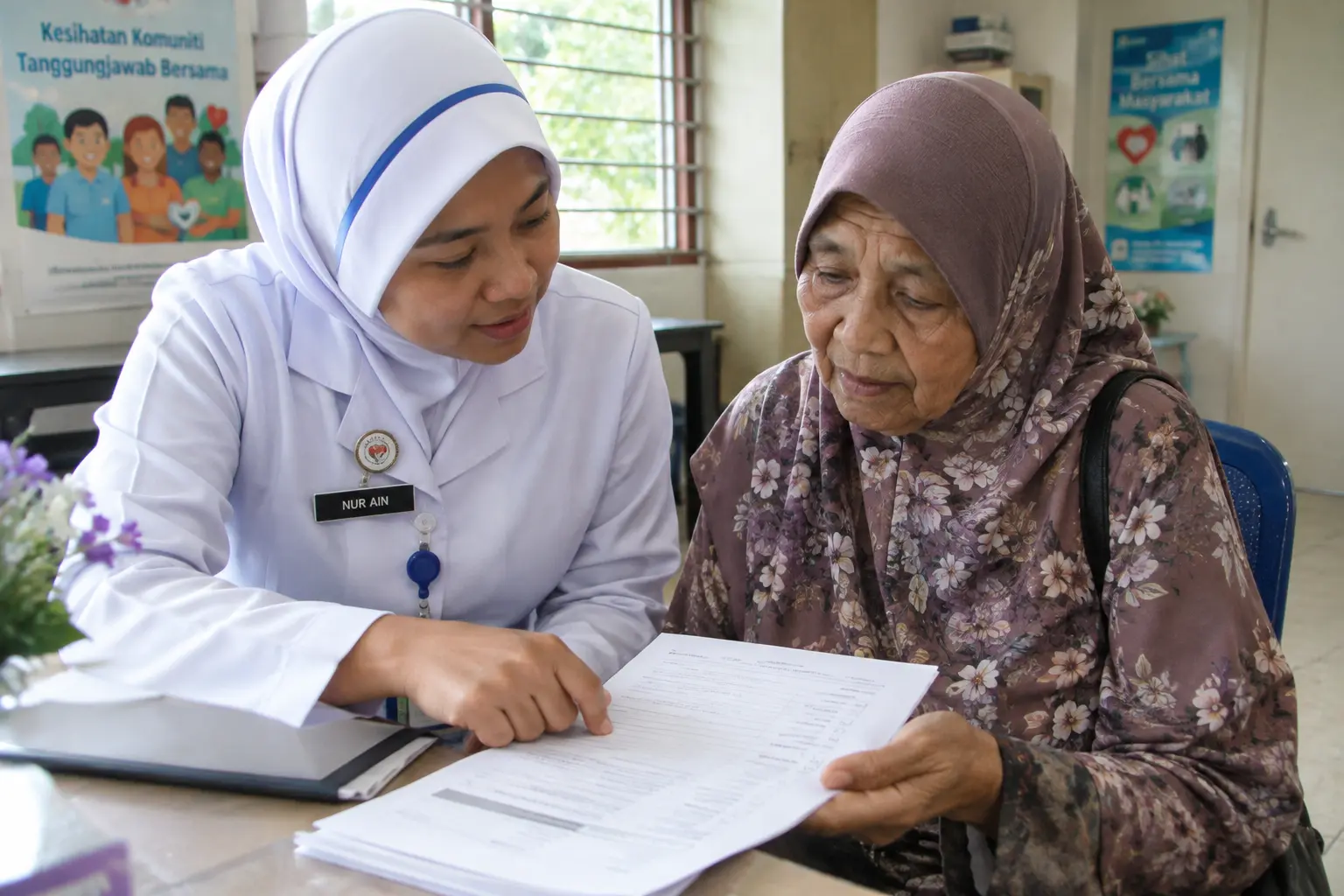
- Community-dwelling older adults — reached through community health clinics (klinik kesihatan), residents’ associations, or a Senior Citizens Activity Centre (Pusat Aktiviti Warga Emas, PAWE) if your university or supervisor has an existing relationship with one. This is the most accessible setting for an undergraduate or master’s timeline.
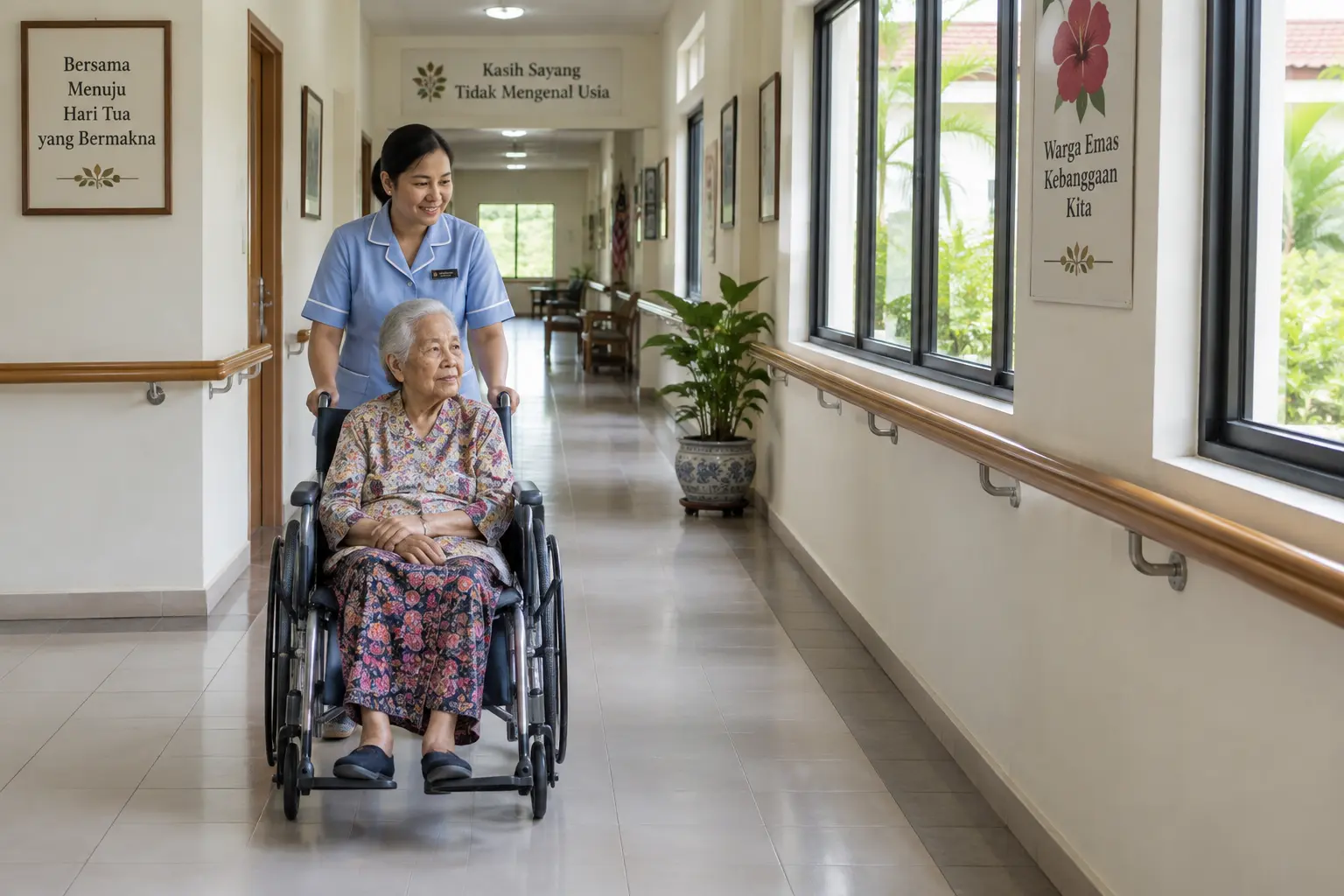
- Residential care (nursing homes / rumah orang tua) — requires the facility’s own written consent in addition to your ethics approval, and typically a smaller, more heterogeneous sample in terms of cognitive and functional status.
- Hospital geriatric wards or outpatient geriatric clinics — usually the hardest to access on an undergraduate timeline because it requires hospital-level ethics review (NMRR registration plus MOH’s Medical Research and Ethics Committee, MREC, for MOH facilities) on top of your own university’s committee, but gives you a clinically defined population if your research question needs one.
Pick the setting your access actually supports before you finalise your research question — a hospital-based question you cannot get hospital access for is not a smaller version of the same study, it is a different study you cannot complete.
What consent process do I need for older participants, including those with cognitive impairment?
Standard informed consent applies to cognitively intact older adults, in the same written and verbal form used for any adult participant. Where cognitive impairment is a realistic possibility in your sample (common in residential-care or hospital settings), your ethics protocol needs a documented capacity-assessment step before consent is sought, and a proxy-consent pathway (typically next of kin or a legally appointed guardian) for participants who lack capacity, with the participant’s own assent still sought even when a proxy formally consents on their behalf. Build this into your ethics submission from the start — see what ethics approval a Malaysian nursing thesis needs for the committee-level process this sits inside — since a protocol that assumes every older participant can consent independently is one of the fastest ways to get a protocol returned for revision.
Which validated Malay-language instruments exist for this population?
Three instruments cover the areas a Malaysian nursing thesis on older adults most often needs, each with a Malaysian track record you can cite:
- Elderly Cognitive Assessment Questionnaire (ECAQ), Malay version — a short cognitive-screening instrument suited to participants with limited literacy; a study of 399 older outpatients at Hospital Universiti Sains Malaysia (Medical Journal of Malaysia, 2009) screened literate participants with the Malay MMSE and illiterate participants with the Malay ECAQ. Trace and cite its validation reference before you rely on it.
- Comprehensive Geriatric Assessment Questionnaire, Malay version — translated and validated by Harith and Tan among 166 older patients and published in Annals of Geriatric Medicine and Research (2020), covering socio-demographic characteristics, medical condition, quality of life, nutritional status, functional capacity and depression status in one structured tool rather than requiring you to assemble several separate scales.
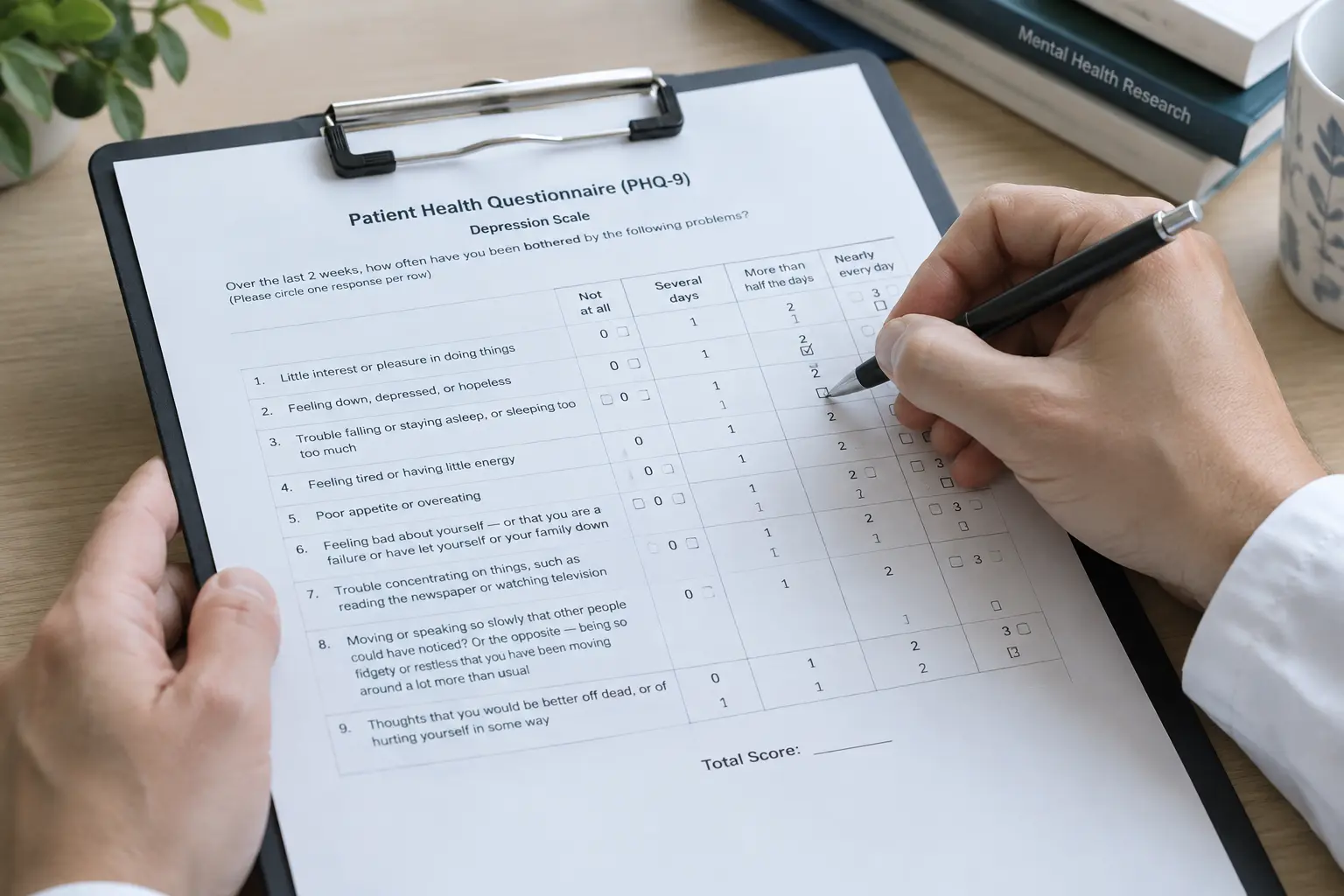
- Geriatric Depression Scale, Malay version (M-GDS-14) — a 14-item adaptation of the GDS-15 in which item 9 was dropped during validation among 60 older inpatients by Teh and Hasanah (Penang Hospital and Universiti Sains Malaysia), with Cronbach’s alpha of 0.84 and test-retest reliability of 0.84. A separate 2021 study in the Malaysian Journal of Medical Sciences examined the Malay GDS among 219 older adults with cognitive impairment and reported an overall Cronbach’s alpha of 0.89.
Cite the validation paper for whichever instrument you use, not just the original English-language scale — your methodology chapter needs both: the original instrument’s source and the Malay validation study that justifies using it with a Malaysian sample.
What researchable questions come out of this population and archetype?
A few starting points, each phrased as the kind of question a supervisor can approve quickly because the population, setting and instrument are already aligned:
- What is the level of cognitive function among community-dwelling older adults attending a specific klinik kesihatan, measured using the Malay ECAQ?
- What factors are associated with depressive symptoms (M-GDS-14) among residents of a specific residential care facility?
- How do functional capacity scores (using the Comprehensive Geriatric Assessment Questionnaire) differ between older adults living independently and those in residential care?
- What are the barriers nurses report to conducting a full geriatric assessment within routine outpatient consultation time?
- What is the relationship between functional capacity (Comprehensive Geriatric Assessment Questionnaire) and depressive symptoms (M-GDS-14) among older adults attending a specific outpatient clinic?
- How does cognitive function, screened using the Malay ECAQ, differ between older adults who live alone and those who live with family?
Each of these is answerable within a single-site, cross-sectional design, which is the design most undergraduate and taught-master’s timelines in Malaysia can realistically complete.
What sample-size and design should I expect for a single-site study like this?
A cross-sectional descriptive or correlational design is standard for this population at the undergraduate and taught-master’s level, since a longitudinal design with older participants carries a real risk of attrition through relocation, hospitalisation, or death during your study period — a risk your supervisor will expect you to have considered and to state as a limitation if you choose cross-sectional over longitudinal for this reason. Base your sample-size justification on your primary instrument’s validation study and your chosen statistical test, not a round number — see how many respondents you actually need for the general reasoning this borrows from.
What mistakes do supervisors most often flag in this kind of proposal?
Four recur across older-adults nursing proposals. First, an undefined or shifting age cut-off — stating “elderly participants” in Chapter 1 without the 60-and-above threshold, then applying a different cut-off in the actual inclusion criteria in Chapter 3. Second, an access plan that assumes institutional cooperation without having secured it — naming a specific nursing home or hospital ward as your setting before you have a letter of permission in hand. Third, treating a validated instrument as interchangeable with an unvalidated translation you made yourself; if you cannot cite a published Malay validation study for your instrument, you either use a different validated tool or add formal translation and pilot-testing as its own methodology step — the same discipline applies to any instrument, not just this population; see how validated Malay-language scales are sourced and cited in a different field for the same logic applied to psychology. Fourth, no explicit plan for participants who cannot complete a self-administered questionnaire — illiteracy, visual impairment or mild cognitive difficulty are common enough in this population that “the questionnaire will be self-administered” alone is treated as an incomplete methodology section, not a minor gap.
How should I write the significance of the study section for this population?
Anchor it to something concrete rather than a general statement about an “ageing population.” A stronger significance paragraph names the specific gap your setting and instrument combination fills — for example, that the facility or clinic you are studying has no prior published assessment of this kind, or that your chosen instrument has been validated in Malaysia but not yet applied in your specific setting type (residential care versus community, for instance). Reviewers and examiners respond better to a significance section that says what is missing at your access point specifically than one that restates national ageing statistics without a dated source.
Where Tesify fits into this workflow
Tesify helps you structure and plan Chapter 1 and Chapter 3 around a population-and-setting combination like this — problem statement, objectives, and a methodology section matched to your instrument and design — while you write the argument and make every final decision, so the thesis stays 100% written by you. Once you reach your findings, how to write the discussion chapter of a nursing thesis covers the step that follows this one. More than 9,000 students have used Tesify, across 15,000+ chapters.
Frequently asked questions
What age counts as “older adult” in a Malaysian nursing thesis?
60 years and above — the Ministry of Health Malaysia definition used in Malaysian validation studies and the population addressed by the National Policy for Older Persons (Dasar Warga Emas Negara, 2011).
Do I need a different ethics process for older adults with cognitive impairment?
Yes. Your protocol needs a documented capacity-assessment step and a proxy-consent pathway for participants who cannot consent independently, with the participant’s own assent still sought alongside the proxy’s consent.
Which setting is easiest to access for an undergraduate nursing thesis on older adults?
Community-dwelling older adults reached through a community health clinic, a senior citizens activity centre or a residents’ association, since hospital and residential-care settings add extra layers of institutional consent and, for hospital settings, national ethics registration.
What instrument should I use to screen for cognitive impairment in this population?
The Malay-language Elderly Cognitive Assessment Questionnaire (ECAQ) is one option suited to participants with limited literacy; Malaysian studies have paired it with the Malay MMSE for literate participants.
Is there a validated Malay depression scale for older adults?
Yes, the M-GDS-14, a 14-item Malay adaptation of the Geriatric Depression Scale validated by Teh and Hasanah among older inpatients, with Cronbach’s alpha of 0.84 and test-retest reliability of 0.84.
Should I choose a cross-sectional or longitudinal design?
Cross-sectional is standard at the undergraduate and taught-master’s level for this population, given the real attrition risk (relocation, hospitalisation, death) a longitudinal design faces with older participants over a typical thesis timeline.
Do I need the residential care facility’s own consent in addition to university ethics approval?
Yes. A nursing home or residential care facility’s own written consent is required on top of your university’s ethics committee approval before you can recruit residents.
What ethics bodies apply if I want to recruit from a hospital geriatric ward?
Both your university’s own ethics committee and, for MOH facilities, National Medical Research Register (NMRR) registration plus review by the Medical Research and Ethics Committee (MREC).
Can I use the Comprehensive Geriatric Assessment Questionnaire instead of separate scales?
Yes — its Malay version, validated among older patients in Malaysia (Harith and Tan, 2020), covers medical condition, quality of life, nutritional status, functional capacity and depression status in one structured tool, which can simplify your Chapter 3 instrument section.
What is a realistic single-site research question for this population?
A question like “what factors are associated with depressive symptoms among residents of a specific residential care facility, measured using the M-GDS-14” — narrow enough for one site and one instrument, broad enough to justify a full chapter of literature.
What is the most common mistake in the access plan for this population?
Naming a specific facility or ward as your setting before securing its written permission — an access plan should reflect cooperation you already have, not cooperation you are hoping to get.
Can I translate an English instrument myself if no Malay version exists?
Only as a formal methodology step with translation, back-translation and pilot-testing documented in Chapter 3 — an informal translation used as though it were validated is treated as a methodology gap, not a shortcut.
How should I frame the significance of the study for this population?
Name the specific gap at your access point — what has not yet been assessed at your chosen facility or clinic, or what setting type your chosen instrument has not yet been applied to in Malaysia — rather than restating general population-ageing statistics.