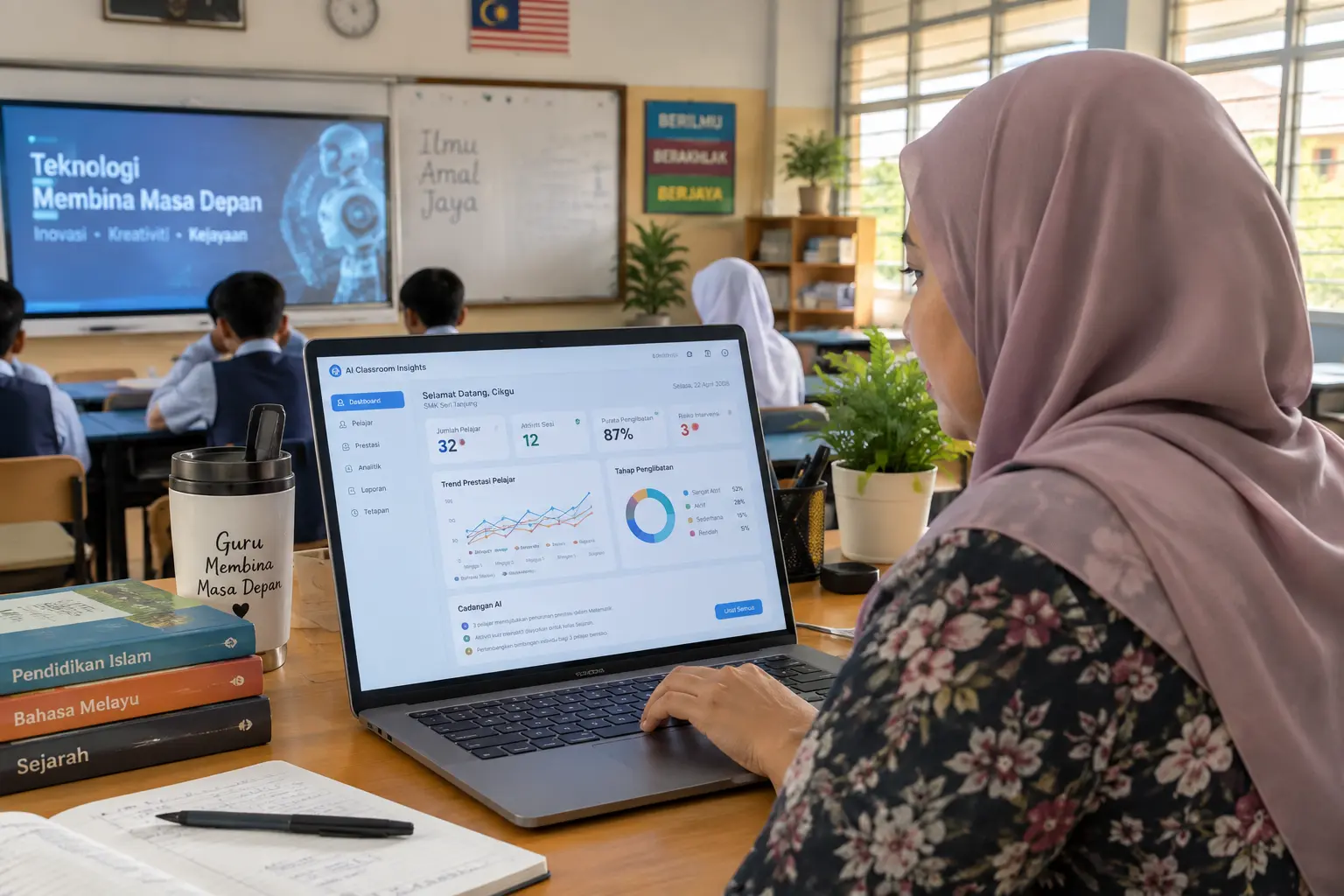
A thesis on AI in education needs one narrow angle, not the whole topic: a specific user group (teachers, students, or administrators), a specific AI application (adaptive learning tools, automated marking, or generative chatbots), and a specific outcome (adoption intention, learning performance, or academic integrity behaviour). Framed this way, “AI in education” becomes a testable objective instead of a topic too large for one semester.
Why “AI in Education” Is a Live Thesis Topic in Malaysia Right Now
The Ministry of Education’s AI-Powered Classroom initiative (Bilik Darjah Berkuasa AI) began with 27 schools in 2025 and is set to be expanded to all schools nationwide by 2030 — figures Education Minister Fadhlina Sidek gave in the Dewan Negara on 18 December 2025, responding to Senator Dr Jufitri Joha’s question on the Digital Education Transformation Plan. Separately, the Ministry of Education was reported in July 2025 to be finalising AI Literacy Guidelines for schools, and the Ministry of Higher Education, through its Department of Higher Education (Jabatan Pendidikan Tinggi, JPT), has published a guideline on using generative AI technology in teaching and learning in higher education (Garis Panduan Penggunaan Teknologi Kecerdasan Buatan Generatif dalam PdP Pendidikan Tinggi). Together these give a Malaysian education thesis on AI a genuine, current policy backdrop to cite — provided you read the actual guideline or official statement yourself rather than repeating a secondhand summary of what it says.
Where to Read the Actual Policy Documents Yourself
Before citing any of the initiatives above in your background section, open the primary source rather than a news summary of it. For school-level guidance, check the Ministry of Education’s own website (moe.gov.my) for the current published version of its AI guidance; the JPT generative-AI teaching-and-learning guideline is listed on JPT’s own publications page at jpt.mohe.gov.my. Read the specific document relevant to your education level — schools fall under the Ministry of Education’s guidance, while a thesis about lecturers or university students should cite the higher-education-specific guideline instead, since the two ministries have issued separate guidance with different scope and different institutions in mind.
The Problem With “AI in Education” as a Thesis Title
“The Impact of AI on Education in Malaysia” is not a thesis title — it is a book title. A supervisor reading it cannot tell who the study is about (teachers? students? one school level?), which AI application is being studied (a chatbot? an adaptive learning platform? a marking tool?), or what outcome is being measured (adoption? performance? attitude? integrity behaviour?). Every one of the four angles below narrows all three of those dimensions to a size a single FYP or thesis can actually complete.
Four Specific Angles to Choose From
| Angle | Who | What AI application | Typical outcome measured |
|---|---|---|---|
| Teacher adoption | Teachers | AI-based marking or lesson-planning tools | Behavioural intention to adopt, using a technology-acceptance model |
| Student learning use | Students | AI tutoring or adaptive learning platforms | Self-reported learning engagement or a measured performance outcome |
| Academic integrity | Students or lecturers | Generative AI chatbots (ChatGPT-type tools) | Reported usage behaviour, perceived acceptability, or detection-avoidance behaviour |
| Institutional policy response | Administrators or lecturers | Institution-level AI guidelines | Awareness, perceived clarity, or compliance with the institution’s own stated policy |
Pick one row, not several — a thesis that tries to study teacher adoption and student integrity behaviour and institutional policy all at once usually ends up doing none of them with enough depth to defend at viva.
Worked Illustrative Example: Framing the Teacher-Adoption Angle End-to-End
The worked example below develops the first row of the table — teacher adoption of AI-based marking tools — all the way from problem to method, to show what “framing” concretely produces. It is illustrative: adapt every specific choice (the theory, the sample, the instrument items) to your own supervisor’s guidance and your own school or institution context.
Problem Statement
Illustrative: As AI-based marking tools become available to Malaysian secondary school teachers under national digital education initiatives, teachers vary widely in whether they actually use these tools once access is provided — a gap between tool availability and tool adoption that determines whether policy investment translates into classroom practice.
Objectives and Research Questions
- Objective 1: To determine the level of secondary school teachers’ behavioural intention to adopt AI-based marking tools.
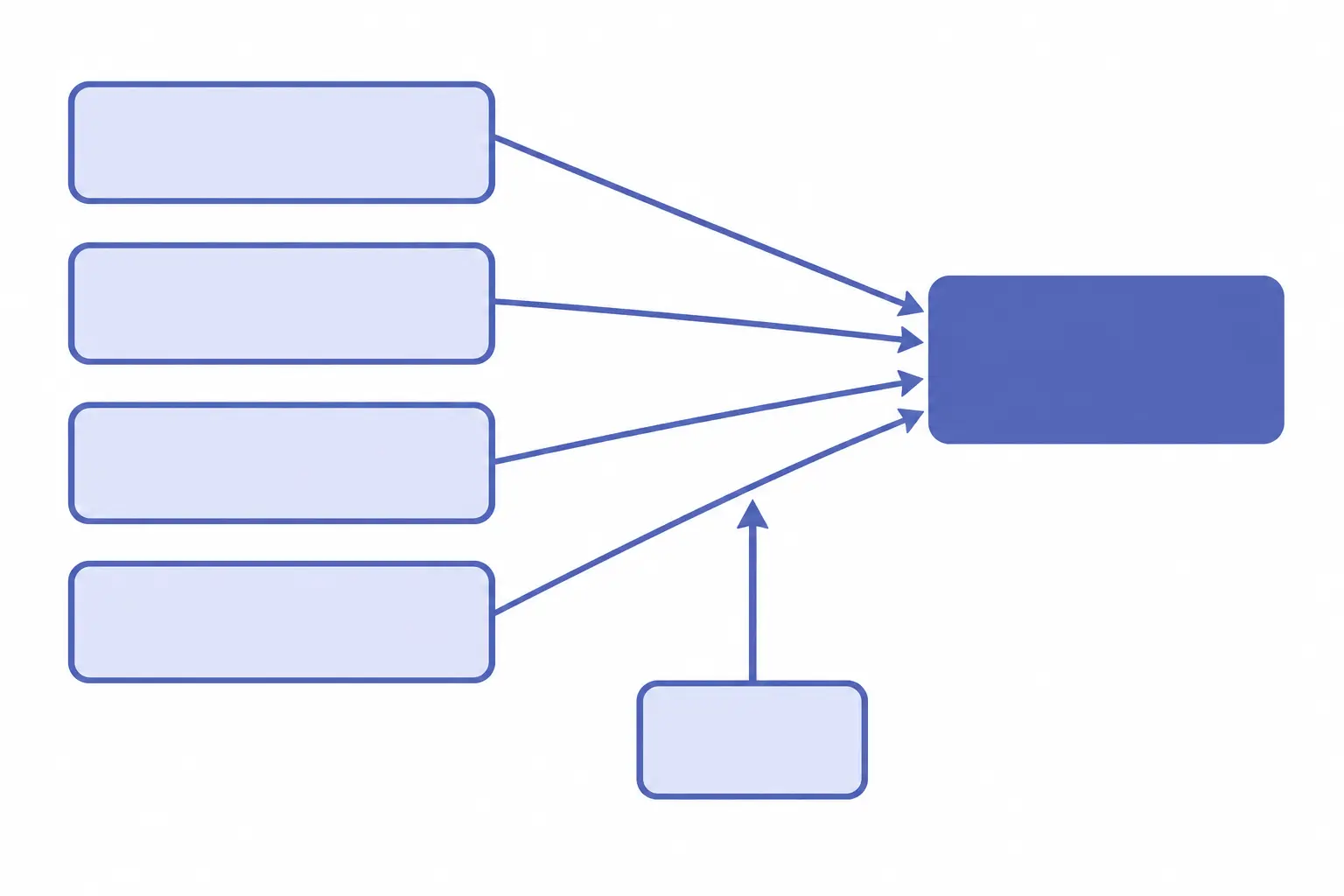
Question 1: What is the level of teachers’ behavioural intention to adopt AI-based marking tools? - Objective 2: To examine the relationship between performance expectancy, effort expectancy, social influence, and facilitating conditions, and teachers’ behavioural intention to adopt AI-based marking tools.
Question 2: Do performance expectancy, effort expectancy, social influence, and facilitating conditions significantly predict behavioural intention? - Objective 3: To determine whether teaching experience moderates the relationship between the predictors above and behavioural intention.
Question 3: Does teaching experience moderate the relationship between the predictors and behavioural intention?
Conceptual Framework and Variables
This illustrative framework borrows its four core constructs — performance expectancy, effort expectancy, social influence, and facilitating conditions — from the Unified Theory of Acceptance and Use of Technology (UTAUT), originally developed by Venkatesh, Morris, Davis and Davis (2003) to explain technology adoption in organisational settings. Teaching experience is added as a moderator on the illustrative assumption that more experienced teachers may weigh these predictors differently than newer teachers — an assumption your own literature review should confirm or challenge with actual prior studies, not simply assert.
Method
A quantitative, cross-sectional survey design fits this framework: a structured questionnaire adapting validated UTAUT items (cited to Venkatesh et al., 2003, with permission or open-access terms checked directly against the original source) distributed to secondary school teachers at schools already participating in, or scheduled to join, an AI-based classroom initiative. Sampling would typically be purposive or stratified by school type, with the target population and sample size justified against your faculty’s own sample-size guidance rather than an imported rule of thumb.
Common Framing Mistakes for AI-in-Education Theses
- Keeping the title broad (“AI and Education in Malaysia”) after the proposal stage instead of narrowing it once the specific angle is chosen.
- Citing a ministry initiative’s existence as if it were itself a research finding, rather than as background context that motivates the study.
- Choosing a technology-acceptance model without reading the original source paper for the model’s actual constructs and item wording.
- Mixing outcome types across objectives — for example, Objective 1 about intention to adopt and Objective 2 about actual measured learning performance, which are different constructs requiring different instruments.
- Assuming a specific AI tool’s features or a ministry guideline’s exact provisions without opening the tool’s own page or the guideline document directly.

Adapting This Model to a Different AI-in-Education Angle
The same four-part sequence — problem, objectives and questions, conceptual framework with named variables, then method — applies to any of the four angles in the table above. A student-use angle would replace UTAUT’s organisational-adoption framing with a learning-engagement or self-regulated-learning framework more common in educational psychology; an academic-integrity angle would typically use a qualitative or mixed-methods design (interviews on reported usage behaviour alongside a survey on perceived acceptability) rather than a purely quantitative one; an institutional-policy angle would centre on the actual text of your own institution’s AI guideline as the primary document analysed, compared against how staff report understanding or following it.
A Second Illustrative Sketch: The Student-Use Angle
Illustrative: A student-use angle on the same general topic might frame its problem statement around students at one faculty having access to an AI tutoring platform but showing uneven engagement with it, then set objectives around measuring self-reported engagement and testing whether a construct such as perceived usefulness or self-regulated learning capacity predicts that engagement. The method would typically still be a quantitative survey, but the instrument would be adapted from an educational-psychology scale rather than from UTAUT, and the target population would be students rather than teachers — illustrating how changing one row of the four-angle table changes the theory, the instrument, and the population together, not just the title.
Realistic Scope for a One-Semester AI-in-Education Study
Whichever angle you choose, keep the scope matched to your actual timeline. A single-institution, cross-sectional survey with one predictor set and one outcome (the teacher-adoption sketch above, for instance) is realistic within a typical one- or two-semester undergraduate FYP once ethics approval, data collection and analysis are accounted for. Attempting a multi-school, longitudinal, or multi-method design on the same topic is a postgraduate-level scope decision, not an undergraduate one — state your chosen scope explicitly in your limitations section so an examiner sees it as a deliberate design decision rather than an oversight.
Frequently Asked Questions
Is “AI in education” too broad a topic for an undergraduate FYP?
As a general topic, yes — but any one of the four narrowed angles above (one user group, one AI application, one outcome) is a normal-sized undergraduate FYP topic once title, objectives and method are aligned.
Can I study more than one AI tool in the same thesis?
You can compare two tools within the same angle (for example, two different AI marking tools’ adoption rates), but keep the user group and outcome the same — comparing multiple tools across multiple user groups in one study usually overloads an undergraduate timeline.
Do I need to cite the Ministry of Education’s AI initiatives directly?
If you use them as background motivation, cite the actual circular, guideline, or official statement directly rather than a secondhand blog summary, since the wording and figures in secondary sources can be inaccurate or outdated.
Is UTAUT the only theory I can use for a teacher-adoption angle?
No — the Technology Acceptance Model (TAM) and the Diffusion of Innovations framework are also commonly used for adoption studies; choose based on which one your literature review shows is most used for AI-adoption studies specifically, and discuss the choice with your supervisor.
Should my AI-in-education thesis be quantitative or qualitative?
It depends on the angle and outcome: adoption-intention studies with a named theoretical model are usually quantitative surveys, while studies on lived experience, perception, or nuanced integrity behaviour often suit a qualitative or mixed-methods design better.
Can I study my own school or institution for this kind of thesis?
Often yes, with appropriate permission from the school or institution and your university’s ethics approval, but check your faculty’s specific rules on researching your own workplace or institution before finalising your proposal.
How do I avoid my AI-in-education thesis becoming outdated before I finish it?
Frame your research question around the underlying human behaviour (adoption, engagement, integrity decisions) rather than around one specific tool’s current feature set, since specific AI tools change faster than a thesis timeline.
What ethics approval do I need if I am surveying teachers about a ministry initiative?
Standard human-participant ethics approval from your university applies, and if the study touches a school under Ministry of Education administration, check whether your faculty also requires separate research-permission clearance through the relevant state or federal education authority.
Can I use a mixed-methods design combining a teacher survey and a policy-document analysis?
Yes — combining a quantitative teacher survey with a qualitative analysis of your institution’s own AI guideline is a legitimate mixed-methods design, provided both components are clearly justified and integrated in your findings rather than reported as two disconnected studies.
Once your angle, objectives and framework are set, Tesify can help you turn this structure into a fully drafted proposal chapter — you remain responsible for verifying every source and figure it cites. Draft your thesis proposal with Tesify.
For the theoretical framework choices this UTAUT example builds on, see which theoretical framework an education thesis in Malaysia should use. For the academic-integrity side of student AI use, see whether Turnitin can detect ChatGPT. For writing the literature review chapter this framing sits inside, see how to write a literature review for your FYP or thesis. For the FYP-versus-thesis distinction relevant to how deep your AI-in-education study needs to go, see what is the difference between an FYP, a thesis and a dissertation in Malaysia.