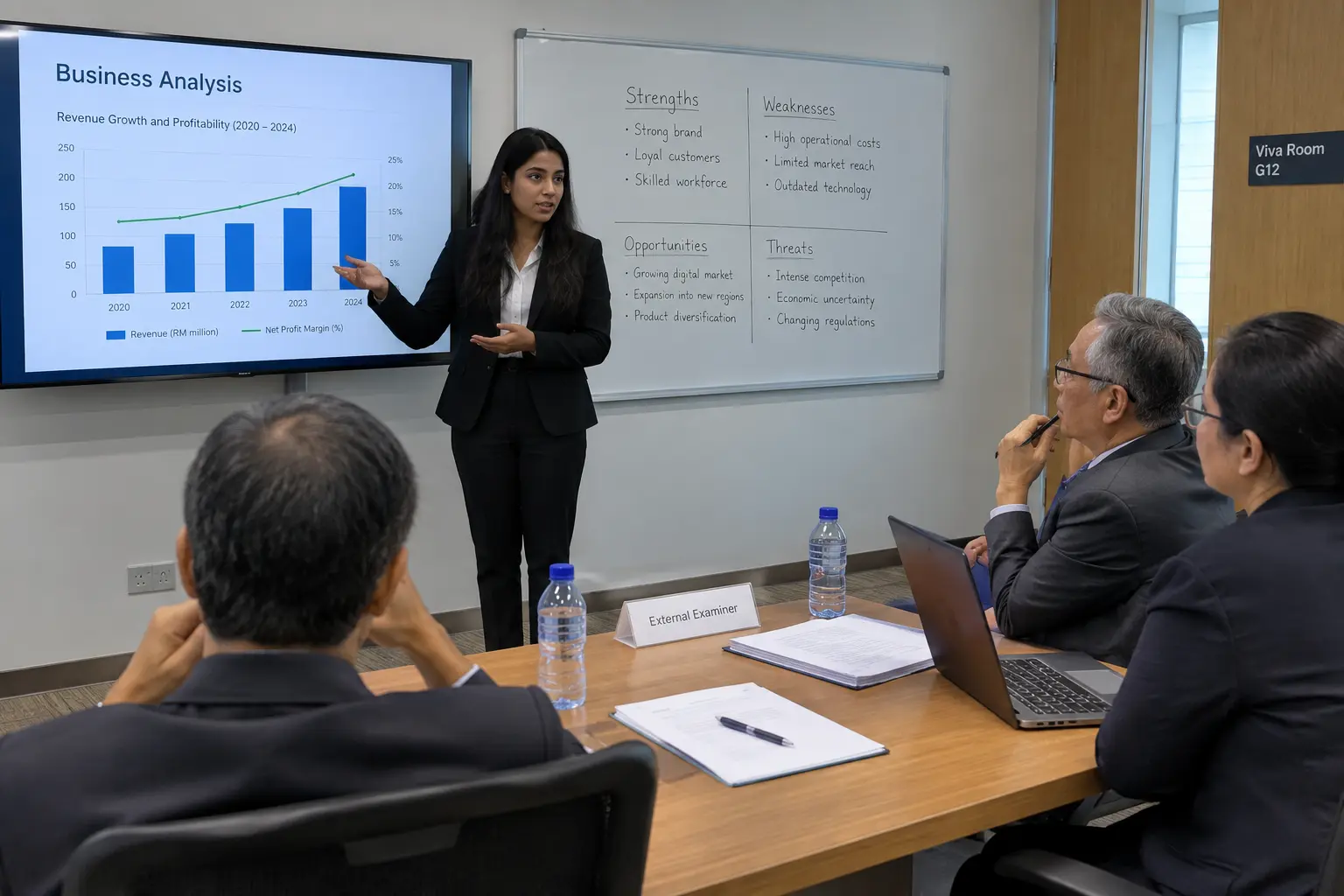
A Business Administration FYP usually gets sent back not because the writing is weak, but because the analysis does not actually answer a research question a case study or survey can support. Here are the objections examiners commonly raise on Malaysian Business Administration FYPs (assuming the undergraduate FYP scope described in what separates an FYP from a thesis or dissertation in Malaysia), and how to fix each one before you submit.
Objection 1: “Your case study cannot generalise to what you’re claiming”
A single-company case study is a legitimate design, but only for claims scoped to that company or to a clearly bounded population of similar companies — not for claims about “Malaysian SMEs” or “the retail industry” broadly. If your Chapter 1 states a broad population and your Chapter 3 describes one company’s data, the mismatch is the first thing an examiner flags. Fix it by narrowing your research objective to what your case actually supports: “factors affecting employee retention at the case company” (named in your own FYP) rather than “factors affecting employee retention in the Malaysian retail sector,” with a clearly stated transferability discussion in your limitations rather than a generalisability claim in your conclusion.
Objection 2: “A SWOT table is not an analysis”
Business Administration FYPs default to SWOT, PESTEL or Porter’s Five Forces as a structuring device, and examiners accept that — but only when the framework is applied to your actual data and connects to your research objectives, not dropped in as a generic four-quadrant list with bullet points that could describe almost any company. If you use SWOT, each point needs to trace to evidence from your interviews, financial data or industry sources, and your discussion needs to say what the framework implies for your specific research question, not just present the table and move on.
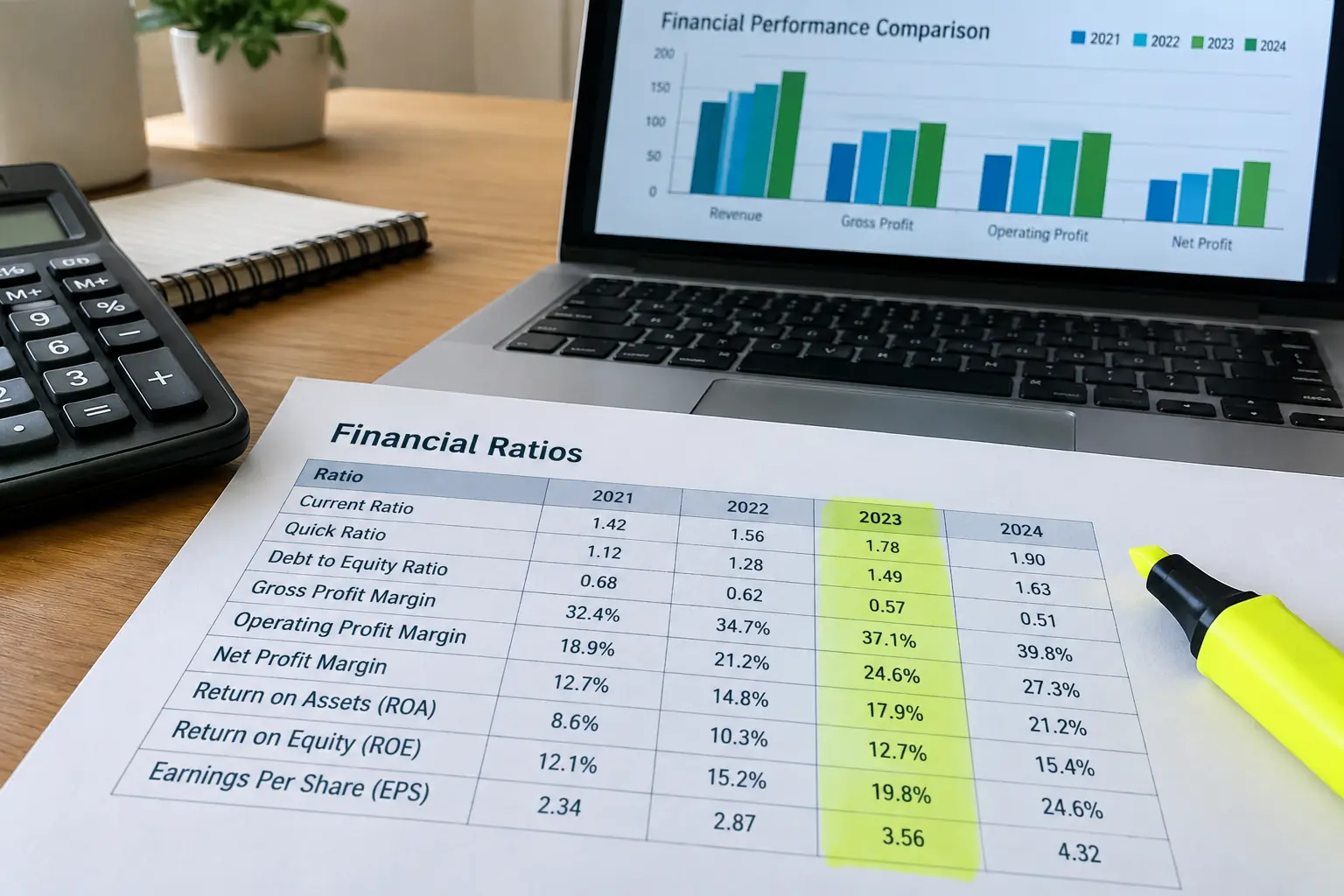
Objection 3: “Your financial ratios have no benchmark”
A common finance/accounting-adjacent objection inside Business Administration FYPs: reporting a company’s current ratio, ROE or debt-to-equity ratio as a number without comparing it to an industry average, a competitor, or the same company’s figures across several years. A ratio in isolation tells an examiner nothing about whether it is good, bad, or typical. Pull at least one comparator — an industry average from a source you can name, a direct competitor’s published figures, or a multi-year trend for the same company — before you interpret any ratio as a finding.
Objection 4: “Your variables have no theoretical framework connecting them”
If your research question links two or more variables (leadership style and employee performance, service quality and customer loyalty, working capital and profitability), an examiner expects a named theory or model that predicts the relationship you are testing — not just a hypothesis stated because it “seems logical.” Pick a framework the literature actually uses for your specific relationship (the Resource-Based View for a competitive-advantage question, SERVQUAL for a service-quality question, agency theory for a governance question) and show how your hypotheses derive from it, rather than presenting the framework and the hypotheses as two separate, disconnected sections.
Objection 5: “You are analysing at the wrong level”
A frequent structural objection: a research question framed at the strategic level (should the company enter a new market, should the company diversify) answered with data and methods suited to an operational-level question (a satisfaction survey of customers, a review of one department’s records). Match your method to the level of your question before you finalise your design — a strategic question usually needs case-study depth, multiple data sources, and triangulation; an operational question can be answered with a single-source survey or a records review.
Objection 6: “Your secondary data source doesn’t actually say what you’re claiming”
Business Administration FYPs draw heavily on secondary sources — annual reports, Bursa Malaysia filings, industry reports, government statistics — and examiners regularly find a citation that does not support the specific claim attached to it, either because the source is older than claimed, covers a different market segment, or reports a different metric than the one quoted. Before you finalise a citation to a statistic or industry claim, re-open the source yourself and confirm the exact figure, year and scope match what your sentence says — do not rely on a secondary summary or a citation you copied from another source’s reference list.
Objection 7: “Your recommendations don’t follow from your findings”
A closing-chapter objection: recommendations that read as generic business advice (“the company should improve marketing,” “the company should invest in training”) rather than specific actions that trace directly back to what your data actually found. Each recommendation should answer “which finding, specifically, led to this recommendation” — if you cannot point to the finding, the recommendation does not belong in your conclusion.
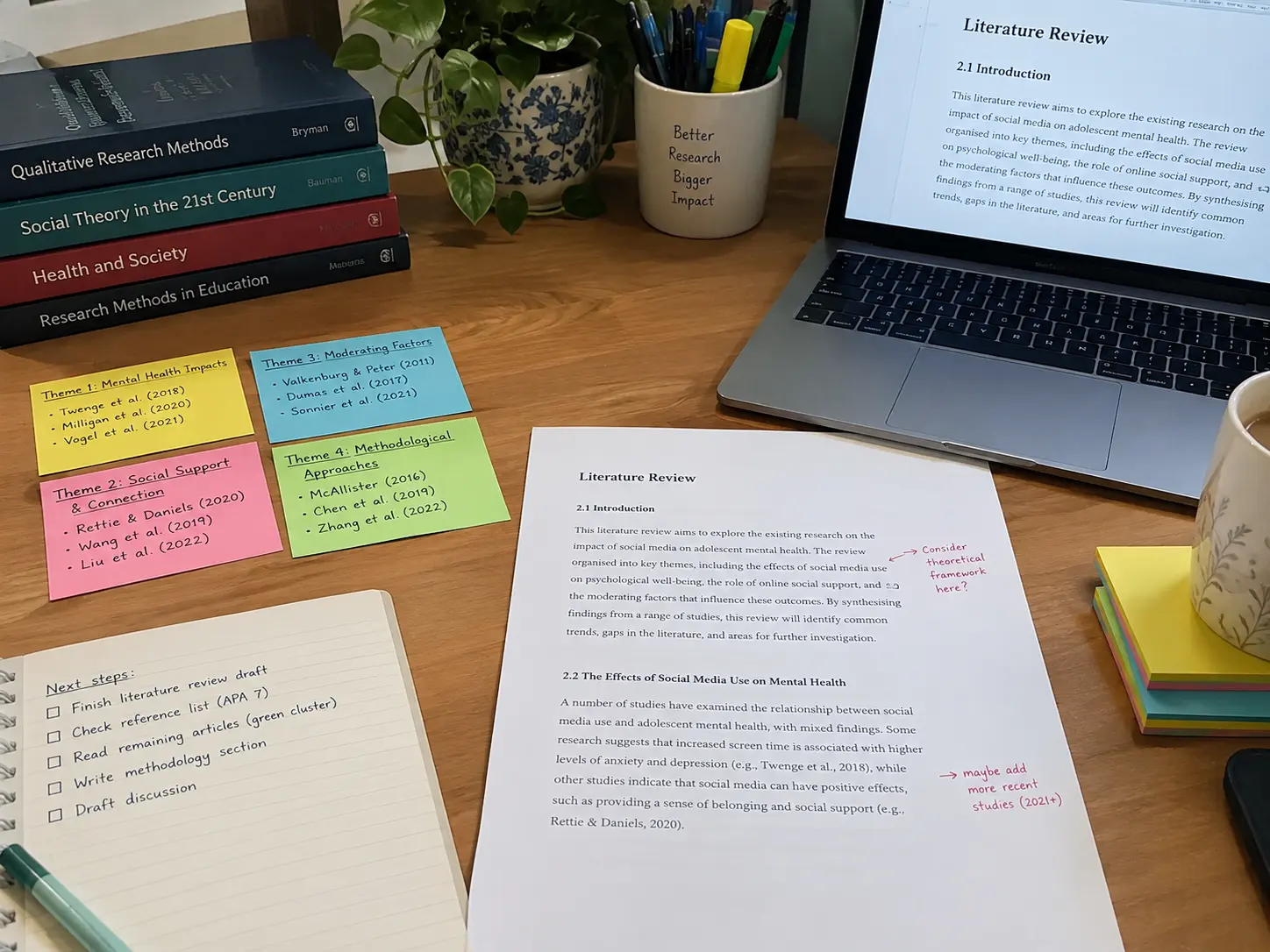
Objection 8: “Your literature review lists studies instead of synthesising them”
A literature review that summarises one study per paragraph, in the order you found them, reads as an annotated bibliography rather than a review — examiners want to see studies grouped by theme, compared against each other, and used to build the case for your own gap — see how to write a literature review for your FYP or thesis for the full synthesis method. If your review moves study-by-study rather than theme-by-theme, group your sources under the variables or themes your framework identifies, and end each group with a sentence on what is agreed, what is contested, and what is missing — which is where your own study fits.
Objection 9: “Your methodology doesn’t match your stated objectives”
If your objectives promise to “explore” or “understand” perceptions in depth, a structured Likert-scale survey analysed only with descriptive statistics does not deliver that — an exploratory objective needs either a qualitative or mixed-methods design (see which statistical test to use for your FYP data once your design is set), or quantitative objectives phrased to match what a survey can actually measure (levels, relationships, differences between groups) rather than depth of understanding. Check every objective against your actual data-collection method before you finalise Chapter 3; a mismatch here is one of the fastest ways a proposal gets sent back before data collection even starts.
One pattern ties several of these objections together: a Business Administration FYP is judged not on how much you cover, but on how tightly your problem statement, your framework, your method and your findings connect to each other. An examiner reading Chapter 5 is checking whether every claim in your conclusion can be traced back through your data to a specific objective stated in Chapter 1 — a chain that breaks at any single link (an unsupported generalisation, an unapplied framework, an uncompared ratio, an unmatched method) is what produces many of the objections above, more often than any single chapter being weak on its own.
Objection 10: “Your sampling method doesn’t match your claimed generalisability”
Convenience sampling — surveying whichever employees or customers are available — is common and defensible in a Business Administration FYP, but only when your conclusions are framed accordingly. Examiners flag it when a study built on a small convenience sample from one branch then concludes with population-level claims about “Malaysian consumers” or “the banking industry.” State your sampling method plainly in Chapter 3, and match the scope of every claim in Chapter 5 to what that sampling method can actually support — a convenience sample supports claims about your specific sample and cautious, clearly labelled inferences beyond it, not a population-representative finding.
Where Tesify fits into this workflow
Tesify helps you plan and draft your FYP chapter by chapter so the chain from Chapter 1 objectives to Chapter 5 conclusions is built in from the start — a framework you actually apply, a method matched to each objective, recommendations tied to findings — while every word you keep is your decision, so the analysis and the argument stay 100% written by you. More than 9,000 students have used Tesify, across 15,000+ chapters.
Frequently asked questions
Can I use a single-company case study for a Business Administration FYP?
Yes, but only if your research objective and conclusions are scoped to that company or a clearly bounded comparable population — not generalised to an entire industry or country — see how a company-based Business Administration FYP is structured from an industrial training placement for a worked example of scoping a single-company study correctly.
Is SWOT analysis acceptable for a Business Administration FYP?
Yes, if each point traces to evidence from your actual data and the discussion applies the framework’s implications to your specific research question, rather than presenting a generic table.
Why do examiners object to financial ratios without a benchmark?
A ratio on its own does not show whether performance is strong or weak — examiners expect a comparator (industry average, competitor, or multi-year trend) before a ratio is interpreted as a finding.
Do I need a named theory if my FYP only has one variable?
A single-variable descriptive study needs less theoretical scaffolding than a study linking two or more variables, but you should still situate your variable within an established framework or model relevant to your field.
How do I know if my research question is at the right level for my method?
Match the scope: a strategic-level question (market entry, diversification) usually needs case-study depth and multiple data sources; an operational-level question (customer satisfaction, one department’s records) can be answered with a single-source survey or records review.
What should I check before citing an industry statistic?
Re-open the original source yourself and confirm the exact figure, year and market scope match your sentence — do not rely on a secondary summary or a citation copied from another source’s reference list.
Why do my recommendations get flagged as too generic?
Because they read as standard business advice rather than actions that trace directly to a specific finding — each recommendation should answer which finding led to it.
What is a typical Chapter 1 mistake examiners flag?
A population or generalisability claim in the problem statement that is broader than what the study’s actual case, sample or data source can support.
Can I use Porter’s Five Forces instead of SWOT?
Yes, and it is often a stronger choice for questions about competitive positioning — the same rule applies: apply it to your actual data and connect it to your research objective, not just present the framework.
Do examiners expect the same theoretical rigour at undergraduate level as at postgraduate level?
Less depth is expected, but a named framework connecting your variables is still expected at undergraduate level for any FYP that tests a relationship between two or more variables.
What does it mean to “synthesise” rather than “summarise” a literature review?
Grouping studies by theme or variable and comparing them against each other — what is agreed, what is contested, what is missing — rather than describing one study per paragraph in the order you found them.
My objectives say “explore” but I used a survey — is that a problem?
Yes. An exploratory objective needs a qualitative or mixed-methods design; if you are using a structured survey, rephrase your objectives to match what quantitative data can measure (levels, relationships, group differences) instead of “explore” or “understand in depth.”
Is convenience sampling acceptable for a Business Administration FYP?
Yes, and it is common, but your conclusions must be scoped to your actual sample rather than presented as population-representative findings about an entire industry or market.