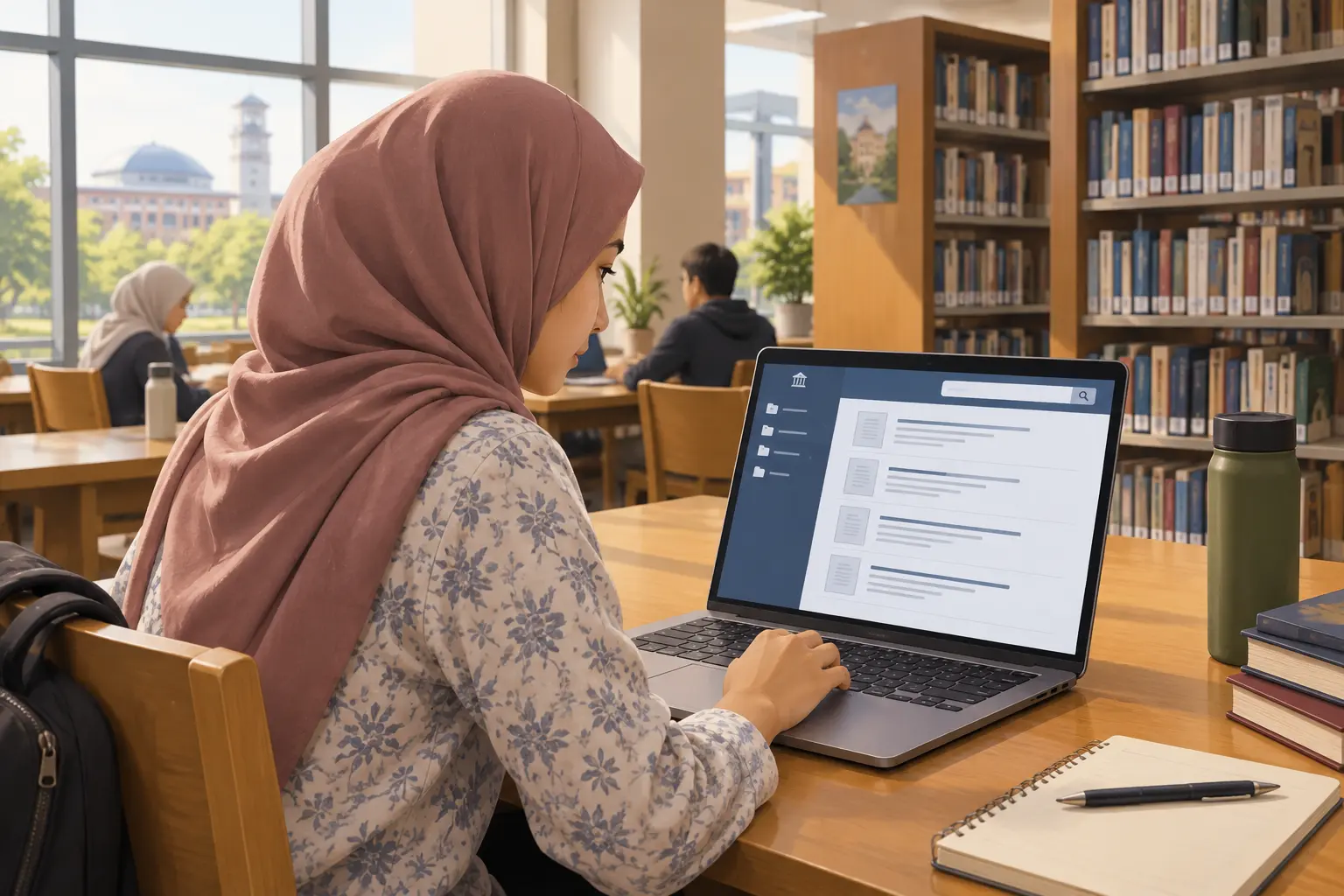
The best place to find previous Malaysian theses depends on your field and on what you need to read: the UM Students’ Repository is the most open for full dissertations, UiTM’s repository separates theses and student projects, UUM has a dedicated eThesis site, UPM shows only the abstract, Chapter 1 and references of its theses, USM restricts sharing of downloaded doctoral work, and UTM and UTHM run general institutional repositories. The comparison table below sets out what each repository’s own page says, then explains how to search by field and how to use what you find without copying it.
How were the repositories compared?
This comparison uses four criteria that matter to a student looking for earlier theses, and each statement comes from the repository’s own home or about page: what kinds of student work it holds, how you can browse it, what the page says about access, and whether it is a dedicated thesis collection or a general research repository. It does not rank universities. A good thesis can sit in any of them, and your own faculty library may hold printed copies that no online repository shows. Repositories change their policies, so check the live page before you plan around any access rule.
Which repositories hold previous theses, side by side?
| Repository | Address | What the page says it holds | Ways to browse | Access note on the page |
|---|---|---|---|---|
| UM Students’ Repository | studentsrepo.um.edu.my | Written work of Universiti Malaya students: academic exercises, dissertations and theses | Year, subject, division, author | Most items can be accessed unless embargoed or restricted by copyright; no account needed to access documents |
| Repository@USM | eprints.usm.my | USM institutional repository | Year, types, subject, school or centre, author | States that doctoral theses and academic work downloaded from USM platforms must not be shared, distributed, printed or reproduced without USM’s written permission |
| UPM Institutional Repository | psasir.upm.edu.my | Master and PhD theses, project reports, articles, conference papers and more | Search by title, author and item type; browse menu | For theses, access only to the abstract, Chapter 1 and references |
| UiTM Institutional Repository | ir.uitm.edu.my | Articles, theses, student projects, research reports and other types | Collections by type, including Thesis and Student Project | Check each record for access |
| UUM eTheses | etd.uum.edu.my | UUM electronic theses and dissertations | Year, subject, division, author; search tips page | Check each record for access |
| UTM Institutional Repository | eprints.utm.my | Research output of the UTM community | Year, subject, division, types | Page states no login is needed to get most papers and articles |
| UTHM Institutional Repository | eprints.uthm.edu.my | Published and unpublished research work by UTHM researchers | Years, subjects, divisions, authors | Check each record for access |
The access notes above are paraphrased from each repository’s home page at the time of writing. Whether a given thesis is open, embargoed or abstract-only is set at record level, so always read the item page.
Which repository is best for which kind of student?
- If you need full dissertations to study structure: UM Students’ Repository. It is a dedicated collection of student work and its page says most items are accessible unless embargoed or restricted.
- If you are writing an undergraduate project or industrial training report: UiTM Institutional Repository. Its collections list a Student Project type next to Thesis, which is closest to an FYP.
- If your topic is business, management, accounting or public administration: start with UUM eTheses. It is a dedicated thesis site that you can browse by division, so check which divisions match your field before you search.
- If you only need the research gap, definitions and reference trail: UPM. Even when you only see the abstract, Chapter 1 and references, those are the parts that show the problem statement, the objectives and the sources used.
- If you work in engineering, built environment or computing: UTM and UTHM. Both are technical-university repositories with browse-by-division and subject views; use the division that matches your programme.
- If you can access doctoral work through USM: respect its stated terms. Reading is one thing; sharing or reproducing downloaded theses without permission is what its page prohibits.
How do you search a repository by your field?
Most of these repositories give you the same four tools, so one routine works everywhere:
- Start with the subject or division browse. Pick the faculty or division that matches your programme, then sort by year to see recent work first.
- Search the title field with two or three keywords. Use the construct and the population, for example “job satisfaction” and “nurses”. Try the Malay term as well, such as “kepuasan kerja”, because older theses and some faculties use Malay titles.
- Restrict the item type to thesis or student project when the repository has an item type filter, so articles do not crowd the results.
- Use Google with the site name. Typing a phrase followed by the repository address, for example site:etd.uum.edu.my service quality, searches only that repository when its pages are indexed.
- Open the record page before the PDF. It shows the supervisor, year, degree level, abstract and access status.
Keep a log of every search: the repository, date, terms and the theses you opened. The same log feeds your literature review; see how to write a literature review for your FYP or thesis.
Which previous theses should you read first?
You will usually find more theses than you can read, so rank them before you open any PDF. A quick triage works well:
- Same programme, recent year. A thesis from your own faculty in the last few years shows current expectations for length, structure and referencing.
- Same variables, any population. These show how others defined and measured your constructs.
- Same population, different variables. These show how others accessed your participants and handled ethics.
- Highest degree level you can reach. A master’s thesis shows more depth in the literature review and methods than an undergraduate project, which helps you see what a strong chapter looks like.
- Different method. One qualitative and one quantitative example from your field shows how the same topic is argued in each design.
Read the abstract and the table of contents first, then Chapter 1 and the references, and only then the methodology. Write two lines of notes for each thesis: what it contributes to your thinking and which sources in its reference list you need to find yourself.
What should you take from a previous thesis?
A previous thesis is a model and a pointer, not a source of text. Use it for four things:
- The structure. How the chapters are named and ordered at your university and how long they are.
- The gap logic. How the author moved from context to problem to objectives.
- The reference trail. The studies the author cited, which you then find and read yourself.
- The instruments and methods. Which scale or method they used and where it came from, so you can open the original source.
Do not cite a thesis for a claim that you have not checked against the thesis itself, and do not cite a secondary claim as if you had read the original study. If a thesis helps you find a journal article, cite the article after you read it. Our guide to AI tools for finding papers and building a literature review covers how to take the next step from a reference list to the papers themselves.
How do you cite a thesis you found in a repository?
If your faculty uses APA 7th edition, a thesis found in a repository is cited with the author, year, title in italics, the degree and institution in square brackets, the repository name and the address. A model pattern, with invented details: Author, A. A. (2022). Title of the thesis in sentence case [Master’s thesis, Universiti Example]. Name of repository. https://example-repository.edu.my/record. Use the real record address from the item page. For the general rules, see what APA 7th edition format is, and always check your faculty’s guide in case it prescribes a different style.
How can you use previous theses without plagiarising?
- Take notes in your own words and mark every note with its source and page.
- Never paste sentences from a thesis into your draft, even to rewrite later.
- Do not copy the structure of a literature review paragraph by paragraph; build yours from your own matrix of studies.
- Paraphrase with real change in structure and wording, and cite the author.
- Remember that reusing your own earlier work also has rules; see can you plagiarise yourself.
The aim of reading earlier theses is to understand what a passing thesis looks like at your university, not to reproduce one.
Common mistakes when using thesis repositories
- Searching only the English title. Many relevant theses use Malay titles.
- Treating an old thesis as current evidence. Check the year and look for newer studies.
- Assuming access. A record can be restricted or embargoed; plan alternative sources.
- Citing a thesis as the original source of a theory. Cite the original author.
- Copying the title or objectives of a previous thesis. Examiners may recognise it. Change the population, variable or setting in a meaningful way.
How can Tesify help once you have found your models?
After you have read a few examples, Tesify helps you structure your own chapters. It is used by 9,000+ students across 15,000+ chapters, and the thesis stays 100% written by you. If your next step is the proposal, read how to write a thesis proposal for a Malaysian FYP or postgraduate programme.
Frequently asked questions
Where can I find previous Malaysian theses online?
University repositories such as the UM Students’ Repository, Repository@USM, the UPM, UiTM, UTM and UTHM institutional repositories and the UUM eThesis site hold student work. Search the one linked to your university or field first.
Can I download full theses from these repositories?
It depends on the repository and the record. UM says most items are accessible unless embargoed or restricted, while UPM states that for theses only the abstract, Chapter 1 and references are available. Read each record.
Is it allowed to share a thesis I downloaded?
Not necessarily. USM’s repository page states that doctoral theses and academic work downloaded from its platforms must not be shared, distributed, printed or reproduced without written permission.
Which repository is best for an FYP or student project?
UiTM’s repository lists a Student Project type next to Thesis, so it is a good starting point for undergraduate projects, though other repositories may also hold student work.
How do I search by my field?
Use the subject or division browse, then search the title with your construct and population in English and Malay, filter by item type and sort by year.
Can I use a previous thesis as a source in my literature review?
You can cite it for what it reports, but prefer the original studies it cites. Read the original paper before you cite a claim.
How do I cite a thesis from a repository in APA 7?
Give the author, year, title in italics, the degree and institution in square brackets, the repository name and the record address. Check your faculty’s guide for any preferred variation.
Can I copy the structure of a previous thesis?
You can learn from the chapter order and the length, but your own content must be written by you. Copying structure paragraph by paragraph is risky.
Why can I not find any thesis on my topic?
Try broader and Malay keywords, search the division rather than the title, and look at neighbouring topics. A lack of previous theses can also support a research gap, if your search is documented.
Do these repositories include other universities’ theses?
Each repository holds its own university’s work. For another university, search that university’s repository or ask its library.